
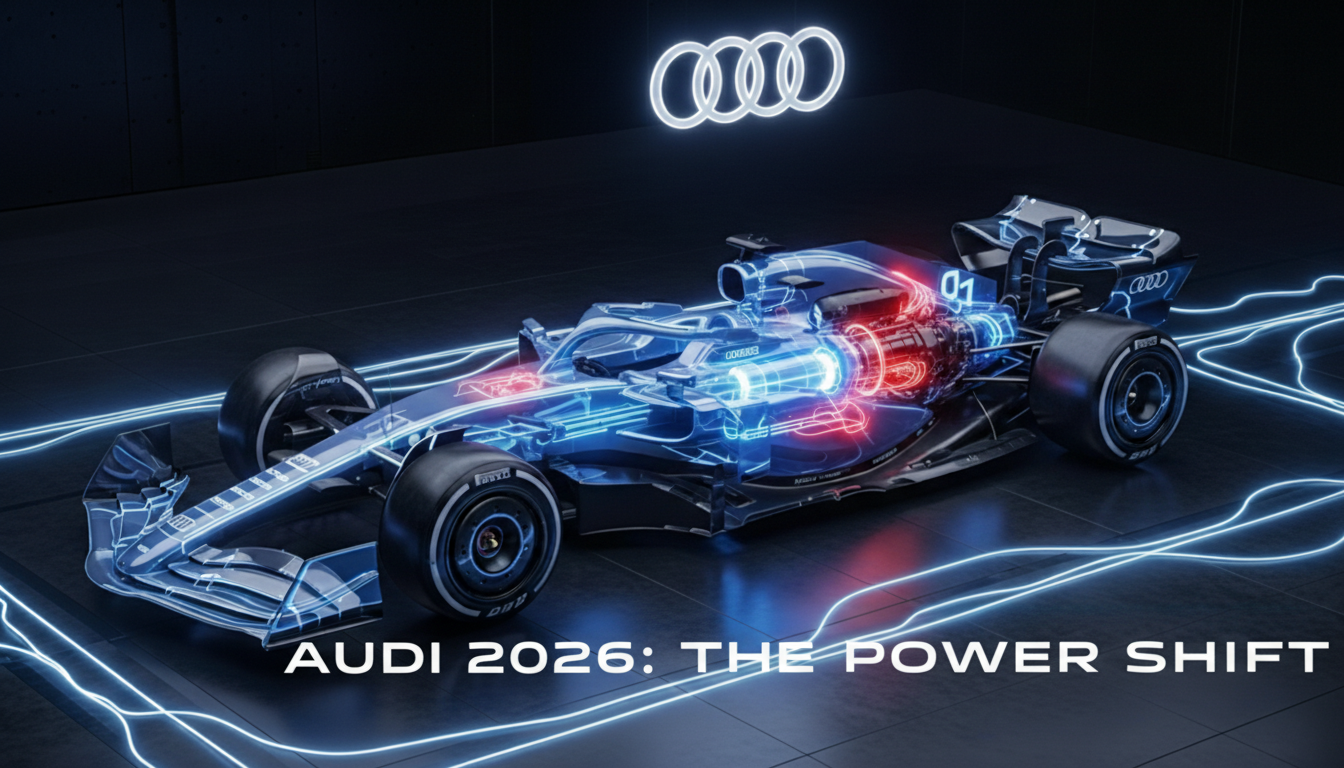
The Audi F1 2026 car explained: Dive into every detail of the Neuburg power unit, active aero, and the Hülkenberg-Bortoleto lineup for the 2026 F1 season.
After years of anticipation and a painful 2025 season under the Sauber name, Audi has finally pulled back the curtain on their 2026 Formula 1 challenger and it might just be the most ambitious manufacturer entry the sport has seen in decades.
The buildup to this moment has been… complicated. Audi announced their F1 intentions back in 2022, took over the Sauber team, and then promptly watched them finish dead last in 2025 with zero points. Not exactly the fairytale beginning anyone imagined.
But here’s the thing—none of that really matters now. The Audi F1 2026 car represents a completely fresh start. New regulations. New power unit. New everything. This is Audi’s real debut, and they’ve come swinging.
Audi R26 specs
| Item | Detail |
|---|---|
| Car | Audi R26 |
| Engine | 1.6 litre turbo V6 (AFR 26 Hybrid TFSI) |
| Combustion power | around 400 kW |
| Electric power (MGU-K) | up to 350 kW |
| Gearbox | 8 speed |
| Fuel | 100% sustainable, developed with BP |
| Power unit built in | Neuburg an der Donau, Germany |
| Chassis built in | Hinwil, Switzerland |
| Drivers | Nico Hülkenberg, Gabriel Bortoleto |
Why Audi Chose 2026 to Enter Formula 1
Audi didn’t randomly decide to jump into F1. They specifically waited for 2026, and that decision was incredibly calculated. See, 2026 brings the most significant regulation changes Formula 1 has seen since the turbo-hybrid era began in 2014. Everything gets reset—the engines, the aerodynamics, the whole package.
For a new manufacturer, this is massive. Instead of trying to catch up to teams who’ve spent a decade perfecting current technology, Audi gets to start on equal footing. Everyone’s figuring out the new rules together. Everyone’s building from scratch. The playing field, at least theoretically, has never been more level.
The new power unit regulations particularly suited Audi’s strengths. The 2026 engines demand roughly equal power from electrical systems and internal combustion—a massive shift toward electrification. Audi’s parent company, Volkswagen Group, has invested billions into electric vehicle technology. That expertise translates directly to F1’s new hybrid systems.
Plus, there’s the MGU-H elimination. That complicated heat energy recovery system gave current manufacturers years of development advantage. Without it, newcomers like Audi don’t face the same uphill battle previous entrants experienced.
The Audi F1 2026 Power Unit: What’s Under the Hood
The Audi power unit represents the company’s first ground-up F1 engine development. They’re not buying from Mercedes or Ferrari. They’re building everything themselves at their facility in Neuburg an der Donau, Germany. That’s a significant commitment, both financially and technically.
Here’s what we know about the Audi F1 2026 power unit specs:
- Electrical power jumps dramatically to approximately 350 kW from the MGU-K, compared to 120 kW in current engines. This makes electric power nearly equal to combustion output.
- The MGU-H is gone completely, simplifying the hybrid system and removing a component that took current manufacturers years to master.
- 100% sustainable fuels become mandatory, fundamentally changing combustion characteristics and requiring entirely new development approaches.
- The 1.6-liter V6 turbo remains the internal combustion foundation, though operating with different fuel and revised regulations.
- Cost caps apply to power unit development, theoretically preventing established manufacturers from simply outspending newcomers.
- Energy recovery systems work differently, with new regulations changing how and when electrical power can be deployed during racing.
For Audi, this represents both opportunity and risk. They’ve hired experienced engineers from other F1 programs, including key figures who worked on previous championship-winning power units. But translating that expertise into a competitive package from day one? That’s the challenge.
The Car Itself: Design Philosophy and Aero Approach
The 2026 aerodynamic regulations dramatically change how downforce gets generated. Active aerodynamics return to F1, with moveable wing elements that adjust based on speed and racing situations. The goal is reduced drag on straights and maintained downforce in corners—essentially, built-in efficiency that should improve racing.
Audi’s interpretation shows a clean, aggressive design language. The front wing appears narrower and simpler than current machinery, reflecting regulations that reduce front-end complexity. Gone are the intricate multi-element designs we’ve grown accustomed to seeing.
The sidepods reveal Audi’s cooling philosophy for their new power unit. Without seeing the car run, it’s impossible to know whether they’ve nailed the thermal management challenge, but the packaging looks tight and purposeful. There’s clearly been significant integration work between chassis and power unit departments.
What’s particularly interesting is how the car’s overall proportions differ from current F1 machinery. The 2026 regulations mandate smaller, lighter cars—addressing long-standing complaints about modern F1 machines being unwieldy giants. Audi’s car looks more compact, more agile, more like the F1 cars many fans remember fondly.
The Driver Lineup: Hülkenberg and Bortoleto
Nico Hülkenberg brings the experience. The German driver has been around F1 forever, knows how to develop cars, provides consistent feedback, and carries no ego that might complicate team dynamics. He’s also German, which obviously matters for Audi’s marketing. Critics might argue his lack of race wins suggests a ceiling on his potential, but for a team in their debut year, stability and expertise arguably matter more than raw speed.
Gabriel Bortoleto represents the future. The young Brazilian showed promise despite struggling with Sauber’s dismal 2025 car, and Audi clearly sees potential worth nurturing. He’s fast, he’s hungry, and he’s locked in long-term. If Audi becomes competitive, Bortoleto could grow into a genuine star.
Is this the most exciting driver pairing on the grid? Probably not. But is it smart for a manufacturer entering F1 and building for sustained success rather than immediate headlines? Yeah, it probably is.
The comparison to Aston Martin’s Fernando Alonso signing is inevitable. Aston went for star power and experience. Audi chose stability and development potential. Different philosophies, and only time will tell which approach works better.
What Audi’s Entry Really Means for Formula 1
Formula 1 has been trying to attract major manufacturers for years. The cost cap implementation, the 2026 engine regulations, the push toward sustainability—all of these changes were designed partly to make the sport more appealing to automotive giants who previously saw F1 as too expensive and too disconnected from road car technology.
Audi’s commitment validates those efforts. A major global manufacturer looked at modern F1 and said, “Yes, this makes sense for us now.” That’s a win for the sport regardless of where Audi finishes in 2026.
There’s also the competitive element. More manufacturer involvement theoretically means more resources flowing into the sport, higher development standards, and ultimately better racing. If Audi becomes competitive—even if that takes a few seasons—they add another genuine contender to a grid that’s already becoming increasingly competitive.
The flipside? Failure would be embarrassing. Not just for Audi, but for F1’s pitch to future manufacturers. If a company with Audi’s resources enters under favorable regulations and still can’t compete, what does that say about the barriers that remain?
Patience Will Be Required
The Audi F1 2026 car looks impressive. The power unit represents serious engineering ambition. The driver lineup makes sense for a long-term project. Everything about this entry suggests Audi understands they’re building for sustained competitiveness rather than overnight success.
But—and this is important—we need to set realistic expectations. Audi themselves have acknowledged they probably won’t be fighting for championships immediately. The 2025 Sauber season showed how far behind the current operation sits, and while 2026 resets many things, institutional knowledge and racing experience don’t appear overnight.
The smart money says Audi will be midfield in 2026, potentially improving into 2027 and beyond as their power unit matures and team operations sharpen. Challenging for titles likely comes later in the decade—if everything goes well.
Is that disappointing? Maybe. But it’s also realistic, and in F1, realistic expectations tend to serve teams better than unrealistic hype.
What we can say with certainty is this: Audi has committed properly. They’re building their own power unit. They’re investing in infrastructure. They’re planning for the long haul. Whether that translates into genuine F1 success remains the great unknown that makes this whole thing fascinating.
The 2026 season opener can’t come soon enough.



1 Comment