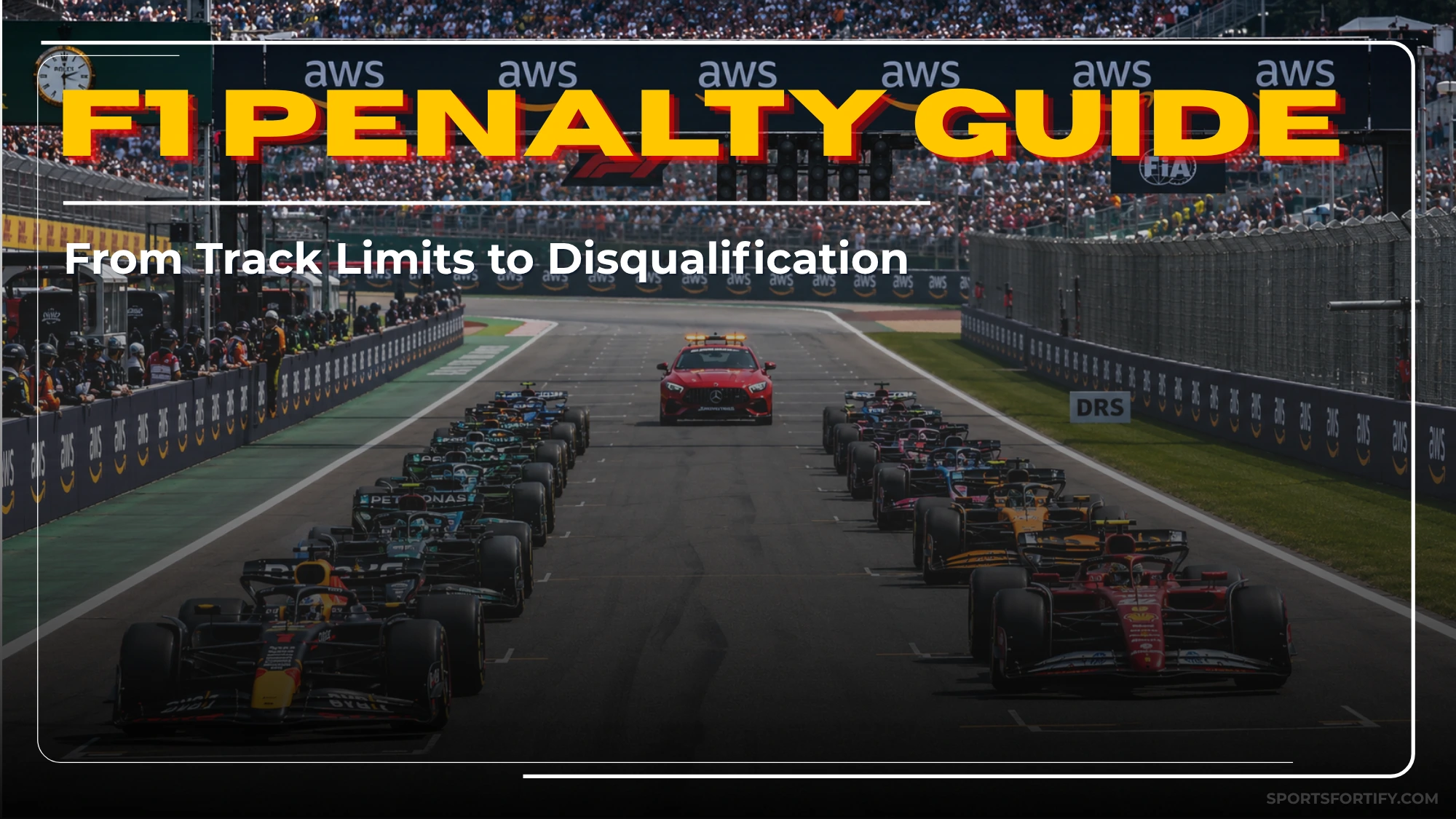
In 2024, Kevin Magnussen became the first F1 driver ever banned from a race under the penalty points system. Several current drivers now sit dangerously close to the same fate.
How do F1 penalties work?
The FIA stewards review every incident using TV footage, onboard cameras, telemetry and team radio. A panel of three to four stewards, usually including a former driver and a national steward, decides if a breach occurred under the FIA Sporting Regulations. So the process moves fast, often while the race is still running.
From there, they assign a penalty based on severity. Some get served during the race. Others get added after. The most serious end a driver’s weekend outright. Here is every type, explained the way stewards actually apply them.
WHY ARE F1 PENALTIES ISSUED?
F1 penalties exist because the sport enforces three separate rulebooks at once. On-track breaches cover racing incidents like yellow flag violations and collisions. Off-track breaches cover technical infractions like plank wear and aerodynamic parameters. Team breaches cover things like unsafe pit releases and cost cap violations.
The FIA governs all of this through its Sporting Regulation articles and International Sporting Code, or ISC, articles. Formula1.com and the stewards’ published verdicts confirm every decision publicly. Photographer Kym Illman has documented stewards’ room proceedings from Silverstone and other venues, giving fans rare insight into how these hearings actually run.
WHO DECIDES F1 PENALTIES?
The Race Director refers incidents to the stewards, who then investigate and rule. A panel of three to four FIA stewards handles each case. It typically includes a former driver, a national steward and a permanent FIA steward, all holding an international Grade A license.
Many stewards are unpaid volunteers who receive expenses only, though some professional paid stewards now rotate through rounds. Once a driver or team is placed under investigation, they may be summoned to a stewards’ room hearing. An on-screen message confirms the outcome, whether that is a published penalty or no further action.
WHAT ARE THE MOST COMMON F1 TIME PENALTIES?
Five-second and ten-second time penalties are the most frequent punishment in Formula 1. If a driver still needs to pit, they serve it there, sitting completely still in the pit box for the full duration before mechanics can touch the car. If they have already pitted, the time gets added to their final result.
At the 2024 United States Grand Prix, Lando Norris took a five-second penalty for leaving the track and gaining an advantage over Max Verstappen. That dropped him from third to fourth. Ten-second penalties carry more weight and often follow a collision or an ignored yellow flag.
HOW DO F1 GRID PENALTIES WORK?
Grid penalties push a driver backward from their qualifying position, most often for exceeding power unit component limits. F1 restricts engines, gearboxes and energy stores to control costs. Go over the limit and the drop is typically five or ten places, though penalties stack.
At the 2023 Las Vegas Grand Prix, Carlos Sainz hit a loose drain cover in practice that destroyed his power unit. Even though the track caused the damage, he still took a ten-place grid penalty and started twelfth instead of second. Grid drops also follow qualifying infringements. Verstappen received a one-place grid penalty at the 2024 Qatar Grand Prix for driving unnecessarily slowly on a cooldown lap.
WHAT IS A DRIVE-THROUGH OR STOP-GO PENALTY IN F1?
A drive-through penalty forces a driver into the pit lane at the speed limit with no stopping, costing roughly 20 to 25 seconds. A ten-second stop-go penalty is harsher. The driver stops completely in the pit box, waits the full ten seconds, and no mechanic can touch the car during that time.
At the 2024 Qatar Grand Prix, Norris served a stop-go for failing to slow under double-waved yellow flags. That cost him around 35 seconds and likely a podium finish. Beyond the stop-go, a black flag means immediate disqualification. Nico Hülkenberg took the sport’s first black flag in 17 years at the 2024 São Paulo Grand Prix after marshals pushed him back onto the track.
Post-Race Disqualifications
Disqualification also happens after the race for technical breaches. George Russell lost his 2024 Belgian Grand Prix win when his car was found underweight. That was a technical infringement, not a driving error, and it shows how far a penalty can reach even after the chequered flag.
HOW DO F1 PENALTY POINTS WORK?
F1 penalty points work like a driving license, and twelve points within twelve months triggers an automatic one-race ban. Points expire twelve months after being issued, which creates a rolling window that keeps repeat offenders under constant pressure.
Specific values are set out clearly. Causing a collision usually carries two or three points. Forcing a driver off track adds one or two. Track limits violations can add a point if repeated. Five reprimands trigger a mandatory ten-place grid penalty on their own, separate from any points total.
When Do F1 Penalty Points Reset?
Points reset individually, twelve months after each one is issued, not all at once at season’s end. Magnussen became the first driver banned under this system in 2024, missing the Azerbaijan Grand Prix after reaching twelve points. Steward discretion exists, but the rule is rarely overruled once the threshold is hit.
WHAT IS THE FIA RIGHT OF REVIEW IN F1?
The Right of Review lets a team request a new hearing if genuinely new evidence emerges after a penalty is issued. Carlos Sainz used it successfully at the 2025 Dutch GP, when new 360-degree footage overturned his ten-second penalty and two penalty points.
Fernando Alonso’s Aston Martin team also won a Right of Review at the 2023 Saudi Arabian Grand Prix, restoring his podium after submitting video evidence of seven similar incidents that had gone unpenalised. Even so, the Right of Review is rare. Teams must prove the new evidence was genuinely unavailable during the original hearing, which is a high bar few teams clear.
WHO CAN BE PENALISED IN F1: DRIVERS OR TEAMS?
Both drivers and teams face F1 penalties, but the offences differ. Drivers face on-track sporting offences like collisions and track limits. Teams face off-track breaches including unsafe pit releases, cost cap violations, scrutineering-form breaches and personnel curfew failures.
Team fines range from €5,000 to €100,000 depending on severity, with stewards weighing mitigating and aggravating factors before deciding. Leclerc picked up a fine for press-conference language at the 2024 Mexico City Grand Prix, while McLaren and Williams both faced technical infringement penalties in 2025, at Las Vegas and Singapore Qualifying respectively.
FIA 2026 PENALTY GUIDELINES: OFFENCE TABLE
The FIA’s 2026 Penalty Guidelines introduced a structured table covering Free Practice, Qualifying and Race sessions separately, since the same offence can carry a different weight depending on when it happens.
| Offence | Free Practice | Qualifying | Race |
|---|---|---|---|
| Leaving track & gaining advantage | Lap deleted | Lap deleted | Time penalty |
| Leaving track & rejoining unsafely | Reprimand | Grid drop | Drive-through |
| Track limits (4 breaches) | Warning | Lap deleted | Time penalty |
| Driving unnecessarily slowly | Reprimand | Grid drop | Time penalty |
| Causing a collision (reckless) | — | — | Drive-through or DSQ |
| Causing a collision (deliberate) | — | — | DSQ |
| Forcing a driver off track | Reprimand | Grid drop | Time penalty |
| Failing to slow for yellow/red flag | Reprimand | Grid drop | Drive-through |
| Failing to respect black flag | — | — | DSQ |
| Unsafe pit release | — | — | €5,000–€100,000 fine |
| Five reprimands | 10-place grid penalty (any session) | ||
Fines for non-sporting breaches like political statements, ceremony non-compliance or press-conference misconduct range from €5,000 to €270,000 depending on severity, with a public apology sometimes required alongside the fine.
NOTABLE F1 PENALTY EXAMPLES
Grosjean took a grid penalty at the 2012 Belgian Grand Prix after a first-lap collision that ended several other cars’ races. Oscar Piastri picked up a yellow-flag infringement penalty during FP2 at the 2025 Azerbaijan Grand Prix. Lewis Hamilton lost track position at the 2025 Mexico City Grand Prix after gaining an advantage off-track, dropping from third to eighth.
Each case shows the same pattern. Stewards weigh intent, context and precedent every time, which is why identical-looking incidents can draw different penalties depending on the race, the session and what came before it.
FREQUENTLY ASKED QUESTIONS
F1 time penalties come in five-second and ten-second increments, served in the pit box if the driver still needs to pit, or added to the final race time if they do not. The car cannot be worked on during the penalty.
A grid penalty moves a driver backward from their qualifying position, most commonly for exceeding power unit component limits. Drops are typically five or ten places and can stack into the twenties.
F1 penalty points accumulate on a driver’s Super Licence for on-track offences. Reaching twelve points within a twelve-month period triggers an automatic one-race ban, and each point expires individually twelve months after it was issued.
A stop-go penalty forces a driver to stop completely in their pit box for ten seconds with no work done on the car, making it more severe than a standard time penalty served during a pit stop.


4 Comments