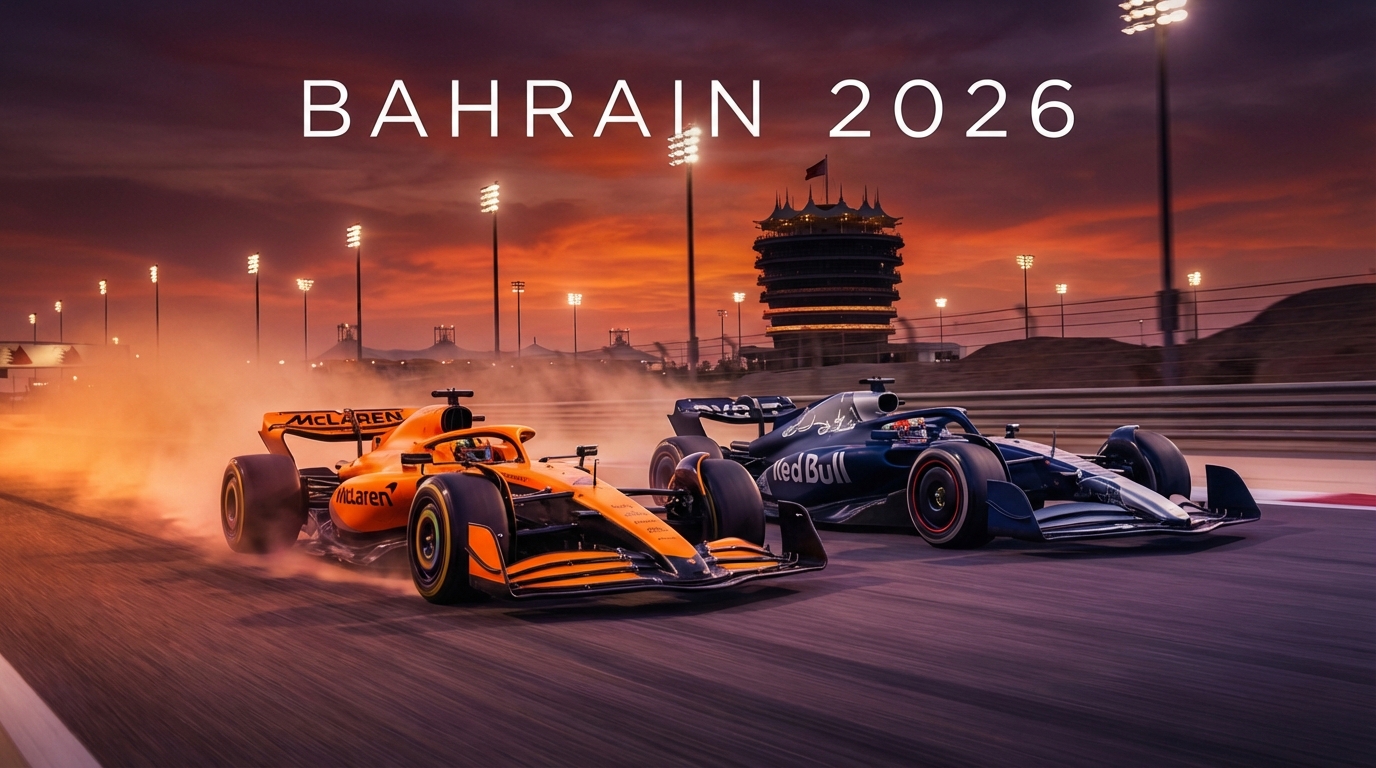
Lando Norris topped the opening day of 2026 pre-season testing with a 1m 34.669s lap, yet the paddock is buzzing over Max Verstappen’s relentless 136-lap marathon in the new Red Bull-Ford.
There is a specific kind of electricity that fills the Sakhir air when Formula 1 resets the clock. As a journalist who has paced this paddock for fifteen years, I can tell you that Bahrain test day one felt different. This isn’t just another season—it is the dawn of a radical technical era. While the timing screens showed a familiar papaya car at the top, the real story was written in the staggering mileage of the car just one-tenth behind it. Lando Norris may have the headlines, but Red Bull and Ford have sent a chilling message to their rivals.
The Champion Sets the Early Benchmark in Sakhir
Lando Norris began his season in the most clinical way possible. Taking over the McLaren MCL40 from Oscar Piastri in the afternoon heat, Norris whittled his times down until he sat comfortably at the top. The McLaren looks stable, a stark contrast to some of the nervous rear ends we saw elsewhere on the grid.
However, we must temper our excitement with the reality of testing fuel loads. While Norris was fast, he only completed 58 laps compared to the monstrous total of his main rival. McLaren focused on aerodynamic correlation, running large rakes early on to ensure their wind tunnel data matched the desert floor. It was a professional, quiet performance that suggests the Woking squad has transitioned into these new regulations without losing their 2025 momentum.
Red Bull Ford Silences the Power Unit Critics
For months, the rumors suggested that the Red Bull-Ford power unit project was behind schedule and struggling with energy deployment. If Bahrain test day one proved anything, it is that those rumors might have been wishful thinking from the competition. Max Verstappen spent the entire day in the RB22, racking up 136 laps without a single mechanical hiccup.
To put that into perspective, Verstappen drove over 730 kilometers in seven hours. This is the first time Red Bull has run an engine they built themselves, with Ford’s battery expertise, and it looked bulletproof. Mercedes boss Toto Wolff has already been spotted checking GPS traces, reportedly telling colleagues that the Red Bull is gaining nearly a second on the straights through sheer electrical deployment. If that data holds true, the rest of the field is in serious trouble.
#F1TESTING: DAY ONE CLASSIFICATION
— Formula 1 (@F1) February 11, 2026
Lando Norris on top after a busy first day in Bahrain #F1 pic.twitter.com/284cGbXC0Q
New Era Technology and the Active Aero Learning Curve
The 2026 regulations have introduced “Active Aero,” and watching it in person is a surreal experience. On the main straight, you can see the front and rear wing elements flatten out into “X-Mode” to shed drag. As the drivers hit the brakes for Turn 1, the flaps snap back into “Z-Mode” for maximum downforce.
It hasn’t been an easy transition for everyone. We saw several drivers, including Lewis Hamilton in his new Ferrari SF-26, struggle with the balance shift as the wings transition. Hamilton suffered a high-speed spin in the morning, a rare sight for the seven-time champion, proving that even the greats are essentially rookies again in these narrower and nimbler cars. The learning curve for managing the 50-50 split between petrol and electric power is clearly steeper than anyone anticipated.
Audi and Williams Provide the Day One Drama
The arrival of Audi as a full works team is a historic moment for the sport, but their first official day was a rollercoaster. Nico Hulkenberg caused the day’s most significant red flag when his car ground to a halt just before the final corner. While he was back on track fifteen minutes later, it served as a reminder of how punishing these new power units can be.
On the other side of the coin, Williams emerged as the surprise package. After missing the initial shakedown in Barcelona due to build delays, Alex Albon and Carlos Sainz combined for 145 laps on Bahrain test day one, surpassing nearly everyone else for total mileage. It is a testament to the work at Grove that they have produced such a robust baseline car, even if Albon admitted the FW48 is still significantly overweight as they focus on reliability first.
The Long Road to Australia Starts Now
As the sun sets over the Sakhir desert, the initial hierarchy is forming, but it is far from set in stone. We have seen Cadillac impress with their reliability, completing 107 laps with Perez and Bottas, while Aston Martin-Honda struggled, managing a dismal 36 laps in the afternoon. These stark differences in mileage will define the development race over the next five days.
Ultimately, Bahrain test day one belonged to the veterans who could adapt the fastest. The cars are lighter and the “Boost” button is now a driver’s best friend, but the fundamental requirement of F1 remains the same—finding the limit without crossing it. Norris has the speed, Verstappen has the stamina, and the rest of the grid has 48 hours to find an answer before the second test concludes.