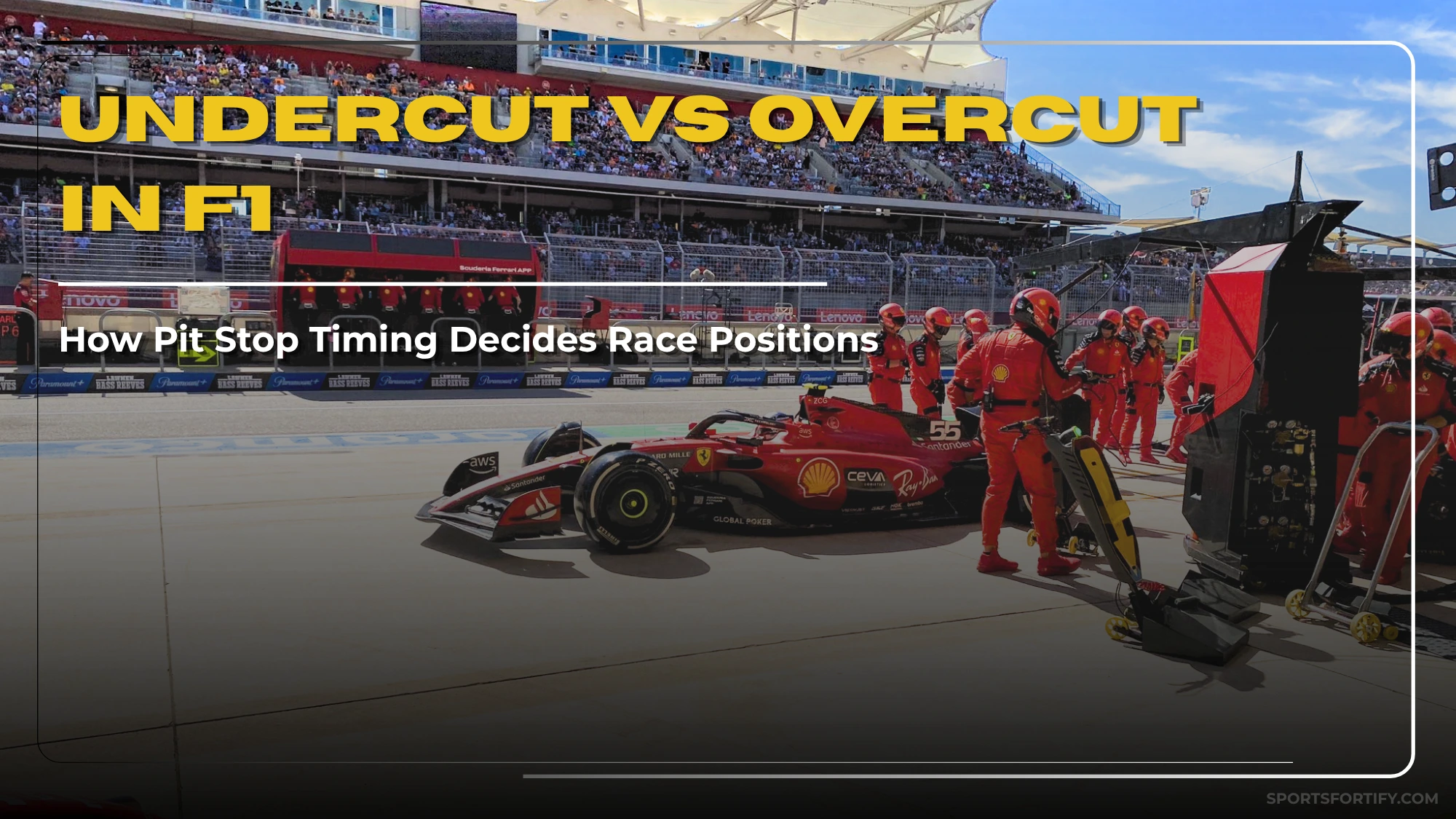
Positions in Formula 1 change without cars ever passing each other on track. The undercut vs overcut F1 strategy is how teams move drivers up the order through the pit lane instead. One call timed correctly turns a third-place car into a race leader. One call timed wrong, and that same driver falls further back than where they started.
What Is Undercut and Overcut in F1
Both strategies use pit stop timing to gain positions. The undercut means pitting before the car ahead, collecting fresh tyres, and using the pace advantage to close or flip the gap before the rival stops. The overcut is the opposite. The driver stays out longer on older tyres, builds a gap, and comes out ahead after the rival has already made their stop.
Fresh tyres can be one to two seconds per lap faster than worn ones.
For example, imagine two cars running three seconds apart at lap twenty. The car behind pits first and pushes hard on a fast out-lap. Meanwhile, the car ahead stays out on worn rubber and loses small amounts of time each lap. By the time the leader eventually pits, the gap has closed or reversed. The driver who pitted first comes back out in front.
How Does the F1 Undercut Work
When a driver pits before the car directly ahead, they get fresh rubber immediately. That tyre advantage lets them lap faster during the window between their stop and the rival’s stop. The rival is still on worn tyres, losing small fractions of time each lap.Knowing what soft, medium and hard tyres do in a race helps make sense of stop timing.
By the time the rival pits, the gap has flipped entirely, and the undercutting driver emerges ahead. Fresh tyres do the overtaking that the car cannot do on track.
When to Use Undercut vs Overcut in F1
The undercut works best when tyre degradation is high. On circuits like Bahrain or Spain, worn rubber loses performance quickly, so fresh tyres give a large pace advantage. Furthermore, tracks where overtaking on track is nearly impossible strongly favour the undercut because changing positions in the pit lane is more reliable than fighting at a corner.
High degradation and difficult overtaking circuits almost always point teams toward the undercut.
The overcut suits lower degradation circuits where older tyres stay competitive for longer. Additionally, the overcut works when the driver can match the lap times of rivals who have already pitted. Teams also watch traffic. If the rival is likely to emerge from the pit lane behind slower cars, staying out and building a gap becomes the smarter option on that particular lap.
The undercut vs overcut F1 call comes down to these factors every single time.
The undercut is the right call when
- The chasing car sits within two to four seconds of the car ahead
- Tyre degradation is high and fresh rubber gives a clear lap time advantage over worn tyres
- Overtaking on track is difficult and the pit lane is the more reliable place to change positions
- The pit stop is fast and the driver exits into clear track with no slower traffic immediately ahead
- Race simulations show the tyre advantage will last long enough to hold the gained position
The overcut makes sense when
- Tyre degradation is low and the driver can maintain competitive lap times on older rubber
- The rival who just pitted is likely to get stuck behind slower cars on their out-lap
- Clear track ahead lets the staying-out driver push hard without being held up by traffic
- The gap to the pitting rival is large enough to absorb the pit stop time loss
- Safety car risk is low and the race looks set to run cleanly for the next several laps
Is Monaco Undercut or Overcut
Monaco is an overcut circuit. The narrow, tight layout makes on-track overtaking almost impossible, which means tyre degradation stays low because drivers cannot push freely. Old tyres remain competitive far longer than at other venues, and that makes staying out the smarter option for most teams. Furthermore, Monaco’s short lap time means the time lost in a pit stop is proportionally larger than anywhere else on the calendar.
At Monaco, patience almost always beats aggression.
The 2021 Monaco Grand Prix proved this clearly. Hamilton attempted to undercut Pierre Gasly but could not get his hard tyres up to temperature fast enough. Importantly, Gasly on older rubber was lapping quicker than Hamilton on fresh ones, so the undercut failed completely. Vettel then stayed out even longer than both drivers, managed his tyres carefully, and overcut both to jump ahead after his own later stop.
Vettel’s patience that afternoon was a perfect overcut execution on the perfect circuit for it.
What Goes Wrong With Undercut and Overcut Strategy
The undercut collapses when the pitting driver exits into slow traffic. A clean pit stop means nothing if the driver cannot get a free out-lap immediately. Additionally, a slow stop itself destroys the plan before it starts. Teams sometimes lose a full second in the pit box, and that alone wipes out the tyre pace advantage. Everything has to go right at once for the undercut to work.
A half-second slow pit stop is often enough to cancel an undercut completely.
The overcut carries different risks. If tyres fall apart faster than predicted, lap times drop and the advantage disappears. Furthermore, a safety car appearing right after a rival pits can erase any gap almost instantly. The safety car slows the entire field equally, shrinking the performance gap between fresh and old tyres to almost nothing. Teams weigh safety car probability carefully before committing to the final undercut vs overcut F1 plan.
No team predicts a safety car perfectly, and that one variable can flip an entire race strategy. Following race strategy in real time is far easier once the basics of how an F1 race runs are clear.
FAQs
The undercut means pitting before the car ahead to gain position through fresh tyre pace. The overcut means staying out longer and building enough of a gap that the rival exits the pit lane behind you after their own stop.
The overcut driver stays out on older tyres while rivals pit for fresh rubber. The goal is to maintain strong enough lap times to cover the pit stop time loss, so that when the overcut driver eventually stops, they rejoin the race ahead.
Monaco is an overcut circuit. Low tyre degradation means older tyres stay competitive far longer than at other tracks. Combined with the near-impossibility of overtaking on the narrow layout, staying out and building a gap is almost always more effective than pitting early.
Yes. A safety car slows the entire field and dramatically reduces the time cost of pitting. If a team has just completed an undercut and a safety car appears immediately after, rivals behind can stop for almost free and cancel out the undercut advantage entirely.


1 Comment