
Every Formula 1 race involves a decision that shapes the entire result. That decision is tyres. The three F1 tyre compounds determine how fast a car goes, how long it can stay on track and when it must pit. Understanding these three coloured tyres transforms confusing pit stop conversations into something genuinely exciting.
Think of it this way. Tyres are like running shoes. Some grip perfectly but wear out fast. Others last forever but feel slow. F1 teams balance that trade-off every single race.
What Are the Three F1 Tyre Compounds
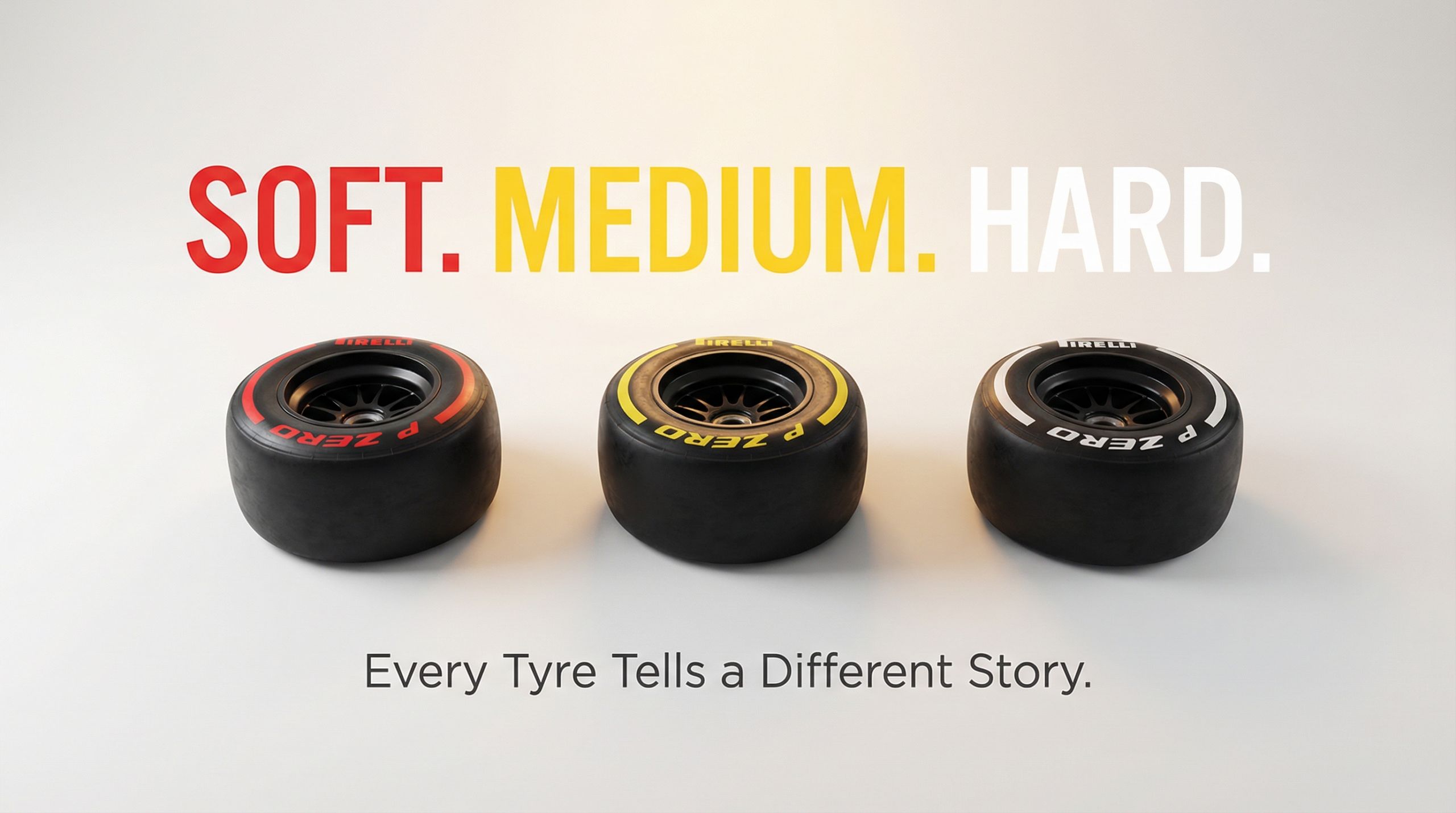
Pirelli supplies every team with three dry-weather tyre compounds for each Grand Prix. They are colour-coded for easy identification on screen.
- Soft tyres (red marking). The fastest compound. Maximum grip. Maximum speed. However, they wear out the quickest. A set might last only 15 to 20 laps depending on the circuit.
- Medium tyres (yellow marking). The balanced option. Good grip with reasonable durability. Most teams use these as their primary race tyre. They typically last 25 to 35 laps.
- Hard tyres (white marking). The slowest compound but the most durable. These can survive 40 laps or more. Teams use them when they want to run long stints without stopping.
Every driver must use at least two different compounds during a race. That rule alone forces at least one pit stop every Sunday.
Why Do Different Tyres Exist
The simple answer is strategy. If every car used the same tyre, races would become predictable. Consequently, Pirelli creates compounds with deliberately different performance levels. This forces teams to make strategic choices about when to pit and which tyres to use.
Furthermore, each circuit treats tyres differently. A smooth track like Monza is gentle on rubber. A rough street circuit like Melbourne chews through tyres aggressively. Pirelli selects specific compound ranges for each race based on the track surface, temperature and layout.
Those choices create drama. The soft tyre might be fastest now but the hard tyre could be faster in 20 laps. That uncertainty keeps racing unpredictable.
How Do Tyres Actually Affect Lap Times
The difference between compounds is genuinely significant. Typically, soft tyres are about 1 to 1.5 seconds per lap faster than hards. That gap sounds small but in Formula 1 it is enormous. For context, most qualifying sessions are decided by less than half a second.
However, that speed advantage disappears over time. Soft tyres lose grip rapidly as the rubber wears down. A driver on fresh hard tyres can eventually catch and overtake someone struggling on worn softs. Additionally, tyre temperature plays a massive role. Cold tyres have almost no grip. Every driver must warm the tyres to an optimal temperature window before pushing hard.
This is exactly why commentators constantly discuss “tyre degradation.” It simply means how quickly the tyres lose their performance.
What Happens When It Rains
Rain changes everything. The three dry compounds become useless on a wet track. Consequently, Pirelli provides two additional wet-weather tyres.
- Intermediate tyres (green marking). Designed for a damp track that is drying or has light rain. These clear moderate water while still providing decent speed.
- Full wet tyres (blue marking). Built for heavy rain. These tyres channel massive amounts of water away from the contact patch. They sacrifice speed for safety and grip.
Switching between dry and wet tyres creates some of the most dramatic moments in F1. A sudden downpour forces the entire grid into the pits simultaneously. Consequently, the team that reacts fastest gains a huge advantage. Furthermore, guessing when to switch from wets back to dry tyres as the track dries can win or lose an entire race.
Rain tyres are the wildcard that turns a predictable Sunday into absolute chaos.Understanding what happens during an F1 weekend helps new fans follow these tyre decisions across all three days of action.
How Do Teams Decide Which Tyres To Use
Every team has a strategy department working constantly on tyre decisions. Before each race, teams run computer simulations predicting the fastest overall strategy. However, the race rarely follows the plan perfectly.
Several factors decide tyre strategy during a race.
- Track temperature changes throughout the afternoon. Hotter temperatures increase tyre wear.
- Safety car deployments give teams a free pit stop opportunity. Jumping into the pits under a safety car costs far less time than stopping under green flag racing.
- Rival strategies force reactions. If a championship rival pits early for fresh tyres and gains speed, the other team must respond or risk losing the position permanently.
- Tyre graining and blistering can destroy a set unexpectedly. Graining happens when the surface tears slightly. Blistering occurs when heat builds inside the rubber. Both kill grip rapidly.
For example, imagine Max Verstappen leads on medium tyres. Lando Norris pits for fresh softs and suddenly laps two seconds faster. Verstappen must decide immediately. Pit now and cover the move. Or stay out and hope the softs wear out before Norris catches him.
That decision happens live under enormous pressure.Every position gained or lost carries real weight because the F1 points system rewards consistency across an entire season. It makes F1 tyre compounds one of the most important strategic elements in the entire sport.
What Changed About Tyres for the 2026 Season
The 2026 F1 tyre compounds face entirely new challenges. The cars are lighter, narrower and produce significantly more electrical power. Consequently, the way tyres interact with the car changed fundamentally.
Furthermore, Pirelli lost critical wet-weather testing data after cancelling its Bahrain rain test over security concerns. That means the opening races of 2026 carry extra uncertainty around wet tyre performance. Additionally, the new active aerodynamics change how much downforce pushes the tyres into the track surface. More downforce means more grip but also more wear. Less downforce on straights means the tyres cool slightly before the next corner loads them again.
The Bahrain tyre test cancellation created gaps in data that every team now carries into the opening races. These changes make tyre strategy even more complex and unpredictable for the 2026 season.
FAQs
No. Pirelli selects a specific range of compounds for each circuit. The actual rubber composition changes from race to race based on track surface, expected temperatures and circuit characteristics. What Pirelli calls “soft” at one track might be harder than the “medium” at another.
Teams must use at least two different dry compounds during a race. Beyond that rule, the choice is completely free. Strategy departments decide which compounds to use and when based on live conditions and rival behaviour.
Each driver receives 13 sets of dry tyres for a standard race weekend. Pirelli decides the allocation split between soft, medium and hard. Drivers must return used sets at specific points during the weekend.


5 Comments