Every time a commentator says a driver cannot get close enough to overtake, dirty air is usually the reason. It is not a weather problem. It is an aerodynamic one. And for most of Formula 1’s modern era it has been the single biggest obstacle between fast cars and exciting racing.
What Is Dirty Air in F1
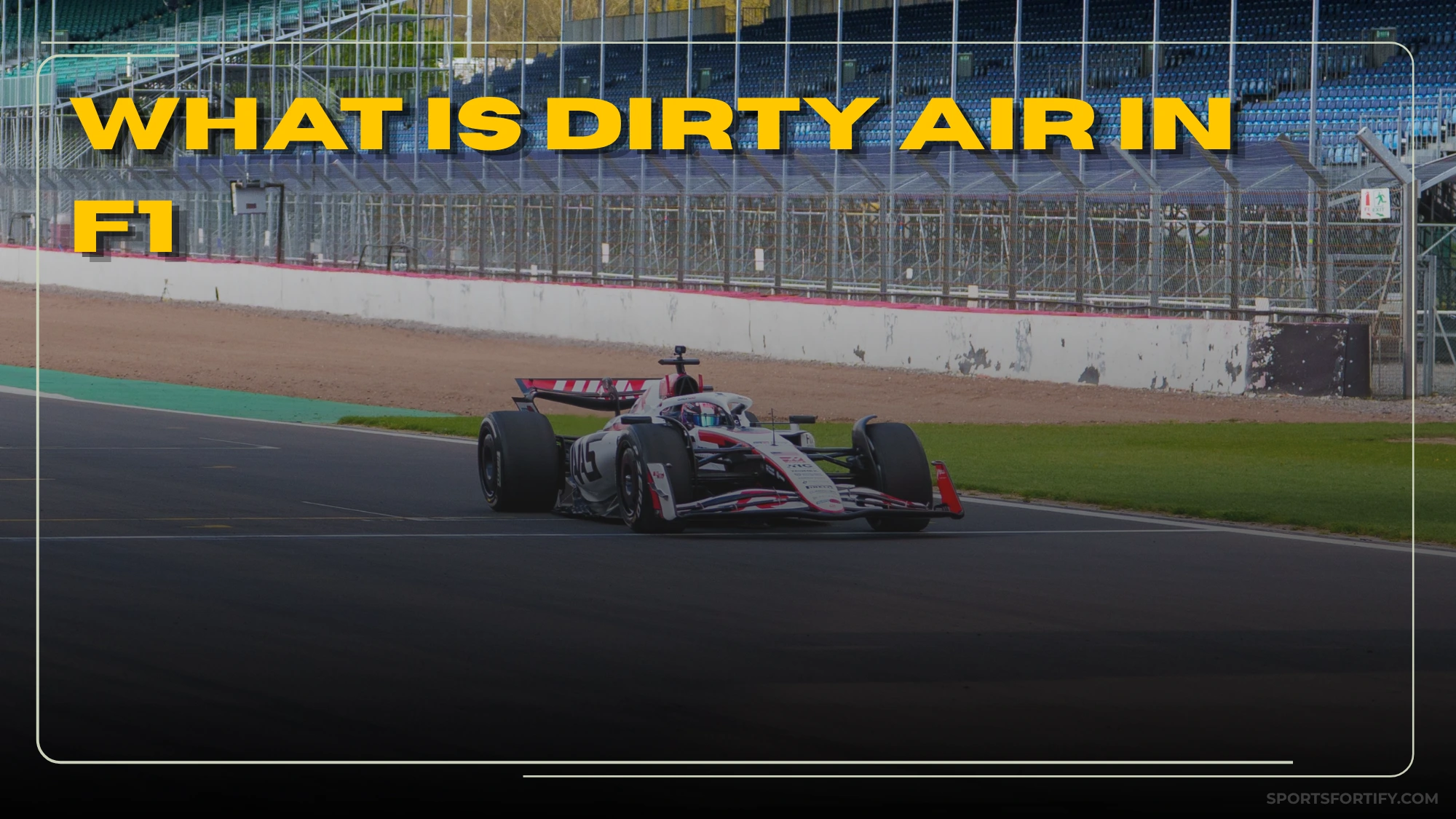
Dirty air is the turbulent, chaotic airflow that trails behind a Formula 1 car as it moves at high speed. When an F1 car pushes through air, it does not leave clean, calm airflow behind it. It leaves a disturbed wake of swirling, unpredictable turbulence that extends for several car lengths behind the rear wing.
The car in front creates this effect as a natural result of its aerodynamic design. The wings, diffusers, and bodywork that generate downforce also tear the air apart. What goes behind that car is nothing like the smooth air that approached it from the front.
Any car driving into that disturbed air experiences it immediately. The aerodynamics start misbehaving, the car loses stability, and the driver has to back off to avoid losing control completely.
What Causes Dirty Air in F1
Modern F1 cars generate downforce by manipulating airflow over and under the car. The front wing splits air around the car. The floor and diffuser accelerate airflow underneath. The rear wing pushes the car down by creating a pressure difference above and below it.
All of that manipulation leaves a chaotic wake behind the car. The rear wing is the biggest contributor. As it generates downforce by redirecting airflow upward, it creates a turbulent vortex that trails directly behind the car at racing height. That vortex sits exactly where a following car needs clean airflow to work its own aerodynamics properly.
The faster the cars go, the bigger the wake. At Montreal speeds above 300 kilometres per hour the turbulent trail behind a car stretches far enough to affect any car within two seconds of the leader.
How Does Dirty Air Affect F1 Cars
A car driving through dirty air can lose up to 35% of its downforce. That number is not gradual. It happens almost immediately as the following car enters the turbulent wake. Less downforce means less grip through corners, higher tyre temperatures, and a car that feels unstable and nervous on corner entry.
The driver notices it first in the corners. The car does not respond the way it should. The front end feels light. Braking points that worked on clear track suddenly feel wrong. The driver has to brake earlier and carry less speed through the corner to stay on track.
By the time the two cars reach the following straight where an overtake might happen, the car behind has already lost ground through the corner sequence. The speed advantage from the tow on the straight is often cancelled out by the loss through the corners. That is why dirty air made overtaking so hard for so many years and why DRS existed to artificially bridge that gap. The full history of DRS in F1 explains exactly how that system worked and why 2026 finally removed it.
Clean Air vs Dirty Air in F1
Clean air is what every driver wants. It is undisturbed airflow that lets the car generate full downforce and behave predictably through every corner. A car running at the front of the field in clear air can push to the limit at every single corner because the aerodynamics work exactly as the engineers designed them to.
Dirty air is the opposite. The car behind is running in conditions the engineers never optimised for. The aerodynamic maps and corner entry setups that work perfectly in clean air stop working the moment the car enters the turbulent wake. The driver cannot simply drive faster through corners. The car will not let them.
This gap between the two experiences is why qualifying pace and race pace can look so different. In qualifying every driver runs in clean air. In a race the car in second place is immediately compromised by the car in first. That is why pole position matters so much at circuits where overtaking is difficult. The F1 qualifying rules explained covers exactly how that session works and why track position from Saturday shapes Sunday.
Why Dirty Air Makes Overtaking So Hard in F1
Dirty air does not just reduce grip. It creates a cycle that compounds the problem at every corner. A following car loses downforce entering the corner, so the driver brakes earlier. Earlier braking means lower minimum speed through the corner. Lower minimum speed means slower exit acceleration onto the straight. By the time both cars reach the overtaking opportunity the gap between them has grown rather than closed.
At a circuit like Circuit Gilles Villeneuve the effect is severe. The tight chicanes in the infield strip downforce from the following car repeatedly across 70 laps. A driver who looks like they have the pace to challenge the car ahead often cannot get close enough to try because dirty air has been working against them since the first corner.
The 2010 Abu Dhabi Grand Prix showed the world exactly how bad the problem had become. Fernando Alonso, in a faster car, could not pass Vitaly Petrov for the majority of the race. Alonso lost the championship partly because dirty air made it impossible to do what his car was capable of. That race pushed the FIA to introduce DRS the following year as a temporary fix.
Will F1 2026 Have Less Dirty Air
The entire 2026 regulation overhaul was designed to reduce the impact of dirty air rather than patch around it. The new car designs produce a cleaner aerodynamic wake which means the following car loses less downforce in the turbulent trail. The target was to allow cars to follow within one second without the extreme downforce loss seen in previous regulations.
Active Aerodynamics also change how teams think about following closely. Because all drivers can adjust their wing settings between high drag and high downforce modes across every lap, the tools available to a chasing driver are different from what existed before.
Manual Override Mode gives the chasing driver additional electrical energy to deploy. Unlike DRS which only activated in specific zones, Manual Override Mode energy can be deployed anywhere on the lap. That flexibility makes it a more genuine racing tool than the system it replaced.
The early races of 2026 suggest dirty air is genuinely reduced but not eliminated. Cars can follow more closely through some corner sequences than they could under previous regulations. Whether that translates to more racing over a full season remains the big question. Understanding how the 2026 safety car rules work matters too because the moments after a safety car restart are where the new dirty air regulations get their hardest test.
FAQ
Dirty air is the turbulent, disturbed airflow that trails behind an F1 car at speed. A following car driving into this turbulence loses downforce and grip, making it harder to drive fast through corners and harder to close the gap needed to attempt an overtake.
Dirty air is caused by the aerodynamic wake created by an F1 car’s wings, floor, and diffuser as they manipulate airflow to generate downforce. The rear wing is the biggest contributor, creating a turbulent vortex directly behind the car at the height where a following car needs clean air to work properly.
A car in dirty air can lose up to 35% of its downforce. The car feels unstable in corners, braking points shift earlier, and corner exit speed drops. By the time both cars reach a straight where overtaking is possible the following car has already lost too much time through the corners to close the gap.
Slipstream and dirty air come from the same place but affect the car differently. Slipstream is the low-pressure pocket directly behind a car on a straight that pulls a following car forward and reduces drag. Dirty air is the aerodynamic turbulence that disrupts downforce through corners. A driver can benefit from the slipstream on the straight while being hurt by dirty air everywhere else.