
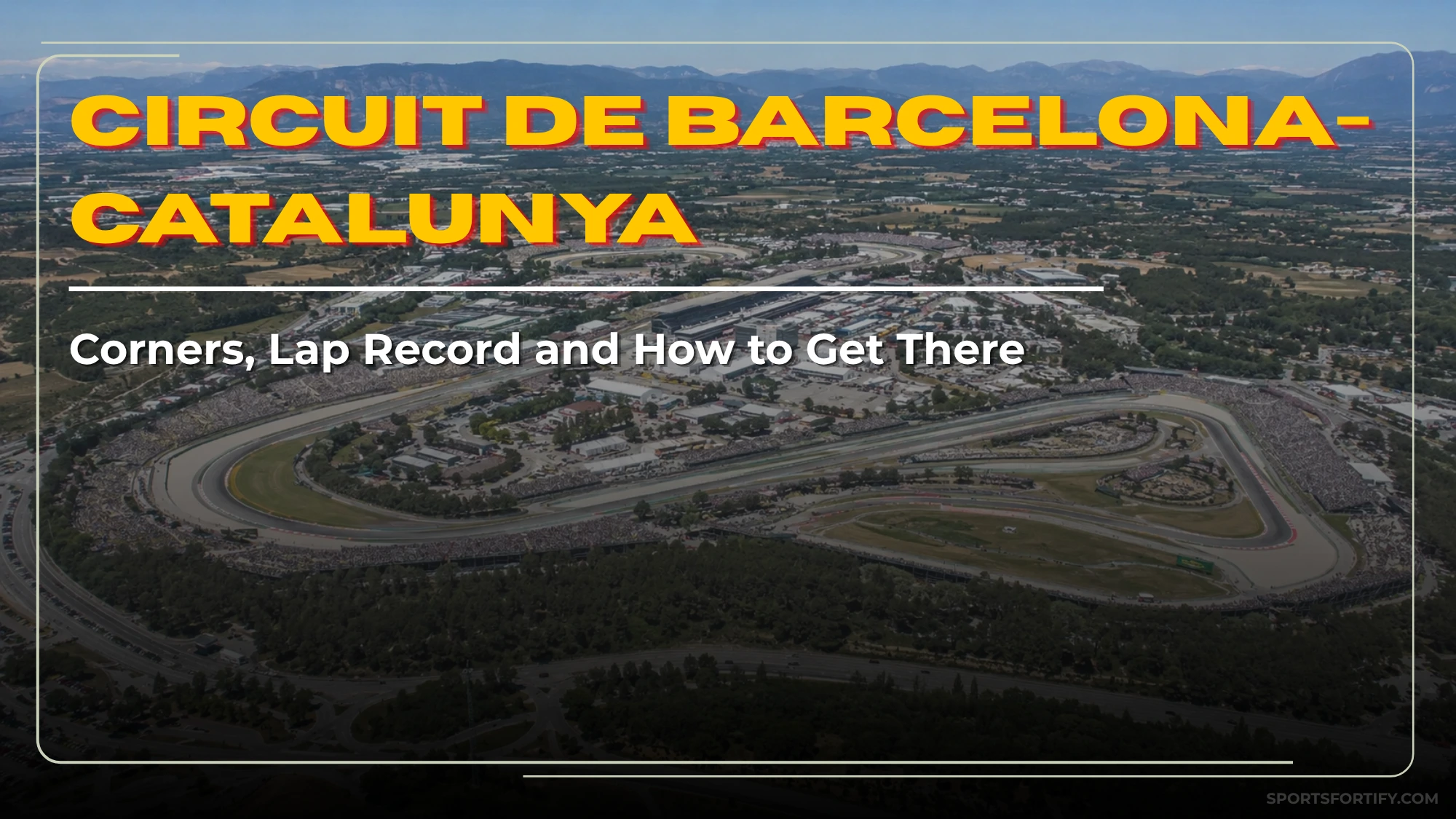
The Circuit de Barcelona-Catalunya has been part of the F1 calendar since 1991 but 2026 is the first year it runs under its own Grand Prix name. F1 spent 35 years here as the Spanish Grand Prix.
Now the Barcelona-Catalunya Grand Prix has its own identity on the calendar through 2032. The track is 4.657 km, has 14 corners, and is used by every team on the grid for pre-season testing. No circuit in F1 gets more study time. This guide covers everything you need to know before the race on 14 June.
CIRCUIT AT A GLANCE
WHERE IS THE CIRCUIT DE BARCELONA-CATALUNYA
The Circuit de Barcelona-Catalunya is in Montmeló, a small town around 30 km north of Barcelona city centre. It sits in the hills of the Vallès Oriental region of Catalonia, Spain. The circuit is a permanent race facility, not a street circuit. It has been there since 1991 and is signposted from the main AP-7 motorway out of Barcelona.
The circuit is not inside the city. It is a standalone motorsport facility in the hills outside it. First-time visitors often expect something close to the Sagrada Família and end up in a very different part of Catalonia. Plan your journey from the city centre, not from whatever landmark Google puts first.
The circuit was known as the Circuit de Catalunya from when it opened until September 2013, when it took its current name. Most F1 fans over the age of 25 still call it that. Both names refer to the same circuit.
CIRCUIT DE BARCELONA-CATALUNYA TRACK LAYOUT
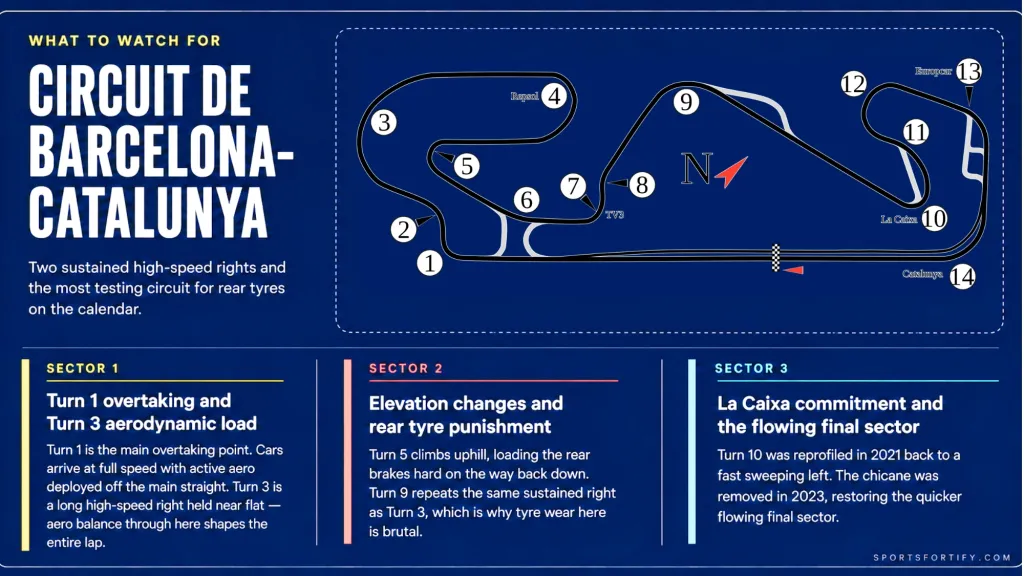
The Circuit de Barcelona-Catalunya runs clockwise and has 14 corners at its current configuration. Here is how one lap unfolds.
- Turn 1 is the main overtaking spot. Cars arrive off the straight at full speedwith active aero deployed, then brake hard for the right-hander. Most of the action happens here.
- Turn 3 is where the lap finds its character. A long, sustained high-speed right that you hold close to flat in qualifying and ease through in the race. The aerodynamic balance through here shapes everything else.
- Turn 5 goes uphill, which catches out setups built for flat tarmac. The elevation also loads the rear brakes harder on the way back down through 7 and 8.
- Turn 9 is the second long sweeping right of the lap. Two corners like that back-to-back is the main reason rear tyre wear at Barcelona runs higher than almost anywhere else.
- Turn 10 has the most history. The original 1991 layout had it as a fast, flowing left. In 2004 it got tightened into a hairpin in an attempt to create overtaking. It didn’t work, and drivers hated it. Valentino Rossi compared it to a supermarket car park. In 2021 it got reprofiled back toward the original sweeping shape, faster and far more rewarding to drive.
The final sector changed twice. A chicane was added in 2007 and used through 2022. From 2023 F1 dropped it and restored the original flowing layout, cutting the official turn count from 16 to 14 and making that section of the lap genuinely worth watching again.
HOW MANY CORNERS DOES THE CIRCUIT DE BARCELONA-CATALUNYA HAVE
The Circuit de Barcelona-Catalunya has 14 corners at the current F1 layout. That is the configuration without the final-sector chicane, which F1 dropped from the 2023 season onwards. The version with the chicane had 16 corners and was used for the 2021 and 2022 Spanish Grands Prix. From 2023, the cleaner 14-corner layout has been used for every F1 race here.
HOW LONG IS THE BARCELONA-CATALUNYA GRAND PRIX
The race typically runs for around 90 minutes to two hours. The average race speed through the lap is faster than at street circuits or slower twisty tracks. Safety car periods and pit stop strategy extend the final time, but Barcelona rarely pushes past the two-hour maximum.
The circuit’s mix of high-speed corners and reasonable straights means average speeds sit around 190 to 200 km/h across the full 66 laps. For reference, at Monaco the average speed across the race is roughly 150 km/h. Barcelona is a fast circuit by any measure other than the absolute fastest.
CIRCUIT DE BARCELONA-CATALUNYA LAP RECORD
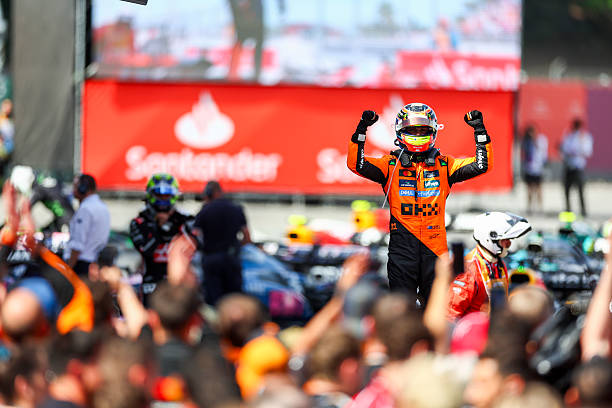
Oscar Piastri holds the current F1 race lap record at the Circuit de Barcelona-Catalunya. He set a time of 1:15.743 on lap 61 of the 2025 Spanish Grand Prix, driving a McLaren. That was the last F1 race held here under the Spanish Grand Prix name.
The fastest qualifying lap ever set at the current layout is 1:11.383, set in 2024 qualifying. The four-second gap between the race lap record and the fastest qualifying time reflects how much tyre condition, fuel load, and traffic affect race pace compared to a single flying lap on fresh rubber.
One piece of context worth noting. The circuit was modified significantly in 2021 (Turn 10 reprofiling) and again in 2023 (chicane removal), making all pre-2021 lap records irrelevant for comparison. Any record set before 2023 was on a different version of the track.
WHY DO F1 TEAMS TEST AT THE CIRCUIT DE BARCELONA-CATALUNYA
Every F1 team ran their 2026 cars at this circuit in January before the season started. That is not coincidence. Barcelona-Catalunya has been the default winter testing venue for F1 for years, and it earns that role for specific reasons.
The weather is reliable. Testing in January and February at most European venues carries rain risk. Catalonia’s Mediterranean climate means teams can expect mostly dry, consistent conditions across a multi-day test. Wet running can be useful but it is not what teams book a five-day test to find.
The track is representative. Barcelona-Catalunya has slow corners, medium-speed sections, long high-speed sweepers, and a proper main straight. It exercises almost every system on an F1 car across one lap. A team that finds a problem here knows it will also show up at other circuits. A team that finds no problems here has a strong baseline to build from.
The facilities handle a full F1 operation. Eleven teams and their trucks, media, sponsors, and hospitality all fit here without logistical chaos. Not all circuits manage that in testing trim.
The result is that every team on the 2026 grid has more laps of this specific circuit than of any other. That makes Barcelona one of the most technically honest races on the calendar. Every team on the 2026 grid has more laps of this circuit than any other, which is part of why the 2026 regulation changes were first stress-tested here.
HOW TO GET TO THE CIRCUIT DE BARCELONA-CATALUNYA
By car: The circuit is on the AP-7 motorway between Barcelona and Girona. Exit at Montmeló. Travel time from Barcelona city centre is around 30 minutes without race-day traffic. On race day, add significant time. Most regular attendees arrive early and use the time to explore the circuit before sessions.
By train: Rodalies de Catalunya line R2 Nord runs from Barcelona Sants station to Montmeló. Journey time is around 40 minutes. This is the easiest option for race day because it avoids road traffic entirely. Trains run more frequently on race weekends. The station is a 20-minute walk from the circuit gates.
From Barcelona airport: The airport is around 50 km from the circuit by road. Take the Rodalies train to Sants station, then the R2 Nord line to Montmeló. The Barcelona-Catalunya Grand Prix 2026 guide covers grandstand options and tickets.
FAQ
The Circuit de Barcelona-Catalunya is in Montmeló, Catalonia, Spain, around 30 km north of Barcelona city centre. It is a permanent racing facility in the hills of the Vallès Oriental region, not a street circuit or a city venue.
The current F1 configuration has 14 corners across 4.657 km. F1 dropped the final-sector chicane from 2023 onwards, reducing the turn count from 16 (the 2021-2022 configuration) to 14.
The most reliable option on race day is the Rodalies de Catalunya R2 Nord train from Barcelona Sants to Montmeló station. It avoids race-day road traffic and runs every 30 minutes, with increased frequency on event weekends.
The circuit has a representative mix of corner types, reliable dry weather in winter, and professional facilities that can handle a full F1 test operation. Those three factors make it the default choice for pre-season testing. Every team on the grid ran their 2026 cars here in January before the season started.

1 Comment