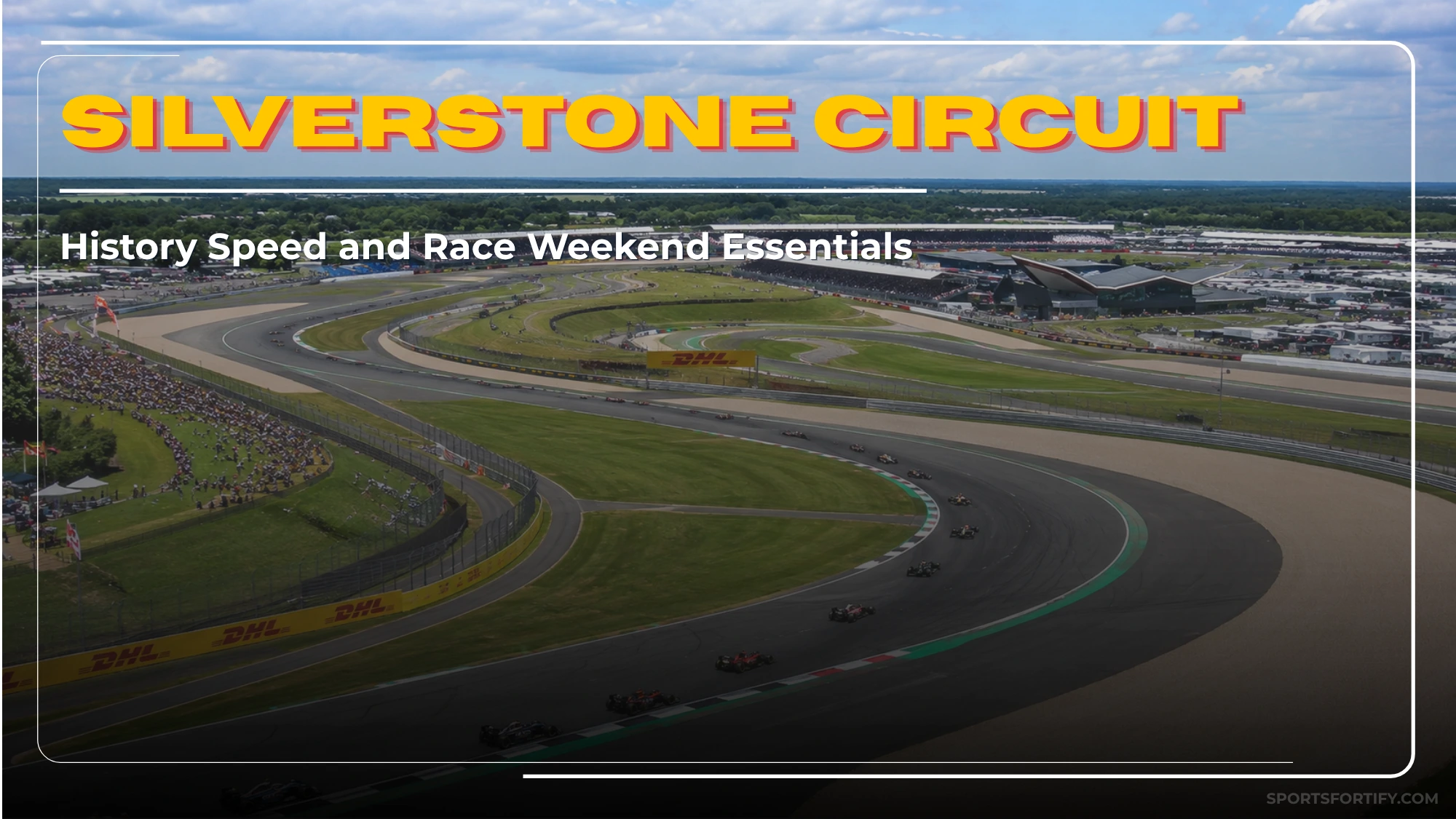
WHERE IS SILVERSTONE CIRCUIT LOCATED?
Silverstone Circuit is a Formula 1 track in Northamptonshire, England, near the village of Silverstone and around 70 miles northwest of London. The circuit is 5.891 km long, has 18 corners and hosts the British Grand Prix.
So the circuit sits roughly one hour north of London by road. Birmingham and Milton Keynes both sit within easy reach too, which makes Silverstone one of the most accessible Grand Prix venues on the calendar.
The site started life as RAF Silverstone, built on abandoned wartime runways. Now it hosts the British Grand Prix every July. From there, the circuit has grown into a 720-acre motorsport complex with its own postcode, hotel, and business park attached.
Silverstone Circuit Quick Facts
- Location: Northamptonshire, England
- Length: 5.891 km (3.660 miles)
- Corners: 18
- Race distance: 306.198 km
- British GP laps: 52
- Owner: British Racing Drivers’ Club
- Operator: Silverstone Circuits Limited
- First F1 World Championship race: 1950
- Lap record: 1:27.097, Max Verstappen, 2020
HOW LONG IS SILVERSTONE CIRCUIT?
Silverstone Circuit measures 5.891 km, or 3.660 miles, on the current Grand Prix layout. That makes it the third-longest circuit on the 2026 F1 calendar. Still, the number has shifted over the decades. Earlier configurations measured closer to 5.890 km before the 2010 Arena redevelopment added the Village, Loop, and Aintree section.

How Many Corners Does Silverstone Have?
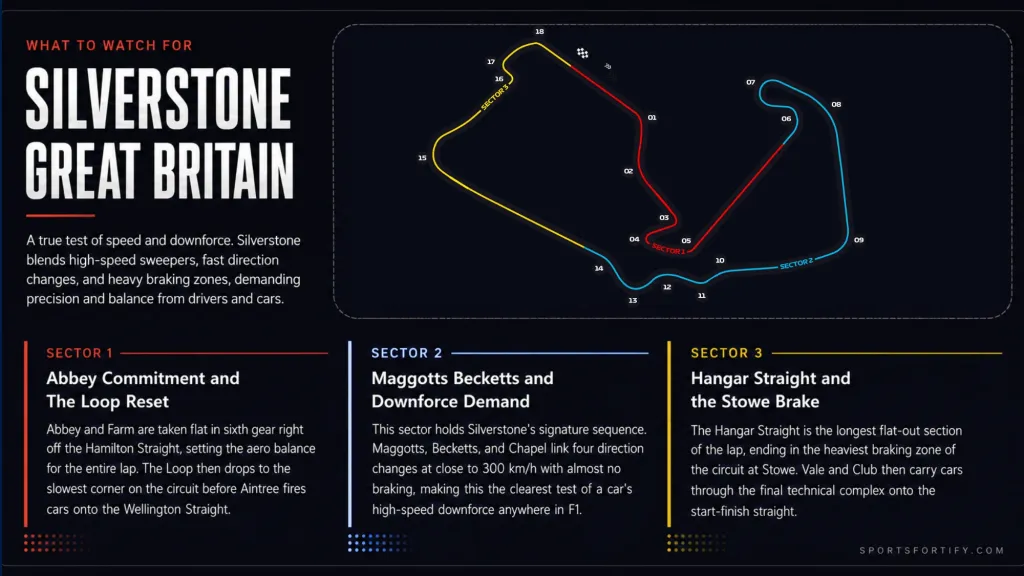
Silverstone Circuit has 18 corners on its current Grand Prix layout. The most famous section is Maggotts, Becketts and Chapel, which tests an F1 car’s high-speed downforce.
HOW TO GET TO SILVERSTONE CIRCUIT FROM LONDON
Silverstone Circuit is around 70 miles northwest of central London by road. By car, the M40 and A43 both run direct routes from London, taking roughly 75 to 90 minutes outside race weekend traffic. The M1 connects from Northampton and Milton Keynes, while the nearest towns are Towcester, Banbury, and Turweston.
Rail travel works too, though it takes more planning. Trains run from London into Northampton, Milton Keynes Central, Banbury, or Bicester Village. From there, shuttle buses and taxis cover the final stretch to the circuit. Even so, expect one-way road systems and heavy congestion on the approach roads during the British GP weekend itself.
THE HISTORY OF SILVERSTONE CIRCUIT
Silverstone Circuit began as RAF Silverstone, an airfield built on abandoned land in 1943. The Royal Air Force used it to train Wellington bomber pilots for night bombing raids over occupied Europe. Once the war ended in 1945, the runways sat unused, and the perimeter road quietly waited for someone to find a new purpose for it.
That someone was a group of local racing enthusiasts, with James “Jimmy” Brown among the figures who helped organise early meetings there. British motorsport had lost two of its prewar venues, Brooklands and Crystal Palace, so a new home was needed. Even Donington Park stayed out of action long after the war, which left a gap Silverstone could fill.
The first informal race took place in 1947 on the abandoned perimeter road, with sheep still grazing nearby. One animal was struck during the event, so locals nicknamed it the “Mutton Grand Prix.” After that, the Royal Automobile Club (RAC) stepped in and ran the first official meeting in 1948 on what became known as the Grand Prix Circuit.
THE FIRST GRAND PRIX AT SILVERSTONE IN 1950
Silverstone hosted the first round of the Formula 1 World Championship on 13 May 1950. Giuseppe Farina won the race driving an Alfa Romeo 158, with straw bales and oil barrels marking the track edges instead of modern barriers. The British monarch attended, lending royal weight to the sport’s opening chapter.
Before that historic afternoon, the circuit had already run as a National Circuit in 1949, a step up from the original 1948 Grand Prix layout. Then, once the World Championship arrived in 1950, organisers reclassified it as the International Circuit, the configuration that carried Formula 1 through its founding decade.
HOW THE SILVERSTONE LAYOUT HAS CHANGED OVER TIME
Silverstone’s layout has changed more than almost any circuit still racing today. The original Club Circuit and Stowe Circuit configurations from the late 1940s gave way to the International Circuit by 1952. Then, through the 1960s and 1970s, the lap settled into the shape most fans of that era would recognise.
1973 brought the circuit’s darkest early moment. Jody Scheckter triggered a multi-car pileup at Woodcote on the opening lap, which was the biggest crash F1 had seen up to that point. Because of this, a chicane was added at Woodcote in 1975 to slow cars through that section permanently.
The 1991 redevelopment linked Maggotts, Becketts, and Chapel into the flowing sequence drivers race through today. After Imola in 1994, safety regulations tightened across the entire sport, and Silverstone added further changes at Priory, Brooklands, and Luffield through 1996 and 1997 to match the new standard.
The biggest shift came in 2010 and 2011, when Silverstone Circuits Limited built the Arena complex and a new Wing Pit building. That redevelopment moved the start-finish line, added the Village and Loop corners, and gave the circuit the layout still used for the 2026 British Grand Prix.
WHAT DO THE SILVERSTONE CORNER NAMES MEAN?
Silverstone’s corners carry names tied directly to the land and the people who shaped the circuit. Abbey, the opening corner, takes its name from the ruins of Luffield Abbey found nearby. Copse sits close to Chapel Copse and Cheese Copse, small patches of woodland that gave the corner its name.
Woodcote and Club, meanwhile, both honour the Royal Automobile Club. Woodcote is named after Woodcote Park, an RAC-owned estate in Surrey, while Club takes its name from the RAC’s clubhouse on Pall Mall in London. The RAC organised Silverstone’s earliest races, so its fingerprints sit across the map.
Stowe comes from Stowe School, the public school just south of the circuit. Hangar Straight marks where two large RAF hangars once stood. So almost every corner name traces back to either the airfield Silverstone replaced or the club that first raced on it.
THE MAGGOTTS BECKETTS AND CHAPEL SEQUENCE EXPLAINED
The sequence of corners at Silverstone known for extreme downforce and speed is the Maggotts, Becketts, and Chapel complex, taken at close to 300 km/h. Drivers commit through a sweeping left right left right rhythm with almost no room for hesitation. Engineers treat this section as the clearest test of a car’s high-speed downforce on the entire calendar.
Maggotts takes its name from nearby Maggot Moor, while Becketts and Chapel Curve honour the medieval chapel of St Thomas à Beckett, demolished in 1943 to make space for the airfield. Until 1991, these were three separate corners. Since then, they have flowed together into the single sequence drivers and fans now treat as one defining moment of the lap.
WHAT IS SILVERSTONE LIKE TO DRIVE?
Silverstone rewards full commitment more than almost any circuit on the calendar. There are no slow corners to recover in, so a mistake at Maggotts or Copse costs a driver the entire lap. Average lap speeds sit higher here than at most European venues, with cars carrying well over 160mph through the fastest sections.
Keke Rosberg’s 1985 qualifying lap, completed on a slow puncture, still gets cited as proof of what flat-out commitment at Silverstone looks like. Lewis Hamilton’s 2020 win on three working tyres echoes that same legacy decades later. Even fighter jets occasionally fly over the circuit during race weekend, a nod to the airfield buried underneath it.
BEST PLACES TO WATCH AT SILVERSTONE CIRCUIT
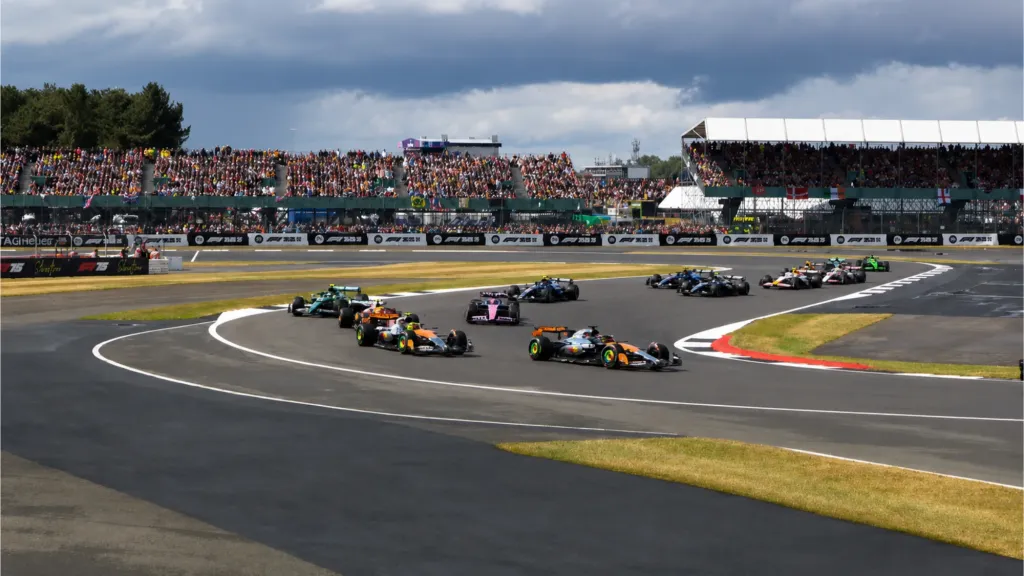
The Becketts grandstand gives fans the clearest view of Silverstone’s signature high-speed sequence. Watching cars commit through Maggotts and Becketts at full speed from trackside shows something broadcast cameras rarely capture properly. For pure technical drama, this remains the spot most regular attendees recommend first.
The Stowe grandstands, meanwhile, sit at one of the circuit’s best overtaking spots. Cars arrive off Hangar Straight under heavy braking, which often produces genuine wheel-to-wheel racing. So for fans who want overtaking over pure speed, Stowe consistently delivers more action across a race distance than most other sections.
WHY VISIT SILVERSTONE CIRCUIT
Silverstone offers far more than one race weekend a year. The Silverstone Museum and Silverstone Experience sit on site, covering the circuit’s full history from RAF airfield to modern Grand Prix venue. The Silverstone Classic, held separately each summer, draws huge crowds of British fans for historic racing across multiple categories.
Business parks now surround the circuit too, including the Aston Martin F1 team factory just down the road. Because of this, Silverstone functions as a genuine motorsport hub rather than a venue that only matters one weekend a year.
CAN YOU VISIT SILVERSTONE CIRCUIT?
Yes, you can visit Silverstone Circuit outside race weekends. The Silverstone Experience museum stays open to the public for most of the year, and several driving experience days let visitors get on track in a car. National Circuit events also run throughout the season, giving access well beyond the British Grand Prix itself.
FREQUENTLY ASKED QUESTIONS
Silverstone Circuit is located in Northamptonshire, England, on the border with Buckinghamshire, near the village of Towcester. The postcode is NN12 8TN. London sits roughly one hour away by road via the M40 and A43.
Silverstone Circuit measures 5.891 km, or 3.660 miles, on the current Grand Prix layout used for the 2026 British Grand Prix. This makes it the third-longest circuit on the Formula 1 calendar.
The Maggotts, Becketts, and Chapel sequence is Silverstone’s iconic high-speed complex, taken at close to 300 km/h. Drivers commit through four direction changes in quick succession, making it the clearest test of a car’s downforce on the entire F1 calendar.
The British Racing Drivers’ Club owns Silverstone Circuit. The club bought the 720-acre freehold from the Ministry of Defence in 1971 and operates the venue through its subsidiary, Silverstone Circuits Limited.