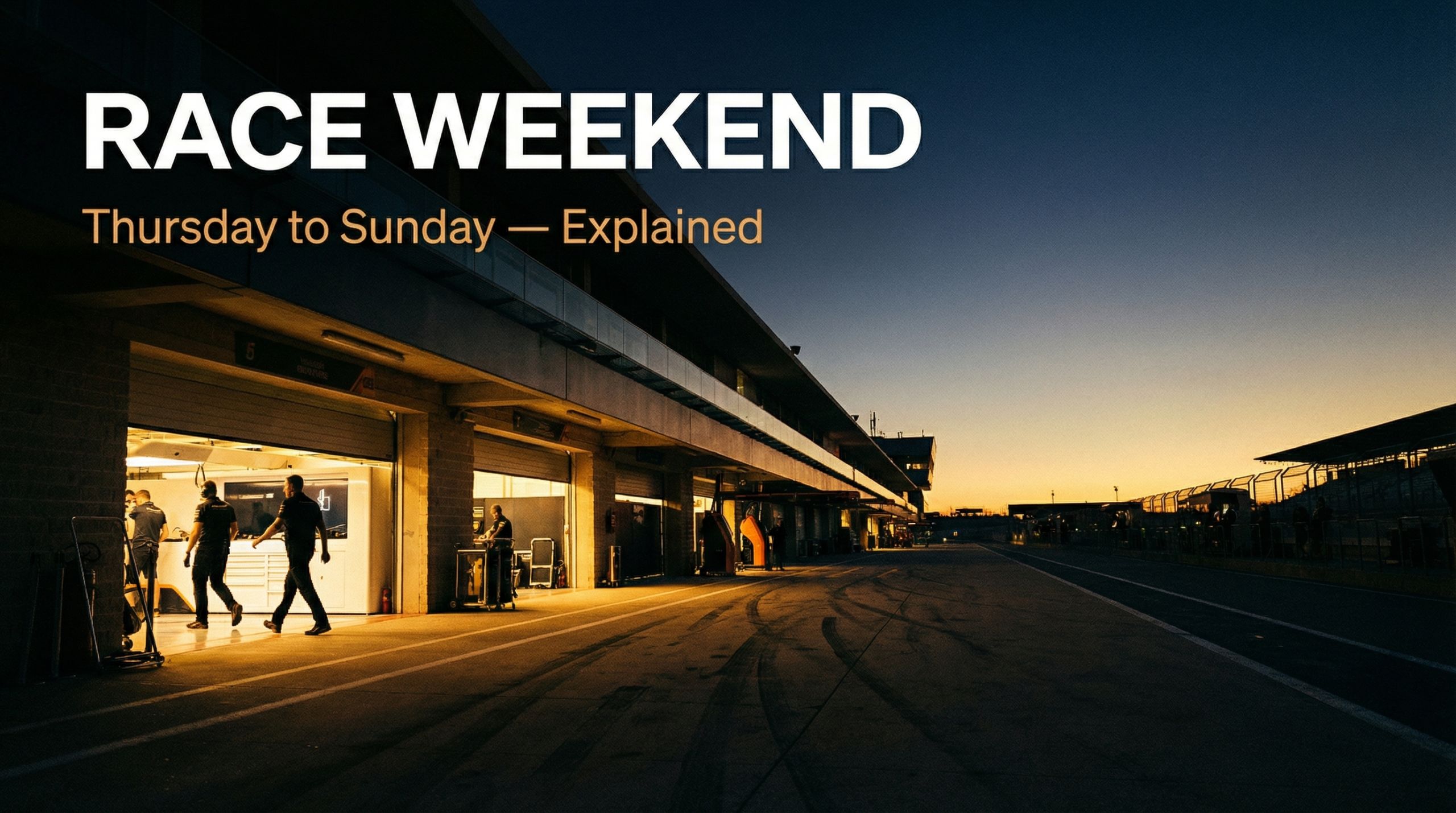
You turned on the TV for the race. The commentators kept referencing things from Friday. You felt lost and confused. That ends right now. Understanding a full F1 race weekend transforms casual viewing into genuine excitement. So here is exactly how the four days unfold — from the quiet Thursday paddock to Sunday’s dramatic checkered flag.
Thursday — The Calm Before Everything
Long before engines fire, Thursday sets the stage. The paddock transforms into a bustling village of team garages, hospitality units and media centres. Meanwhile, drivers attend official FIA press conferences. They face questions about form, team updates and rival battles.
For fans at the circuit, Thursday offers the most relaxed atmosphere. Drivers walk freely. Autographs happen naturally. However, most critical engineering work stays hidden behind closed garage doors. If you are watching from home instead, find out exactly where to stream every F1 session legally in your region.
Friday — Real Data Finally Hits the Track
Friday kicks off the on-track action with two practice sessions. Free Practice 1 runs for 60 minutes in the morning. Teams verify car systems, test initial setups and let drivers build rhythm. Crucially, the 2026 regulations demand heavy focus on energy deployment during this session. The new 50/50 power split between combustion and electric energy forces engineers to spend significant time calibrating electrical maps. Active aerodynamics also require constant fine-tuning throughout the session.
Furthermore, regulations require teams to run rookie drivers in at least two FP1 sessions per season. Consequently, unfamiliar names occasionally appear on timing screens.
Additionally, marshals communicate using coloured flags throughout every session. Understanding those flags completely transforms how you follow the action.
Subsequently, Free Practice 2 fills the afternoon — another 60 minutes. This session shifts focus toward race simulation. Teams load heavier fuel to mimic race conditions. They test tyre degradation across compounds. They refine setups based on FP1 findings. A strong Friday builds qualifying confidence. A messy Friday forces risky guesses that often backfire dramatically.
Saturday Morning — FP3 and the Final Push
Free Practice 3 arrives Saturday morning with genuine urgency. This final 60-minute session leaves zero margin for error. Additionally, the atmosphere shifts dramatically from Friday’s experimentation.
Lap times suddenly matter. Drivers push harder. The competitive order starts revealing itself clearly. Engineers make last-minute setup tweaks while drivers practise qualifying simulations — hunting for crucial extra tenths.
Meanwhile, there is no safety net after this session ends. Mistakes in FP3 leave zero time for corrections. This is the last chance to solve problems before the real fight begins.
Saturday Afternoon — The Qualifying Knockout
Saturday afternoon delivers the first truly competitive action of the F1 race weekend. Track position matters enormously in modern Formula 1. Overtaking remains notoriously difficult. Consequently, starting position often decides the final race outcome.
Qualifying uses a knockout format across three segments. Q1 runs for 18 minutes. All twenty drivers set times and the slowest five drop out. Q2 runs 15 minutes with another five eliminated. Finally, Q3 gives the top ten just 12 minutes to fight for pole position.
The pressure crushes drivers and teams equally. Thousandths of seconds separate pole from fourth. Furthermore, pole position earns one championship point and a massive psychological advantage heading into Sunday.
Sunday — Race Day Changes Everything
Race day transforms the entire weekend into something electric. Before lights out, drivers participate in the grid walk — one of motorsport’s most iconic traditions. Celebrities, sponsors and media crowd the starting positions. The tension builds visibly across the circuit.
The race covers approximately 305 kilometres. Strategy plays an enormous role throughout. Teams decide when to pit for fresh tyres. They react to competitors in real time. They gamble on safety car situations. Moreover, sudden rain can destroy a predictable race and trigger absolute chaos in seconds.
Every finishing position matters because the points system rewards consistency across the full season. Understanding how points work makes every overtake and pit stop feel far more dramatic.
After the checkered flag, work continues immediately. Scrutineering checks car compliance. The podium ceremony honours the top three. Post-race debriefs begin shaping the approach for next weekend.
Sprint Weekends — The Compressed Format
Not every F1 race weekend follows the traditional structure. Several rounds per season use the sprint format — a condensed and action-packed schedule.
- Friday features a single FP1 followed by Sprint Qualifying. This session determines Saturday’s sprint grid.
- Saturday morning hosts the Sprint — a 100-kilometre dash that awards points to the top eight finishers.
- Saturday afternoon brings traditional qualifying for Sunday’s Grand Prix. Consequently, drivers face two high-pressure sessions in a single day.
- Practice time drops significantly. Teams commit to setups with far less data — forcing bold and sometimes risky engineering decisions.
- Sprint winners earn 8 points. Points then decrease down to 1 point for eighth place.
The 2026 season features several sprint rounds scattered throughout the calendar. These weekends demand sharper preparation and faster decision-making from every team on the grid.
What To Watch For Every Weekend
Now that you understand the full structure, focus on three things. First, watch energy deployment experiments during Friday practice. The 2026 cars rely heavily on battery management and teams reveal strategies early. Second, compare qualifying laps on Saturday. The gaps between drivers expose car strengths and weaknesses clearly. Third, track tyre strategy decisions on Sunday. When a team pits often determines whether they win or lose.
These three details separate casual viewers from fans who truly understand Formula 1.

5 Comments