WHAT IS THE MONZA CIRCUIT?
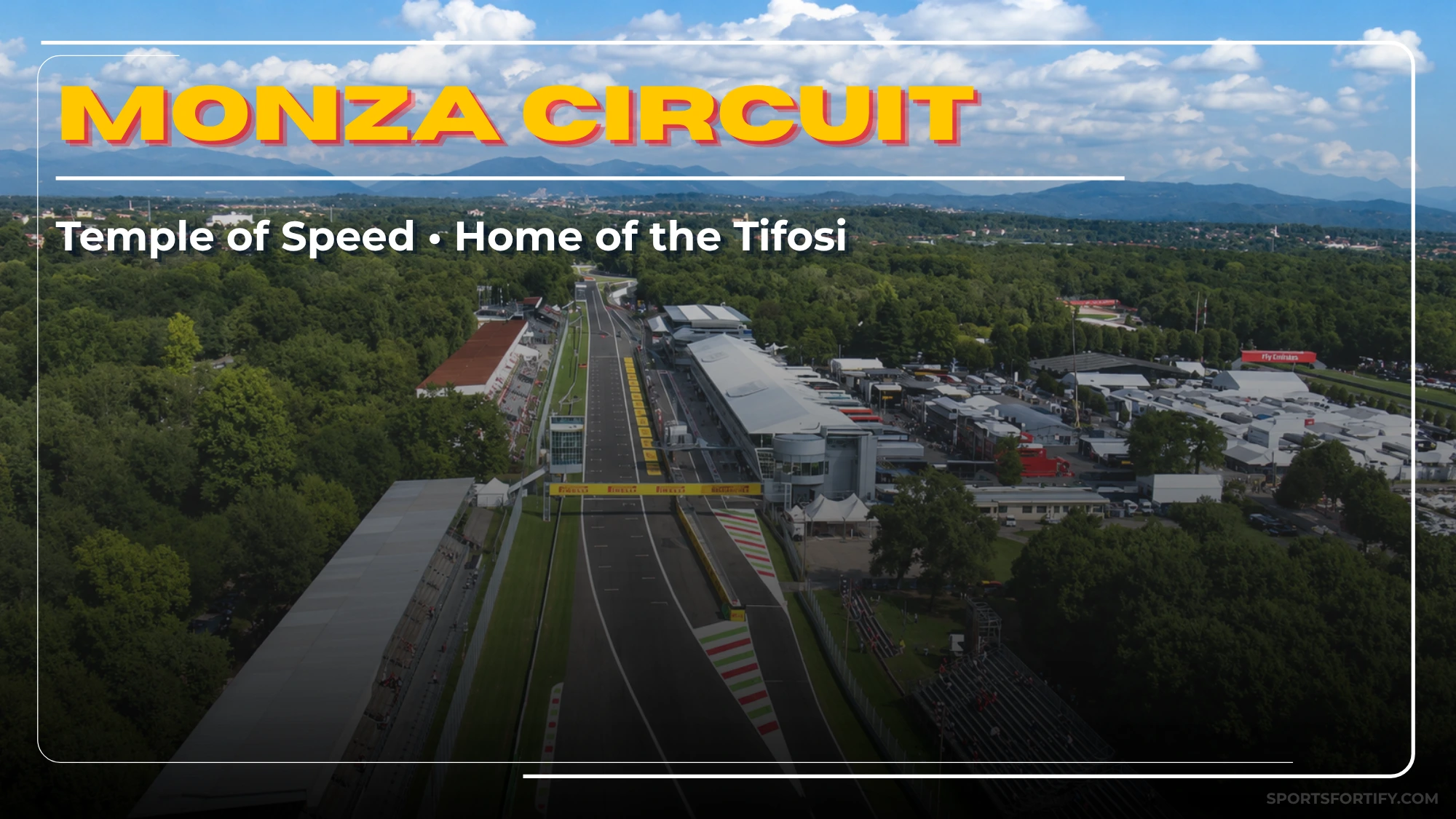
Autodromo Nazionale Monza is a 5.793 km race circuit in Monza, Italy, home to the Italian Grand Prix since 1922. Fans and drivers alike call it the Temple of Speed, a nickname earned honestly. Because Monza’s layout runs 70 to 80 percent of each lap at full throttle, no other circuit on the calendar rewards raw straight-line pace the same way.
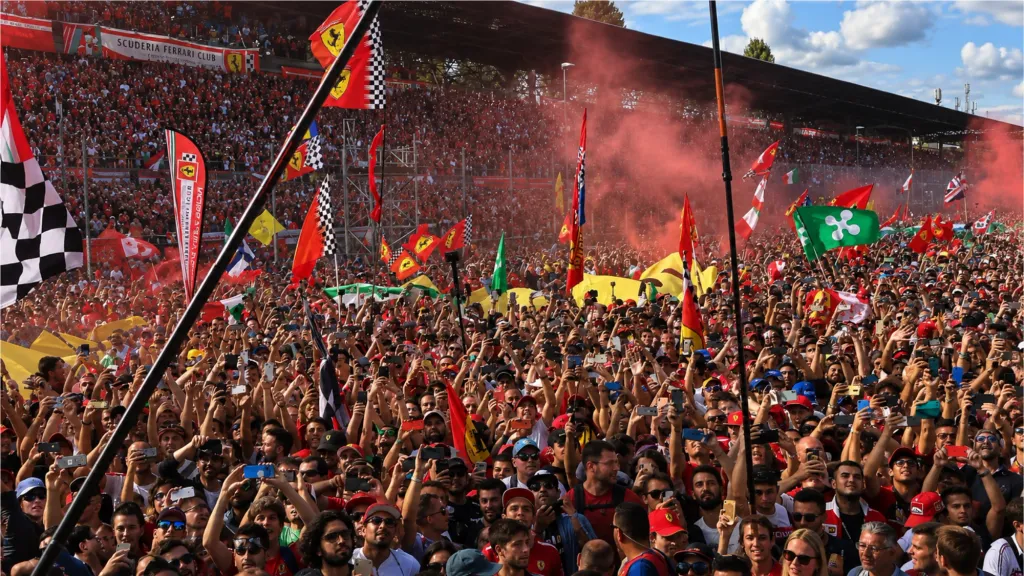
Built inside the historic Parco di Monza parkland, the circuit sits just 15 km northeast of Milan. So visitors get two experiences in one trip, world-class racing wrapped inside centuries-old royal grounds. The Tifosi turn every September weekend here into a sea of red, since Monza doubles as Ferrari’s unofficial home race.
Key Circuit Statistics
Monza Quick Facts
| 🏁 Circuit Length | 5.793 km |
| 🔄 Number of Laps | 53 |
| 📏 Race Distance | 306.72 km |
| ↩️ Number of Turns | 11 |
| ⚡ F1 Lap Record | 1:20.901 (Lando Norris, 2025) |
| 🚀 Max Speed | ~370–372km/h |
| 🏆 Most F1 Wins | Michael Schumacher & Lewis Hamilton (5) |
| 📅 First F1 Race | 1950 |
| 🏗️ Circuit Opened | 1922 |
| 📍 Closest City | Milan |
| 🕐 Time Zone | CEST (UTC+2) |
| 💶 Currency | EUR |
WHERE IS THE MONZA CIRCUIT?
The Monza circuit sits inside Parco di Monza, roughly 15 km northeast of Milan, at coordinates 45°37’06″N 9°16’54″E. Milan Linate is the closest airport, though Milan Malpensa and Bergamo Orio al Serio both serve the region too. Because of Monza’s location so close to Italy’s fashion and design capital, many fans pair race weekend with a Milan city trip.
HOW LONG IS THE MONZA CIRCUIT?
The Monza circuit measures 5.793 km per lap, with a Grand Prix distance covering 53 laps and 306.72 km total. That length makes it one of the longest circuits on the calendar by distance, even though lap times stay among the fastest anywhere, since so much of that distance runs flat out. The current configuration dates to safety-focused changes made through the 1970s, 1990s, and 2000s.
MONZA CIRCUIT HISTORY
The Original Speedbowl
Monza opened in 1922, built in an astonishing 110 days and becoming the world’s third purpose-built race track after Brooklands in the UK and Indianapolis in the US. The very first race ran on September 3, 1922. Even then, the circuit already featured banked curves, a design choice that would define its identity for decades to come.
The Birth of the Italian Grand Prix
Formula 1’s Italian Grand Prix joined the World Championship calendar in 1950, though races had run at Monza since the circuit’s opening in the early 1920s. Juan Manuel Fangio and Tazio Nuvolari both raced through Monza’s earliest championship years, cementing the venue’s place among motorsport’s most storied circuits.
Michael Schumacher and the Modern Era
Michael Schumacher holds the record for most Italian Grand Prix wins with five victories, a mark that captures exactly what Monza means to Ferrari and its Tifosi. Sebastian Vettel delivered the closest finish in the race’s modern history, winning by just 0.18 seconds in 2008.
Even so, Monza remains famous for extreme speeds. Juan Pablo Montoya recorded one of Formula 1’s highest top speeds here (372.6 km/h in 2005 testing), a figure still often cited when discussing the circuit’s outright pace.
WHAT MAKES MONZA THE FASTEST F1 CIRCUIT?
Monza earns its Temple of Speed nickname because drivers spend roughly 80 percent of each lap at full throttle. The 1.1 km main straight alone lets cars approach 350 km/h before heavy braking drops them to under 90 km/h for the first chicane. Because of this extreme speed variation, Monza demands one of the lowest downforce setups anywhere on the calendar, a genuine outlier compared to most modern circuits.
KEY CORNERS AT MONZA
Variante del Rettifilo
Variante del Rettifilo, Turn 1, is the tight chicane drivers hit immediately off the main straight, and it remains Monza’s single most reliable overtaking spot. Cars arrive at speeds near 370 km/h before braking hard into the sharp right-left sequence, making it a genuine first-lap flashpoint every single year.
Curva Grande and the Lesmo Corners
After the first chicane, cars sweep through Curva Grande at full acceleration before reaching the Lesmo corners, a pair of demanding right-handers taken at close to 300 km/h. The Lesmos date back to the circuit’s earliest configuration and remain some of the most technically respected corners on the entire calendar.
Variante Ascari
Named after 1955 world champion Alberto Ascari, the Ascari chicane is a three-part left-right-left sequence that tests car balance more than raw bravery. Drivers hit around 330 km/h on approach before threading through the technical sequence, often described as Monza’s most complex corner combination.
Parabolica, Curva Alboreto
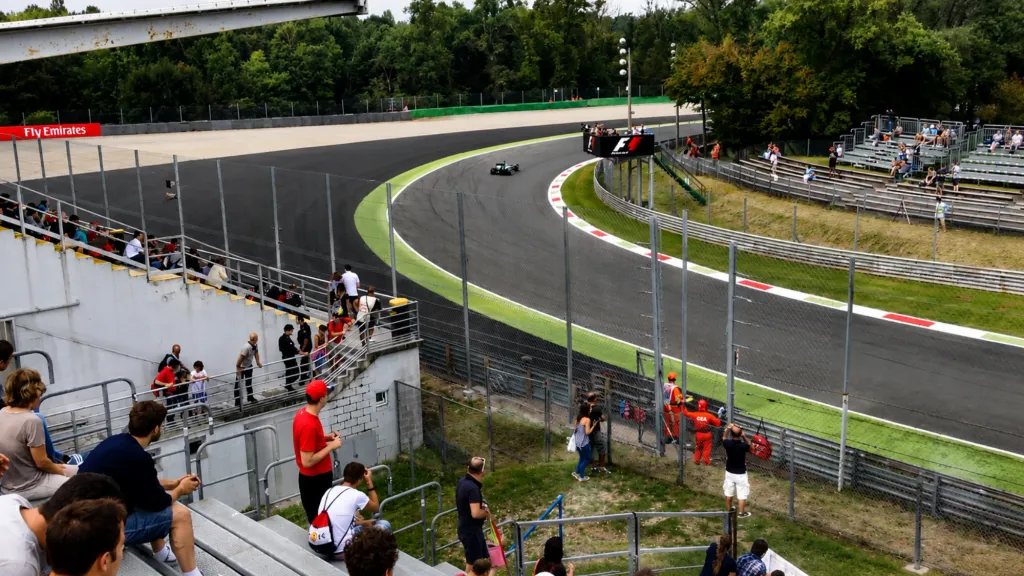
The final corner, officially renamed Curva Alboreto after Michele Alboreto, is still known by most fans simply as the Parabolica. It’s an increasing radius corner that feeds directly onto the main straight, so getting exit speed right here shapes the entire following lap. Drivers take it around 330 km/h, making it one of the last real overtaking opportunities before the chequered flag.
MONZA’S GRANDSTANDS GUIDE
Grandstand 26, Laterale Destra A
Grandstand 26 sits along the main straight and delivers the fullest overall experience at Monza, covering the grid, race start, pit lane, and podium celebrations. It’s widely considered the best all-around seat at the circuit, especially for fans who want to catch the post-race track invasion.
Grandstand 8A/8B, Prima Variante
For pure overtaking action, Grandstand 8A/8B overlooks the first chicane, where cars brake from 337 kph down to just 90 kph within 130 metres. Because this braking zone produces the heaviest action of the entire lap, it’s the pick for fans who want wheel-to-wheel drama.
Grandstand 21, Parabolica Section A
Grandstand 21 at the Parabolica offers the best value at Monza, giving fans a view of the final corner entry alongside the main straight beyond it. From there, watching the cars accelerate flat out toward the finish line makes for one of the most satisfying closing sequences anywhere on the calendar.
THE MONZA TRACK INVASION
After the chequered flag falls, Monza hosts one of F1’s most passionate traditions. Tifosi flood the track within 15 to 20 minutes of the finish, waving Ferrari flags and chanting toward the podium regardless of who actually won. In 2025, roughly 369,000 fans attended across the full weekend, and the scenes around Grandstands 26 through 30 during the invasion remain unlike anything else on the calendar.
GETTING TO THE MONZA CIRCUIT
Milan Linate sits closest to the circuit, though Milan Malpensa and Bergamo Orio al Serio both offer viable alternatives depending on flight availability. From central Milan, the train from Milano Centrale takes roughly 20 minutes to Monza station, followed by a short shuttle to the circuit gates. On race day itself, driving is possible but heavier traffic around Monza makes the train the more reliable option for most fans.
MONZA WEATHER
September in Monza typically brings average temperatures between 20 and 26°C, generally pleasant for a full day trackside. Even so, afternoon thunderstorms are common enough that packing a lightweight rain layer is worth doing regardless of the forecast. Sun protection still matters too, since clear stretches can turn genuinely hot by midday.
FREQUENTLY ASKED QUESTION
The Monza circuit, Autodromo Nazionale Monza, is located roughly 15 km northeast of Milan, Italy, inside the historic Parco di Monza parkland.
The Monza circuit measures 5.793 km per lap, with a full Formula One race distance covering 53 laps and 306.72 km.
Monza earns its Temple of Speed reputation from running roughly 80 percent of each lap at full throttle, combined with a racing history stretching back to 1922 and its deep connection to Ferrari and the Tifosi.
Monza opened in 1922, built in just 110 days, making it the world’s third purpose-built race circuit after Brooklands and Indianapolis. It has hosted the Italian Grand Prix since 1950.
The fastest route from central Milan is the train from Milano Centrale to Monza station, roughly 20 minutes, followed by a short shuttle bus to the circuit itself.


3 Comments