Every corner on an F1 track falls into one of a handful of technical categories, and knowing them changes how you watch a race. Types of F1 corners range from tight hairpins that drop cars from 90mph to 30mph in seconds, to sweeping esses that string three or four corners into one continuous rhythm. This guide breaks down every category, with real corners from the current calendar as examples.
WHAT ARE THE DIFFERENT TYPES OF CORNERS IN F1?
F1 corners split into seven core technical types. Esses link two or more corners in opposite directions, taken in one flowing motion.
Hairpins are the tightest corners on any lap, defined by heavy braking rather than downforce. Chicanes are short left-right or right-left sequences, usually kerb-heavy and built to slow cars down deliberately.
Beyond those three, engineers also classify corners by radius. Double-apex corners carry high aero load and stress the outside tyres hardest.
Long corners then split further into constant, decreasing, or increasing radius, based on whether the turn tightens, loosens, or holds steady through its length. So a single lap can string together five or six of these types back to back, and each one asks something different of the car.
WHAT IS A HAIRPIN IN F1?
A hairpin is the tightest, slowest type of corner on an F1 track, defined by heavy braking rather than aerodynamic grip. Monaco’s Fairmont Hairpin at Turn 6 is the slowest corner on the entire calendar, taken at roughly 30mph after cars approach it at close to 90mph. Because downforce barely matters at these speeds, hairpins reward mechanical grip and braking stability over wing setup.
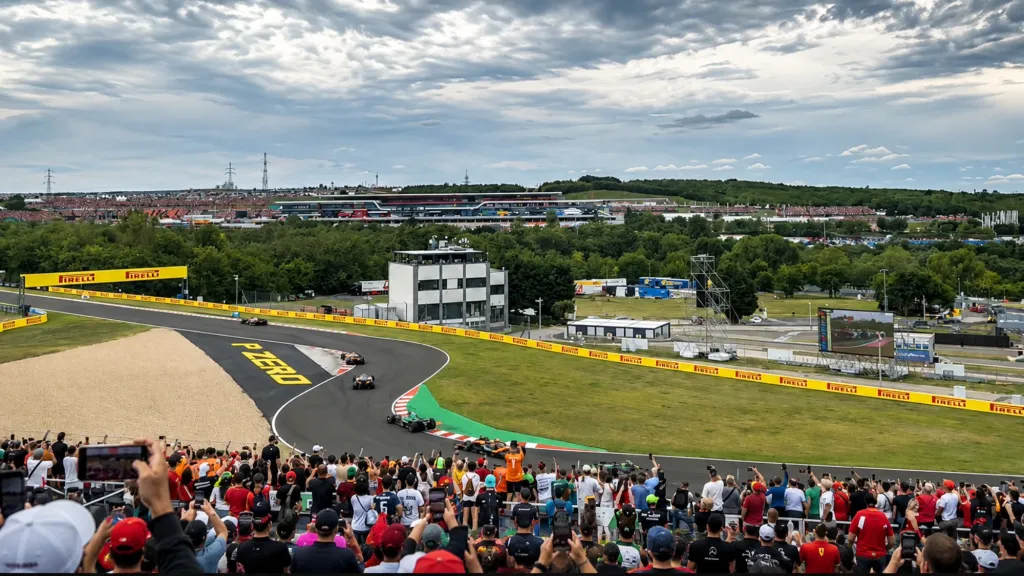
Imola’s Curva Tosa follows the same logic as a long hairpin, and Bahrain’s Turns 9 and 10 drop speed from around 130mph to just 40mph in a similarly brutal sequence. Once a car clears a hairpin, the exit speed it carries often decides how strong the following straight will be.
WHAT IS A CHICANE IN F1?
A chicane is a short, sharp left-right or right-left sequence built specifically to slow cars down. Monaco’s Nouvelle Chicane, formerly known as the Chicane du Port, sits right after the tunnel exit and punishes any driver carrying too much speed out of it. Chicanes lean heavily on kerb usage, since drivers ride the inside kerbs to shorten the line between the two direction changes.
You must have heard chicane many times while watching race and not every chicane survives on the calendar. Singapore’s famous Singapore Sling was removed in 2013 after Kimi Räikkönen’s 2008 crash there exposed how punishing the sequence had become. That’s the trade-off with chicanes specifically, they’re deliberately artificial, added or removed as tracks evolve for safety.
WHAT ARE ESSES IN F1?
Esses are sometimes called an S-bend for the same reason, since the shape a car traces through the sequence literally looks like the letter S when viewed from above.
Esses are a linked sequence of corners taken in alternating directions, treated by drivers as one continuous motion rather than separate turns. High speed esses like Suzuka’s Turns 3 through 7 get taken at around 160mph, demanding constant rhythm through direction changes without a real breathing point.
You must have heard of the Nürburgring, Nordschleife has its own version, the Pflanzgarten II section, renamed the Stefan Bellof S in 2013. Low speed esses work differently. Interlagos’ S do Senna, named after Ayrton Senna, opens the lap at around 200mph before decelerating through its three parts down to roughly 70mph.
Getting the entry speed right into a low speed esses sequence often defines the entire opening sector of a lap.
WHAT IS A KINK IN F1?
A kink is a shallow, high-speed direction change so slight it barely registers as a corner at all, usually taken flat out or with only a small lift. Unlike a hairpin or chicane, a kink doesn’t demand real braking, it’s more of a bend in the road than a genuine turn.
The Masta Kink on Spa’s old public road layout is the most famous historical example, a fast left-right flick taken at full speed that became one of the most feared sections in F1 history before the circuit was shortened. Kinks still exist on modern tracks too, even if they rarely get named the way Masta Kink was. Any point on a lap where a straight isn’t perfectly straight, just slightly bent, technically qualifies.
Drivers barely lift for them, but getting the line even slightly wrong through a kink can still cost real time heading into whatever comes next.
DOUBLE-APEX AND RADIUS-BASED CORNERS EXPLAINED
Beyond hairpins, chicanes, and esses, engineers classify long corners by how their radius changes through the turn.
Double-Apex Corners
A double-apex corner has two distinct turning points within one continuous curve, carrying high aerodynamic load throughout and stressing the outside tyres more than any other corner type. Suzuka’s original 130R, before its 2003 reconfiguration, was the defining example of this category, named for its 130 metre radius.
Constant, Increasing, and Decreasing Radius Corners
A constant radius corner holds the same curve throughout, like Monza’s Parabolica, also known as Curva Alboreto, which takes roughly 7.5 seconds to clear at entry speeds near 200mph. An increasing radius corner opens up as the driver goes through it, the way Barcelona’s La Caixa does, hitting its slowest point around 60mph before widening out.
A decreasing radius corner does the opposite, tightening the further a driver commits, which is exactly what makes Shanghai’s Turns 1 and 2 so demanding on entry.
WHAT IS THE RACING LINE AND APEX IN F1?
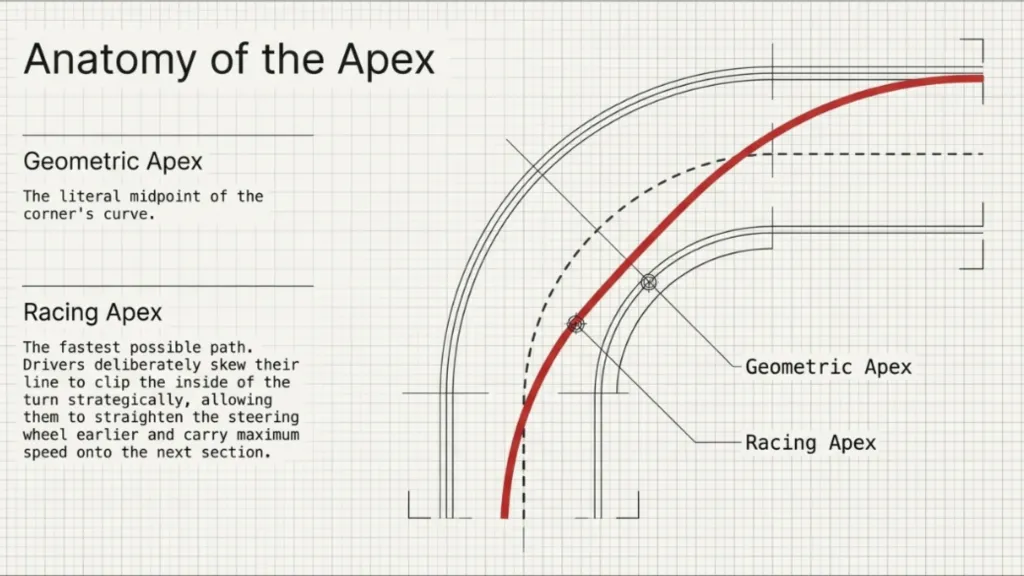
The racing line is the fastest possible path a car can take through a corner, built around three phases: entry, apex, and exit. The apex itself splits into two versions. The geometric apex is the literal midpoint of the corner’s curve, while the racing apex is wherever a driver actually chooses to clip the inside of the turn to carry the most speed onto the next straight.
Drivers also adjust which apex they hit based on what comes next. An early apex favors corner exit speed when a straight follows, while a late apex favors entry speed when another corner comes quickly afterward. That single decision, made in a fraction of a second, is often the real difference between two drivers on the same car.
HOW FAST DO F1 CARS GO AROUND CORNERS?
F1 cars take corners anywhere from roughly 30mph through the slowest hairpins up to nearly 190mph through the fastest flowing corners, with top speed through a corner reaching close to 300kph.
That massive range is exactly why corner classification matters so much to how a car gets set up. The physics behind that speed comes down to a simple relationship. A car’s cornering speed connects directly to the corner’s radius, expressed as centripetal acceleration, roughly speed squared divided by radius.
So a tighter corner physically demands a slower speed no matter how good the car is, while a wide sweeping corner allows drivers to carry far more pace through it.
HOW MANY GS DO F1 DRIVERS PULL IN CORNERS?
F1 drivers typically experience between 4 and 6 g of lateral force through fast corners, meaning their bodies temporarily weigh four to six times their normal weight while cornering.
That force comes from the same physics driving cornering speed, tyre grip working against the car’s mass to change direction at speed. This is also why neck strength training is such a core part of an F1 driver’s fitness regime.
Sustaining 4 to 6 g repeatedly across a full race distance, corner after corner, lap after lap, is a genuine physical demand most fans never see on a broadcast screen.
FREQUENTLY ASKED QUESTIONS
A hairpin is the tightest, slowest corner type on an F1 track, defined by heavy braking rather than downforce. Monaco’s Fairmont Hairpin is the slowest example on the current calendar, taken at around 30mph.
A chicane is a short left-right or right-left sequence built specifically to slow cars down, usually featuring aggressive kerb usage between the two direction changes.
F1 cars take corners anywhere from around 30mph through the tightest hairpins up to nearly 190mph through the fastest flowing corners, depending entirely on the corner’s type and radius.
The geometric apex is the literal midpoint of a corner’s curve, while the racing apex is the point a driver actually chooses to clip based on whether they need more entry speed or more exit speed.


1 Comment