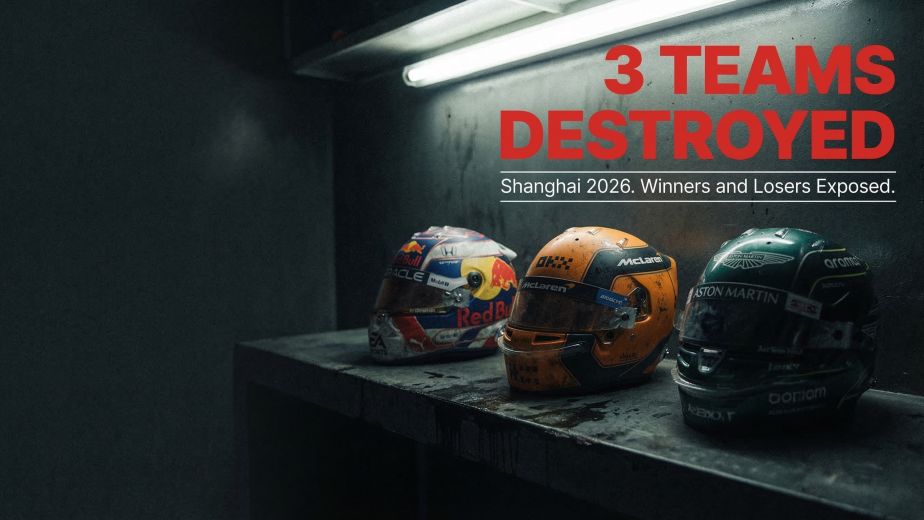
The Chinese GP 2026 arrives in Shanghai with five unresolved crises that Melbourne created and nobody has fixed. Mercedes leads the constructors’ championship by 16 points after just one race. Ferrari’s strategy department remains unchanged. Aston Martin confirmed no spare batteries exist for Shanghai.
Furthermore, the circuit layout amplifies every single weakness that Albert Park exposed. Shanghai’s 5.451-kilometre track features a 1.2-kilometre back straight, 16 corners and historically produces more Safety Car interventions than Melbourne.
Additionally, the Chinese GP runs as a Sprint weekend with just one practice session before competitive action begins. The problems Melbourne revealed are about to get significantly worse.
FERRARI’S STRATEGY GAMBLE FACES A CIRCUIT THAT PUNISHES HESITATION
Shanghai’s layout creates more Safety Car and VSC opportunities than Albert Park ever could. The complex high-speed Turns 7 and 8 combined with the heavy braking zone at the Turn 14 hairpin produce frequent incident windows.
Consequently, the same strategic decisions that cost Ferrari a potential one-two finish in Melbourne will surface again. Furthermore, Fred Vasseur confirmed absolutely nothing has changed. “I have no regret on the strategy. Let’s be focused on China now.” That response suggests Ferrari will gamble again when the next VSC appears.
Additionally, Pirelli nominated harder compounds for Shanghai. The C2, C3 and C4 selection creates a wider strategy window than Melbourne’s softer range. More compound options means more decision points. More decision points means more chances for Ferrari’s pit wall to hesitate at the critical moment.
Leclerc and Hamilton both showed race-winning pace in Melbourne. Neither driver could overcome a pit wall that froze when Mercedes acted.
Ferrari fast-tracked an aggressive aerodynamic update including the “Macarena” rear wing concept for Shanghai. However, new parts cannot fix a strategy philosophy that refuses to adapt. The Ferrari strategy crisis that defined Melbourne now travels to a circuit built to punish exactly the same mistakes.
ASTON MARTIN’S BATTERY CRISIS MEETS SHANGHAI’S ENERGY DEMANDS
Shanghai’s 1.2-kilometre back straight demands sustained battery deployment far beyond anything Albert Park required. Melbourne’s stop-start layout allowed teams to manage energy in short bursts. Shanghai offers no such mercy. Consequently, cars with compromised battery capacity lose time on every single lap through the back straight.
Aston Martin confirmed no spare batteries are available for China. Additionally, Honda’s Koji Watanabe admitted the partnership “can’t stay the same” and requires major changes. Alonso retired after 14 laps in Melbourne specifically to conserve components for future races.
Moreover, Aston Martin must run with high fuel loads to mitigate the vibrations. This prevents low-fuel qualifying simulations entirely. Consequently, neither Alonso nor Stroll can extract the car’s true potential over a single lap.
The team cannot assess their actual pace because the Honda engine prevents them from pushing the car anywhere near its limits. Alonso insists “everybody is convinced, is motivated, is determined.” Motivation alone does not replace missing batteries.
The Aston Martin vibration crisis has forced both drivers into a survival mode that prevents any meaningful performance development.
RED BULL’S QUALIFYING NIGHTMARE HITS A SPRINT WEEKEND
China hosts a Sprint weekend format. Consequently, teams receive just one practice session before Sprint Qualifying determines the Saturday grid. Verstappen’s Melbourne weekend began with a qualifying crash that buried him in 20th. His recovery drive to sixth masked the qualifying failure temporarily.
However, a Sprint format offers zero margin for another disaster. Furthermore, Red Bull carried early power unit reliability concerns from Australia. Verstappen himself noted the 2026 cars feel “different” and that energy management becomes critical at Shanghai’s demanding layout.
Additionally, the Sprint race awards points on Saturday. A poor Sprint Qualifying session means lost points before Sunday even begins. In Melbourne Verstappen had 58 laps to recover from 20th. A Sprint race offers roughly 20 laps. Recovery drives become mathematically impossible across that distance.
Christian Horner acknowledged the team must “improve qualifying positions” but one practice session is simply not enough to solve that problem. Verstappen’s talent rescued Melbourne. Shanghai’s compressed format may not allow a second rescue.
McLAREN’S POWER DEPLOYMENT GLITCH THREATENS PIASTRI AGAIN
Piastri never started the Australian Grand Prix. His car snapped violently on the reconnaissance lap after receiving 100 kilowatts more power than expected. Cold tyres combined with an aggressive kerb and a sudden power spike destroyed his front wing and suspension instantly.
Piastri confirmed it himself. “I had 100 kW more power than I’ve had the whole weekend. It was a combination of bad factors.” McLaren blamed software calibration and declared the car fully repaired for Shanghai.
However, Shanghai presents colder conditions than Melbourne. Temperatures are forecast between 15 and 20 degrees. Consequently, the same cold-tyre vulnerability that triggered Piastri’s crash exists again during the opening laps of every session.
McLaren says the problem is solved. Shanghai will prove whether that is true.
THE GAP BETWEEN THE PREPARED AND THE BROKEN IS WIDENING
Melbourne separated the Chinese GP 2026 grid into two distinct tiers. Mercedes scored 43 points from flawless execution. Ferrari collected 27 despite matching Mercedes on raw pace. McLaren managed just 10 with one car.
Red Bull scraped 8 points entirely through a recovery drive. Aston Martin and Cadillac scored nothing at all. Consequently, the constructors’ standings already reflect a growing chasm between teams that executed and teams that survived.
Furthermore, nobody struggling has announced meaningful fixes. No strategy overhaul at Ferrari. No spare batteries at Aston Martin. No qualifying solution at Red Bull. No confirmed software fix at McLaren. Meanwhile, Mercedes changed nothing because nothing needed changing.
Russell and Antonelli arrived in Melbourne with a plan and executed it without error. That operational gap matters more than any car performance advantage across a 24-race championship season.
The Chinese GP 2026 will not heal these wounds. Shanghai will tear them wide open. The Australian GP exposed the real pecking order and Round 2 will confirm whether Melbourne was an anomaly or a permanent verdict.