

A pit stop is when a Formula 1 car pulls off the track into the pit lane during a race for quick service. The team changes all four tyres. No refuelling happens anymore. That rule ended in 2010. The car stops in a marked box where a crew of over 20 mechanics surrounds it. The whole process from entering the pit lane to rejoining the track takes about 20 to 25 seconds.
Pit stops are mandatory in dry races. Every driver must use at least two different tyre compounds during the race. That forces at least one pit stop. Wet races are different. If a driver uses rain tyres the entire race no stop is required.
Pit stops win and lose races. A fast stop gains positions. A slow one costs the race. Ferrari recorded the fastest F1 pit stop of 2026 so far. At the Japanese Grand Prix Lewis Hamilton’s crew changed all four tyres in exactly 2.00 seconds.
How does a Formula 1 pit stop work
The driver enters the pit lane at full racing speed then slows immediately. The pit lane has an 80 kilometre per hour speed limit. Drivers press a button that activates a speed limiter. Breaking this limit results in a five-second time penalty. Three violations in one season adds a grid penalty for the next race.
The car approaches the team’s pit box. A painted arrow or marker on the ground shows exactly where to stop. Precision matters here. If the car stops even 20 centimetres off the mark the mechanics cannot reach the wheels properly.
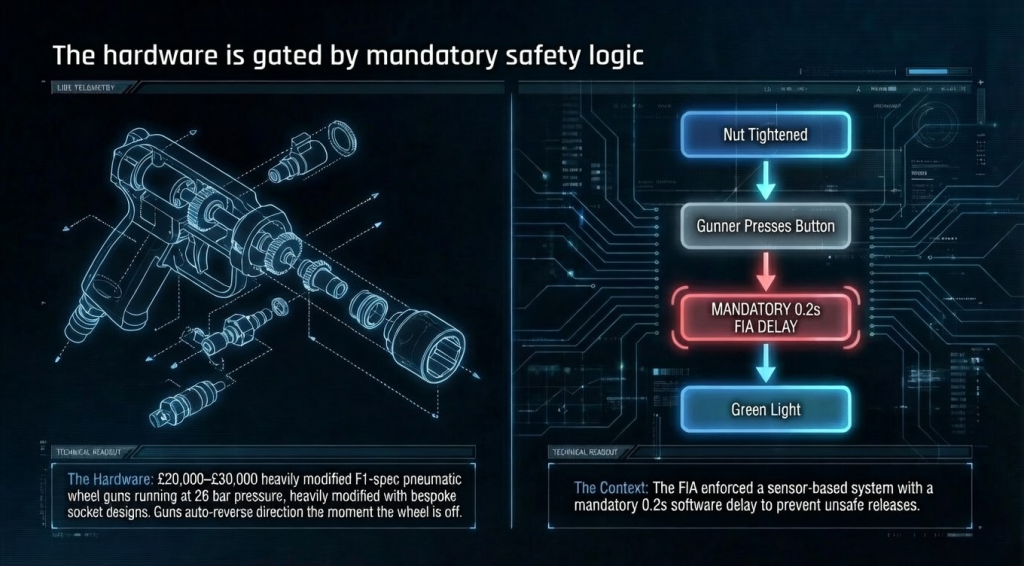
The moment the car stops two jack operators lift the front and rear instantly. Four wheel gun operators move in at the same time. These pneumatic guns spin incredibly fast. Each operator loosens one wheel nut. Four crew members pull the old tyres away. Four more crew members slam fresh tyres onto the hubs. The wheel guns tighten the new nuts with two quick bursts of sound.
The jacks drop. A crew member holding a board or watching a light system signals the driver to go. Some teams use an automated light above the car instead of a person. The driver accelerates hard out of the box and rejoins the race.
The stationary period lasts two to 2.5 seconds when everything goes right. The entire operation is choreographed down to the millisecond. Teams practice pit stops for months before the season even starts. Consistency across all races matters more than one record-breaking stop.
How many people are in an F1 pit crew
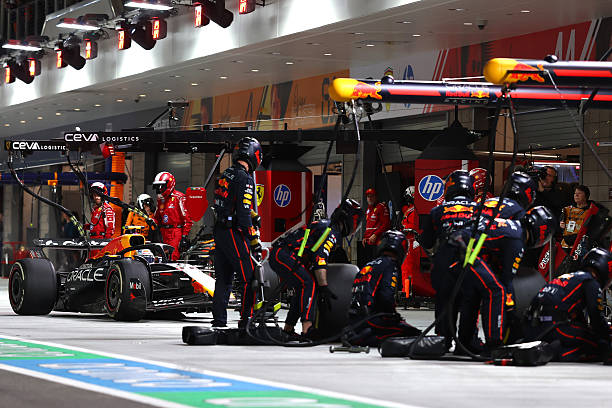
Over 20 mechanics work on each pit stop. Every person has one specific job. Speed comes from everyone doing their task perfectly at the exact same moment. Two jack operators lift the car. One handles the front jack and one handles the rear jack. They raise the car the instant it stops moving.
Twelve people work on the tyres. Four wheel gun operators remove and tighten the wheel nuts. Four crew members pull off the old tyres. Four more crew members fit the new tyres. That makes three people per wheel working together.
Additional crew members handle other tasks. Two stabilizers hold the car steady so it does not roll or shift during the tyre changes. One person operates the lollipop board or traffic light system telling the driver when to leave. Some crew members stand ready to adjust the front wing angle or clean the driver’s visor if needed.
Every mechanic trains daily for their role. One mistake from any person ruins the entire stop. A wheel gun operator who fumbles costs three seconds. A tyre that does not seat properly can end the race if the wheel comes loose on track.
The best teams average under 2.2 seconds across an entire season. Consistency separates championship-winning crews from the rest. Formula 1 even awards the DHL Fastest Pit Stop Award each year to the team with the best average times.
Why are pit stops important in F1
Tyres lose grip as they wear down. Lap times get slower. A driver on worn tyres can be two to three seconds per lap slower than someone on fresh rubber. That time difference decides race positions. Fresh tyres restore speed instantly.
Strategy creates different pit stop timings. The undercut means pitting earlier than your rival. You gain time on fresh tyres while they struggle on old ones. When they finally pit you have already built a gap. The overcut does the opposite. You stay out longer hoping the car that pitted early gets stuck in traffic or cannot warm up the new tyres properly.
Safety cars and virtual safety cars create opportunities. The pit lane speed stays at 80 kilometres per hour but the track speed drops to match during yellow flags. That makes the time loss from pitting much smaller. Teams rush to pit under safety cars to gain positions almost for free.
Damage forces unplanned stops. A puncture or broken front wing requires immediate attention. Drivers also pit to serve time penalties. Track limit violations or unsafe releases add five or ten-second penalties. The car must sit stationary in the box for that duration before the crew can touch it.
One slow pit stop in a tight championship fight can cost the title. A perfect stop executed 20 times in a season adds up to massive points gains. This is why teams spend millions perfecting pit stop procedures every year.
How fast are F1 pit stops
The fastest F1 pit stop ever recorded is 1.80 seconds. McLaren achieved that time at the 2023 Qatar Grand Prix. In 2026 the fastest stop so far is 2.00 seconds. Ferrari completed it at the Japanese Grand Prix for Lewis Hamilton.
Most competitive stops fall between 2.0 and 2.5 seconds. Anything over 2.5 seconds is considered slow and costs positions on track. A three-second stop can drop a driver two or three places depending on the gaps between cars.
Mistakes add huge amounts of time. A wheel nut that cross-threads takes five extra seconds to fix. A tyre that does not seat properly can add ten seconds. A jack that fails ends the stop completely. Some errors force the car to retire if a wheel comes loose during the race.
Penalties punish unsafe work. Releasing a car into the path of another driver results in a minimum ten-second penalty. Mechanics cannot step into the fast lane until the car has fully stopped. Crossing the white line at pit entry or exit adds a five-second penalty.
Speed comes from repetition. Teams run practice pit stops hundreds of times before race weekends. Every mechanic knows their exact movements. Championship teams hit their marks lap after lap without major errors. A single slow stop at the wrong moment can ruin months of work.
FAQS
A typical F1 pit stop takes 2.0 to 2.5 seconds while the car is stationary. The full process from entering the pit lane to rejoining the track takes around 20 to 25 seconds including slowing down and accelerating away.
Yes. In dry races drivers must use at least two different tyre compounds which requires at least one pit stop. Wet races are exempt. If a driver uses only rain tyres the entire race no pit stop is required.
The fastest F1 pit stop ever recorded is 1.80 seconds by McLaren at the 2023 Qatar Grand Prix. In 2026 the fastest stop so far is 2.00 seconds by Ferrari at the Japanese Grand Prix.



1 Comment