

Formula 1 has done it. It seized the rulebook, tore it apart, and rebuilt everything from scratch. The 2026 F1 Australian GP rules don’t tweak the sport. They replace it. New wings, new engines, new fuel, smaller cars, and a completely different strategic game.
March 8 in Melbourne isn’t just the season opener. It’s the official unveiling of the most transformative machine in Formula 1’s modern history. Pre-season testing is wrapped. Teams are packing for Australia right now. You’ve got days. Not weeks. Get up to speed.
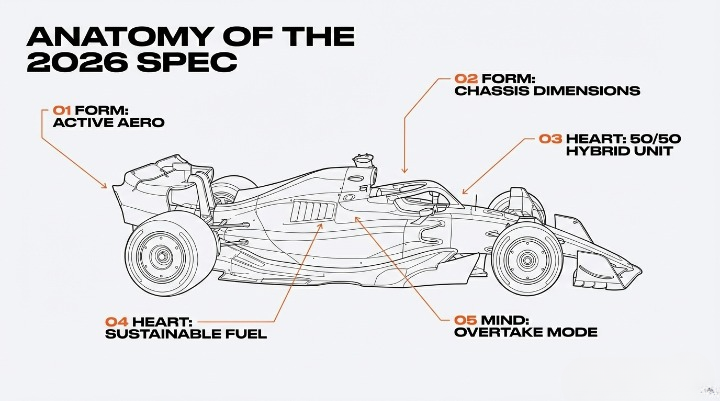
Overtake Mode — The Mushroom From Mario Kart
Meanwhile, that one-second gap still matters. It just triggers something far more powerful than a wing flap now.
Overtake Mode fires when a driver closes within one second of the car ahead, deploying an additional burst of electrical energy targeted specifically at attacking a rival. Think of Mario Kart’s mushroom boost. You hit it at exactly the right moment on exactly the right stretch, and the driver in front simply vanishes in your mirrors.
The tactical weight of this is enormous. Consequently, burn it early or at the wrong point and it’s completely wasted. Drivers and engineers will study each circuit’s activation zones obsessively to maximise when and where Overtake Mode detonates. Max Verstappen, Lando Norris, Charles Leclerc — every driver’s racecraft will be exposed or elevated by how intelligently they manage this single tool.
One second. One chance per lap. No margin for error.
The 50/50 Hybrid Engine — A Prius That Does 200mph
Now for the engine. Because this is where 2026 truly gets radical.
For over a decade, F1’s power split tilted heavily toward petrol, roughly 80% combustion engine and 20% electric. Additionally, the system’s most complex component, the MGU-H, which harvested energy from turbocharger heat, consumed hundreds of millions in development budgets and blocked smaller manufacturers from competing. For 2026, the MGU-H has been scrapped entirely.
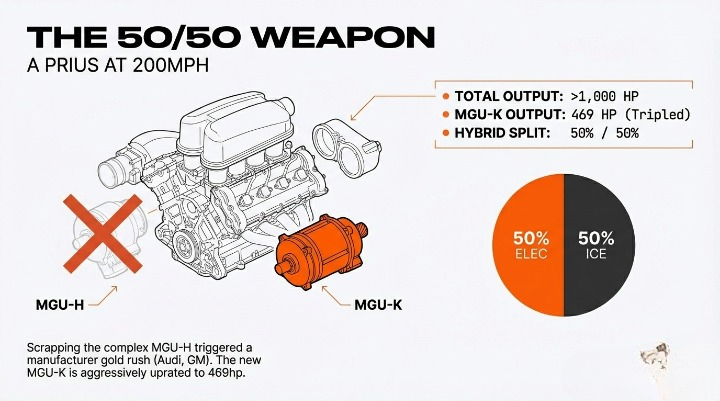
In its place, the MGU-K, the kinetic energy recovery unit, has been aggressively uprated. It now produces 469 horsepower, up from roughly 160 horsepower previously, targeting a genuine 50/50 split between combustion and electrical power.
The analogy is straightforward. Imagine a hybrid family car. Now make it produce over 1,000 horsepower, hit 200mph, and force the driver to manage every single kilowatt of that electrical battery in real time. Braking charges it. Straights drain it. Every decision cascades across the next five laps.
Furthermore, scrapping the MGU-H triggered a manufacturer gold rush. Audi entered as a full works team following their Sauber takeover. Cadillac, backed by General Motors, arrived as the 11th team on the grid. One deleted component transformed the competitive landscape entirely.
This is not a hybrid system anymore. It’s a 50/50 weapon.
Active Aero — The Bird That Killed DRS
Forget everything you knew about DRS. That creaking rear-wing flap system, available only on designated zones and only if you sat within one second of another car, is gone. Active Aero replaces it entirely, dynamically adjusting both front and rear wings depending on exactly where the car sits on the circuit.
Think of a bird hunting prey. Diving at full speed, it tucks its wings tight against its body to cut resistance and maximise velocity. The moment it needs to brake or turn, those wings spread wide to generate lift and control. The 2026 car does precisely this. Wings clamp shut in corners to maximise grip, then flatten open on straights to slash drag and boost top speed.
Crucially, this isn’t a privilege reserved for certain situations. Every driver gets it. Every lap. No gaps required.
The Nimble Car — From SUV to Go-Kart
The generation of F1 cars from 2022 to 2025 were extraordinary machines. They were also enormous. Heavy, wide, and demanding a surgeon’s precision through tight circuits. Melbourne’s Albert Park swallowed them whole. Consequently, teams arrived in Australia managing machines that felt, at times, more like ocean liners than racing cars.
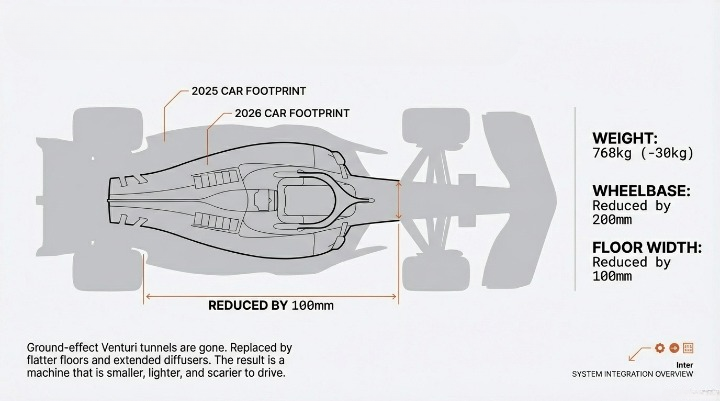
2026 crushed that problem. The minimum weight drops by 30kg down to 768kg. The wheelbase shrinks by 200mm. The floor narrows by 100mm. The analogy writes itself. Moving from a loaded family SUV to a stripped, lightning-quick go-kart. The responsiveness is sharper. Driver inputs have more immediate consequences, which means small mistakes become large incidents very quickly.
Additionally, the ground-effect Venturi tunnels that generated massive downforce under the floor from 2022 to 2025 are gone entirely, replaced by flatter floors and extended diffusers.
Smaller. Lighter. Scarier to drive. Brilliant to watch.
100% Sustainable Fuel — Running a Rocket on Recycled Rubbish
The quietest revolution of 2026 is arguably the most significant.
F1 cars will run exclusively on Advanced Sustainable Fuel, an independently certified blend produced from sources including carbon capture, municipal waste, and non-food biomass. Nothing in the fuel comes from crude oil.
The analogy here is wonderfully absurd and completely accurate. It’s like running a rocket ship on recycled salad. Agricultural waste, captured carbon from industrial emissions, and other second-generation sources are synthesised into a fuel blend that delivers the same energy output as the fossil-based fuel it replaced. ExxonMobil alone spent three years and ran over a hundred formulations to develop the fuel now powering Red Bull Racing’s cars.
Performance is unaffected. The planet, meanwhile, is being treated with considerably more respect.
Furthermore, F1’s commitment targets net-zero carbon emissions across all operations by 2030. All 22 cars burning sustainable fuel across all 24 races in 2026 represents the loudest single statement the sport has made toward that deadline.
Fast cars. Clean fuel. No compromise.
What All 5 Rules Mean Together
These five 2026 F1 Australian GP rules don’t operate independently. They interact. The lighter car benefits from the electrical surge of Overtake Mode because it weighs less to accelerate. Active Aero compounds the speed advantage on straights. The 50/50 hybrid means energy management decisions now shape entire race strategies, not just individual laps.
Here is what changes at Albert Park on March 8.
- Overtaking becomes more frequent because lighter, narrower cars create cleaner air behind them, and Overtake Mode fires targeted electrical attacks rather than relying on raw mechanical advantage alone.
- Energy management replaces tyre management as the dominant tactical conversation. Engineers will manage battery state-of-charge across 58 laps with the same obsession they once applied to tyre degradation windows.
- Smaller cars navigate the Albert Park chicanes with visibly sharper responses. The difference between a composed car and a nervous one will be apparent from lap one.
- Sustainable fuel means performance variance between teams partly depends on how well each fuel supplier, including ExxonMobil for Red Bull, Petronas for Mercedes, and Shell for Ferrari, optimised their blend across three years of development.
- Active Aero activation zones at Albert Park remain subject to the FIA’s final circuit file release. Teams are currently modelling multiple deployment scenarios from pre-season testing data.
Melbourne on March 8 isn’t just a race. It’s the first live proof that F1’s most ambitious overhaul in a generation actually delivers on its extraordinary promise.
The paddock whispers say it will. The timing screens will confirm it.



1 Comment