

The Formula 1 points system awards points to the top 10 finishers in every 2026 Grand Prix. First place earns 25 points, second gets 18, and tenth gets 1 point. Sprint races award additional points to the top 8 finishers. Over 24 races, these points decide both the Drivers Championship and Constructors Championship.
How Many Points Does Each Position Get in F1 2026
Since 2010, the F1 2026 points system has primarily used the 25-point scale for Grand Prix finishes. Formula 1 awards championship points to the top 10 finishers in every 2026 Grand Prix. First place gets 25 points, second gets 18, third earns 15, followed by 12, 10, 8, 6, 4, 2, and 1 point for tenth place. Anyone finishing 11th or below gets nothing.
The seven-point gap between first and second is crucial. It is why you wll see drivers take enormous risks to win rather than settle for second place. Across a full season, that difference compounds significantly.
One major change in 2025 eliminated the bonus point for fastest lap. That point was introduced in 2019, and through 2024 drivers who set the fastest lap while finishing in the top ten earned an extra point. However, after strategic manipulation at the 2024 Singapore Grand Prix where teams gamed the system, the FIA removed it. Teams can now score a maximum of 43 points per race instead of 44.
The 2026 F1 points distribution works as follows:
| Position | Points (Race) | Points (Sprint) |
|---|---|---|
| 1st | 25 | 8 |
| 2nd | 18 | 7 |
| 3rd | 15 | 6 |
| 4th | 12 | 5 |
| 5th | 10 | 4 |
| 6th | 8 | 3 |
| 7th | 6 | 2 |
| 8th | 4 | 1 |
| 9th | 2 | 0 |
| 10th | 1 | 0 |
With 24 races on the 2026 calendar, that is 600 points available from Grand Prix races. Add in sprint races, and the total climbs to 648 points.
How the Formula 1 Points System Has Evolved
The Formula 1 points system has changed several times since the championship began in 1950. Early seasons rewarded only the top five finishers, and only a driver’s best results from the year counted toward the title. A few poor weekends barely hurt a championship contender back then.
In 1991, F1 started counting every race and moved to a 10-6-4-3-2-1 scale for the top six finishers. That system held for over a decade. In 2003, the FIA expanded scoring to the top eight finishers to keep midfield battles alive during Michael Schumacher’s dominant run.
The current 25 point scale arrived in 2010, stretching points down to tenth place and widening the gap for a win. The points system has stayed largely the same since then, aside from sprint points joining the 2021 season and the fastest lap bonus disappearing in 2025.
How Do Sprint Races Award Points
Sprint races joined the 2021 season to add excitement to select weekends. These shorter races award points to the top eight finishers. 8 points for the winner, then 7, 6, 5, 4, 3, 2, and 1 for eighth place. The full F1 race weekend structure explains exactly how sprint weekends differ from standard rounds.
In 2026, there are six sprint weekends scheduled. That means sprint winners can collect an additional 48 points beyond the main races. For drivers in tight championship battles, those sprint points can prove absolutely crucial.
What Happens If an F1 Race Gets Stopped Early
Not every race goes the full distance. Weather or crashes sometimes force early stoppages, and F1 has detailed rules for awarding points based on race completion.
No points are awarded unless at least two racing laps are completed under green flag conditions. Once you cross that threshold, points are awarded on a sliding scale. Between 2 laps and 25% distance, only the top five score reduced points. Between 25% and 50%, the top nine score with 13 points for first. Past 50% but before 75%, the top ten score with 19 points for the winner. Once 75% or more is completed, full points are awarded.
This system ensures shorter races do not hand out the same points as full-distance events, maintaining sporting fairness.
How Do Constructors Championship Points Work
Formula 1 crowns two World Championship titles each season. The Drivers’ Championship rewards the top individual, and the Constructors’ Championship rewards the strongest team. Both titles share the same points, but each counts them in a different way.
For drivers, it is straightforward.Each accumulates points scored based on where they finish across the season. The Constructors’ Championship adds together both drivers’ points from each race. If Lewis Hamilton finishes first (25 points) and Charles Leclerc finishes third (15 points), Ferrari scores 40 constructor points total.
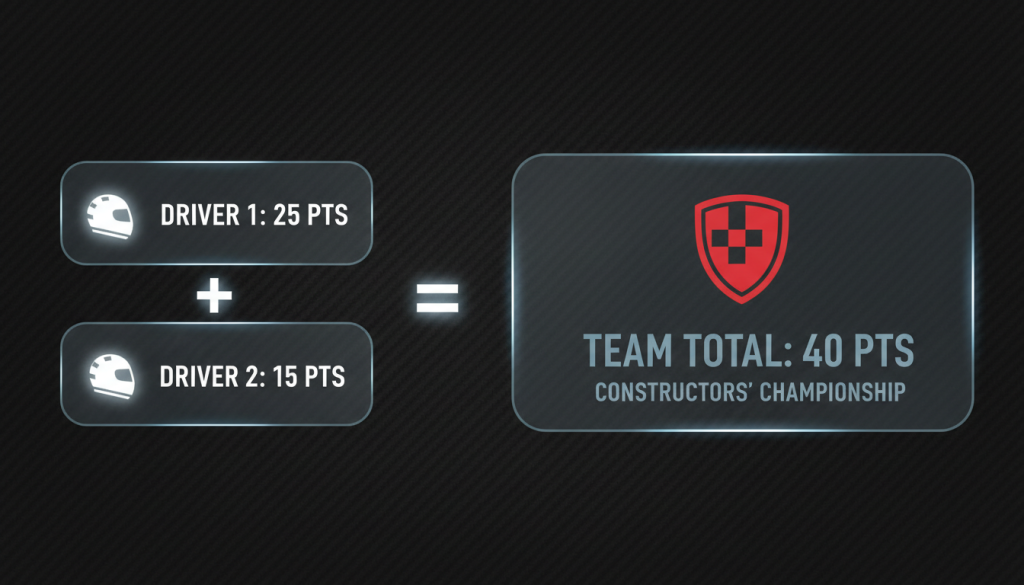
This creates interesting dynamics. A team can win the Constructors’ Championship even if neither driver wins the Drivers’ Championship. In 2024, McLaren clinched the constructors’ title while Max Verstappen won the Drivers’ Championship with Red Bull. That rivalry between Hamilton and Verstappen continues to shape F1 even under the 2026 driver lineup on the current grid.
What Are the Closest F1 Championships Ever
The drama of F1 points becomes crystal clear in actual championship battles decided by razor-thin margins.
2008. Hamilton vs Massa. One Point
Hamilton and Massa arrived at the final race in Brazil separated by seven points. Massa won the race and for about 30 glorious seconds thought he’d won the championship. But on the final corner of the final lap, Hamilton passed Timo Glock to grab fifth place and the one point he needed. Hamilton won the championship 98 to 97.
1984. Lauda vs Prost. Half a Point
The closest championship finish in F1 history. Lauda beat his McLaren teammate Prost 72 points to 71.5. How? The Monaco Grand Prix was stopped early due to rain, and rules then stated only half points would be awarded for shortened races.
2021. Hamilton vs Verstappen. Dead Even
After 21 races, they arrived at the final Grand Prix completely equal on points. The controversial final lap in Abu Dhabi, where Verstappen passed Hamilton to win both the race and championship, became one of F1’s most debated moments.
What Happens If Two Drivers Tie on Points
If two drivers finish the season with exactly the same points, F1 has tie-breaker rules ready:
- Most race wins: The driver with more Grand Prix victories becomes champion (sprint wins do not count)
- Most second-place finishes: If wins are equal, whoever has more runner-up results wins
- Most third-place finishes: Continue counting third places, then fourth, fifth, and so on
- Keep counting down: Move through positions until a difference is found
This has never been needed at the top of the standings in 75 years of Formula 1, but it did decide tied positions behind the champion in 2007.
Why Do F1 Points Matter Beyond Winning
Points translate directly into financial consequences. Teams receive prize money based on their constructors’ championship position, with differences between positions worth tens of millions of dollars. Even teams with no shot at winning the title fight desperately for every position because it funds their entire operation.
For drivers, points are career currency. Consistent points scorers become more valuable to teams regardless of whether they win races. Teams need both drivers scoring to maximize constructors’ points, so reliability can be worth more than occasional brilliance.
Now that the points make sense, find out exactly where to stream F1 so you never miss a single session. Unlike most points systems in sport, the Formula 1 points system uses a tiered scale where the gap between positions matters as much as the finish itself. The points are no longer a mystery. Every race, every overtake and every pit stop now carries real meaning. That understanding transforms casual viewing into something far more exciting for any fan entering the F1 world.
FAQ
First place earns 25 points in a Grand Prix and 8 points in a Sprint race.
No. Only the top 10 finishers in a Grand Prix and top 8 in a Sprint race earn points.
The driver with more race wins becomes champion. If wins are equal, most second places decides it, then third places, and so on.

3 Comments