
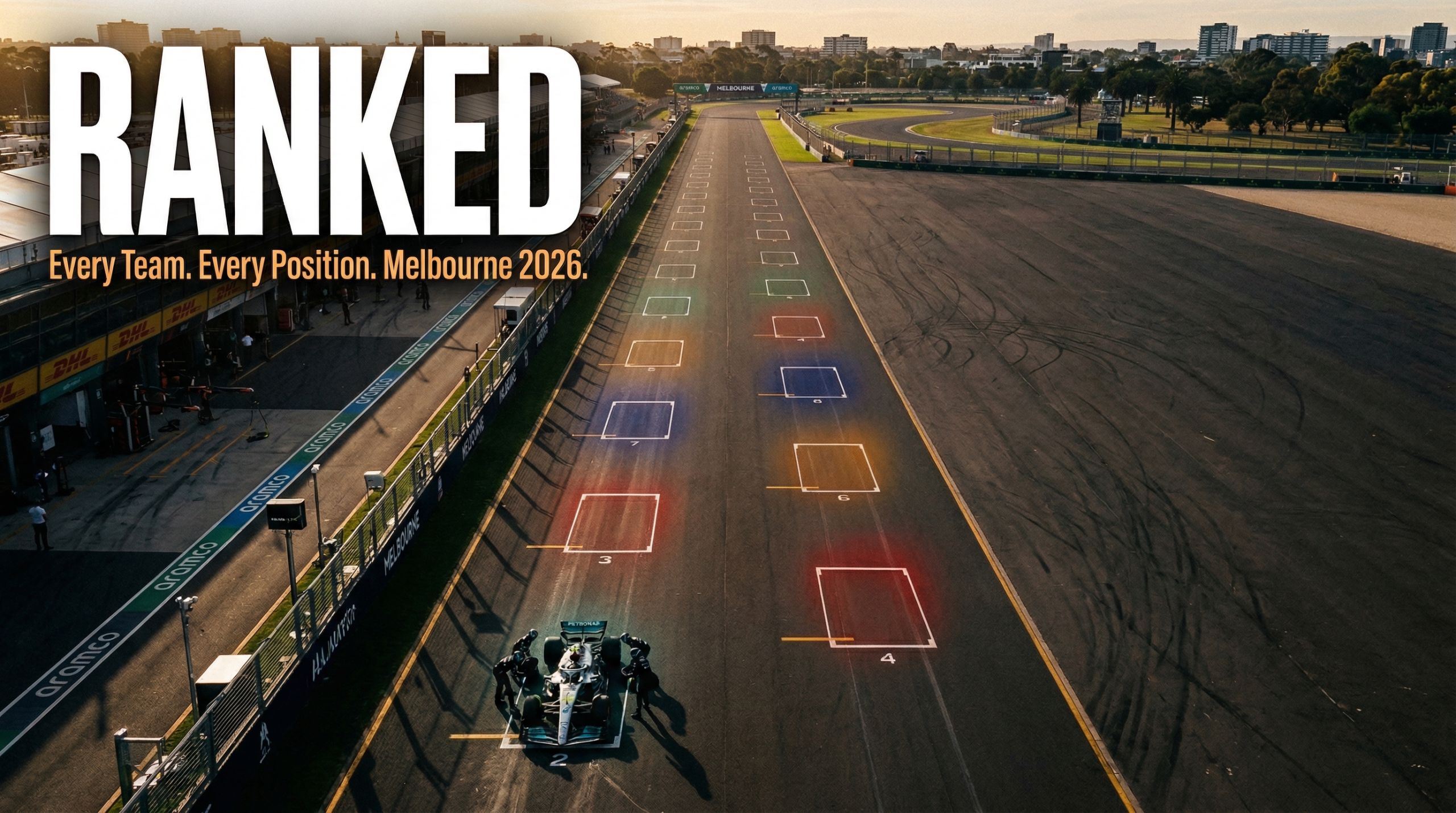
Pre-season testing is over. The data is in. The F1 2026 team rankings heading into Melbourne paint a picture that will make several team principals deeply uncomfortable. The regulation reset was supposed to compress the grid. Instead, it exposed which teams adapted and which teams gambled badly. Here is every team ranked from strongest to weakest based on Bahrain testing evidence alone.
Tier 1. The Teams Nobody Wants to Race
1. Mercedes
George Russell and Kimi Antonelli crushed Bahrain. Long-run pace looked dominant. Energy deployment appeared the most refined on the grid. Furthermore, the power unit advantage from the compression ratio controversy gives them an edge that rivals cannot match until June. Mercedes seized this regulation reset with more conviction than any other team.
2. Ferrari
Lewis Hamilton and Charles Leclerc showed genuine pace throughout testing. However, the car looked nervous under braking. Additionally, energy management appeared slightly less polished than Mercedes. Ferrari has raw speed but still needs calibration. The potential is enormous. The question is whether Melbourne arrives too soon for them to unlock it fully.
3. McLaren
Lando Norris arrives as reigning world champion. Oscar Piastri brings home-race hunger. The MCL40 ran an unusually low-downforce philosophy in Bahrain. Consequently, straight-line speed looked strong but mechanical grip through slow corners raised concerns. McLaren’s gamble might need two or three races to fully deliver.
Tier 2. Fast but Fragile
4. Red Bull
Max Verstappen’s talent alone dragged the RB22 into competitive times. However, the Red Bull 2026 engine suffered a dramatic meltdown at Bahrain that exposed fundamental cooling weaknesses.That Bahrain testing meltdown exposed cooling and deployment weaknesses that shocked even rival engineers. Furthermore, energy deployment clipped earlier than Mercedes in every long run. The car is fast in bursts but fragile over race distance.
Verstappen can win anywhere. But the car must survive 58 laps first.
5. Williams
Carlos Sainz brought structure and experience to a team that desperately needed both. Bahrain testing showed genuine midfield competitiveness. Moreover, reliability looked solid across both test weeks. Williams quietly completed more laps than several bigger teams. That data advantage matters enormously under new regulations.
6. Alpine
Pierre Gasly extracted respectable pace from the A526. Furthermore, the Mercedes customer power unit gives Alpine a proven foundation. However, chassis development appears to lag behind the leading midfield runners. Alpine will fight for points but the podium feels distant.
Tier 3. Questions Outnumber Answers
7. Racing Bulls
Yuki Tsunoda and Liam Lawson share the same RBPT-Ford power unit that melted down in the senior team’s car. Consequently, reliability concerns hang over both cars equally. Nevertheless, the chassis showed decent balance in Bahrain’s medium-speed corners.
8. Haas
The F1 2026 team rankings place Haas in a familiar position. Midfield but scrappy. The Ferrari customer power unit provides a solid baseline. Additionally, the smaller team structure allows faster decision-making under new regulations. Points are possible. Consistent points are unlikely.
Tier 4. Survival Mode
9. Sauber
Nico Hulkenberg leads the team through its transition toward full Audi ownership. However, the car looked heavy and underdeveloped in Bahrain. Furthermore, the Audi power unit raised more questions than it answered during testing. Mattia Binotto faces a massive rebuilding job that extends well beyond Melbourne.
10. Aston Martin
The dream team of Adrian Newey and Fernando Alonso produced a nightmare at Bahrain. The car ran 4.5 seconds off the pace. Honda’s power unit failed repeatedly. The AMR26’s aggressive packaging created cooling problems that consumed entire test days. Alonso threw his gloves down in frustration. The full timeline of Aston Martin’s 2026 collapse reveals problems far deeper than just one bad test.
The F1 2026 team rankings rarely place a Newey car this low. That alone reveals how badly things have gone. Furthermore, Newey confirmed the team will likely limit race stints because severe car vibrations risk nerve damage to both drivers. Alonso faces a 25-lap maximum. Stroll can manage just 15. In a 58-lap race, those limits force multiple extra pit stops that destroy any remaining competitive hope.
11. Cadillac
The newest team finished last across every meaningful metric. 59 combined laps. A 4.7 second deficit to Russell. Sensor failures between the Ferrari power unit and Cadillac chassis created cascading electronic problems. The $200 million investment has not yet produced a car that functions as a cohesive whole.
Melbourne will be painful for the American dream.
Why These Rankings Could Be Completely Wrong
Every ranking above carries one massive caveat. Nobody pushed their true limits in Bahrain. Mercedes could be sandbagging. The question of who was really sandbagging at Bahrain haunts every prediction heading into Melbourne. Ferrari could unlock their braking issues overnight. Red Bull could fix cooling problems before qualifying. Furthermore, wet weather in Melbourne would scramble this entire order within seconds.
These rankings represent the best available evidence. The evidence could be lying. That is exactly what makes the Australian GP unmissable.


1 Comment