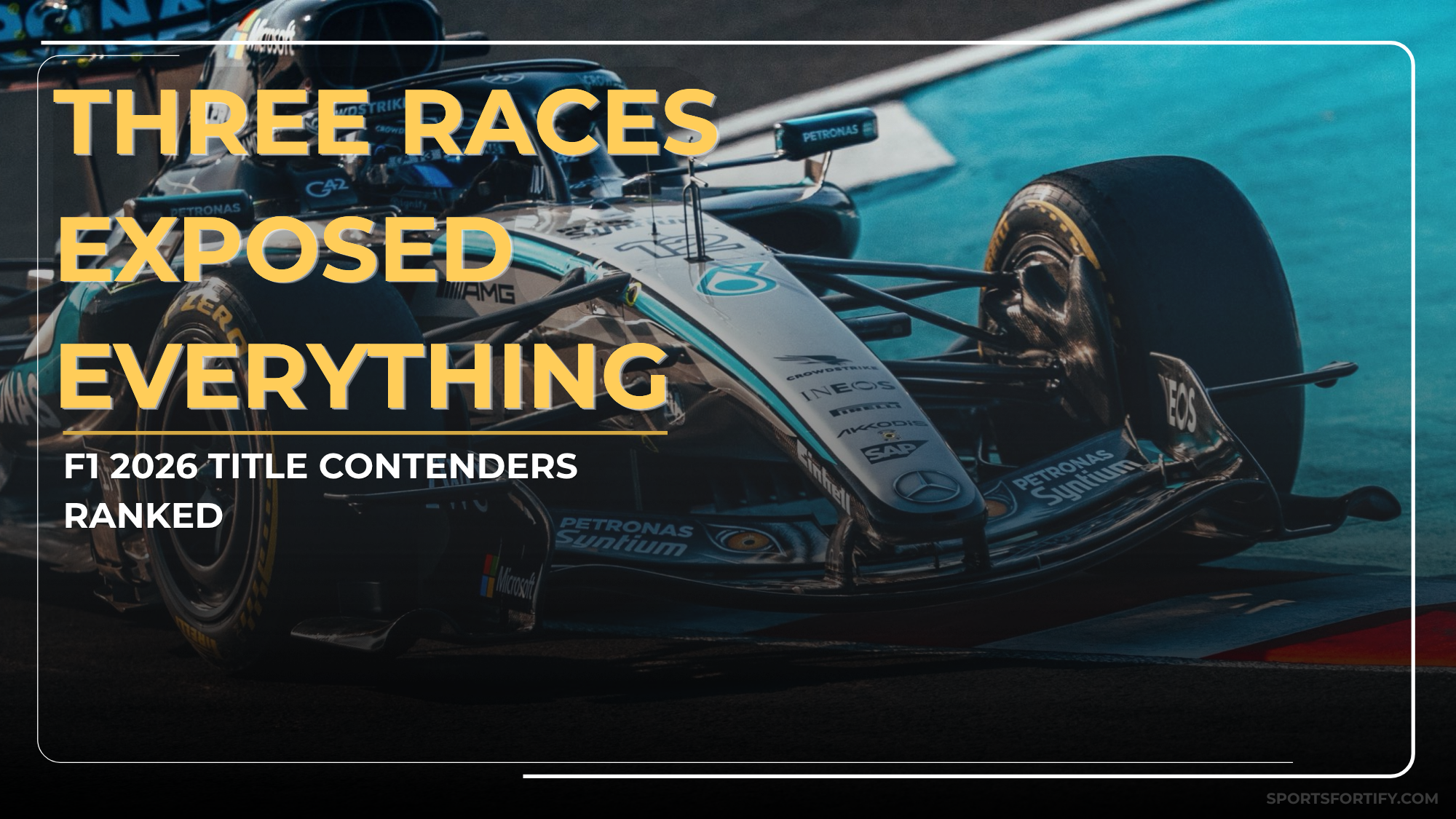
Three races. Three dominant weekends. One team standing alone at the top of the F1 2026 title contenders picture with a 45 point gap that already feels structural. Mercedes swept Australia, China, and Japan with machine like efficiency, collecting three wins and multiple one-two finishes. Kimi Antonelli leads the drivers’ standings on 72 points. George Russell sits nine points behind at 63.
The silver cars have turned the opening chapter of this new regulation era into a personal showcase.
The Numbers That Tell the Full Story
Mercedes holds 135 constructors points after three rounds. Ferrari sits second on 90. McLaren is third on 46, already 89 points adrift of the leaders. Those gaps carry more weight than they appear to in late March. Historically, in regulation reset years like 2009 and 2014, the team leading after three races held that advantage all the way through.
Mercedes won 16 of 19 races in 2014. Additionally, the Silver Arrows retained their edge again in 2017 after major aero rule changes. The 2022 exception exists, and it matters. Red Bull recovered from a slower start under ground-effect rules to completely dominate the season.
However, that recovery consumed months of development and a significant chunk of the calendar. Furthermore, no team in that field faced the scale of power unit upheaval currently swallowing Red Bull and McLaren whole. Early patterns in regulation reset years are rarely random, and this one already carries the hallmarks of a runaway.
Why Ferrari Cannot Close the Gap Yet
Ferrari’s Frederic Vasseur has publicly quantified the problem. The Scuderia sits four to five tenths behind Mercedes on the straights, a deficit almost entirely rooted in the power unit. Leclerc has scored consistently and holds third in the drivers’ standings on 49 points. Hamilton grabbed his maiden Ferrari podium in China and sits fourth on 41.
The chassis clearly works. Nevertheless, power unit shortfall bleeds time on every long straight, at every circuit, across every single lap of the season.
Ferrari’s ADUO upgrade is expected to unlock measurable straight line gains post Miami, aligning with the new technical directive window. Consequently, the real stress test for the Scuderia arrives deep in the season’s second phase when Monaco, Barcelona, and Austria expose every gap in the performance envelope. Moreover, the chassis foundation is strong enough to capitalise immediately if the engine upgrade delivers on its projected numbers.
The question is not whether Ferrari can close the gap. The question is whether they close it before Mercedes builds the gap wider.
The Compression Ratio Wildcard Nobody Should Ignore
Mercedes is suspected of exploiting a thermal expansion loophole buried inside the current compression ratio regulations. The rules cap the ratio at 16 to 1, measured cold. When the engine reaches operating temperature, that effective ratio reportedly climbs higher, delivering additional power outputs the regulations never intended to permit.
The FIA closes this loophole on June 1, switching to a hot measurement at 130 degrees Celsius. The directive represents the single most significant mid season regulation intervention in recent memory.
The paddock is watching the timeline far more closely than the public response suggests. Vasseur himself dismissed the rule change as unconvincing as a game changer, which carries its own implications for where Ferrari believes the real performance gap originates. Nevertheless, if even two to three tenths disappear from Mercedes’ straight-line advantage after June 1, the entire constructors’ fight reshapes overnight.
Furthermore, the directive lands between Monaco and Barcelona, two circuits that test completely different performance dimensions and could amplify whatever shift the engine change triggers.
McLaren’s Disaster Season Hiding a Real Car
McLaren arrived in 2026 carrying the constructors’ title and immediately suffered a catastrophic opening three rounds. Both cars failed to start in Australia. Neither made the Chinese Grand Prix grid, marking the first double DNS since 2005 caused by separate Mercedes power unit battery failures on the same weekend. Then Oscar Piastri crossed the line second at Suzuka in what was effectively the team’s first genuine race start of the entire year.
Consequently, the car itself is not slow. The power unit supply issues cost McLaren weeks of data and dozens of available championship points.
The deficit stands at 89 points with 21 races remaining, and mathematical elimination remains a distant prospect. However, the development time lost during those opening failures cannot be fully recovered. Andrea Stella confirmed the drivers carried the right mindset to rebound, and Piastri’s Suzuka podium validated the chassis competitiveness immediately. Meanwhile, Norris sits fifth with 25 points and no realistic championship narrative yet attached to his season.
The underlying potential is present. The scoreboard, for now, tells a different story entirely.
Max Verstappen and a Car He Cannot Tame
Verstappen described the RB21 as driving like Formula E on steroids, citing energy management demands, constant downshifting requirements, and aggressive lift and coast instructions as fundamentally alien to his driving style. The four-time champion sits ninth in the drivers’ standings on just 12 points after three rounds. A coolant fault retired him in China before the race reached half distance, compounding an already bruising points tally.
Red Bull introduced a fresh aero package at Suzuka, but the underlying power unit instability remains structurally unresolved after three race weekends.
Team principal Laurent Mekies warned before the season even started to bear with the team through the opening months, flagging a new power unit philosophy that carried significant development risk. Moreover, the RB21 suffers balance issues Verstappen himself called unsustainable alongside tyre degradation problems that prevent consistent qualifying pace. Red Bull recovered rapidly in 2022 under ground-effect regulations, but that recovery built on an existing engine programme.
This time the Ford power unit is entirely new territory. The recovery timeline is genuinely uncertain, and the calendar is already moving forward.
Who Actually Belongs in the F1 2026 Title Contenders Conversation
Three races have ruthlessly separated genuine challengers from optimistic projections made in pre-season paddock conversations. Mercedes operates at a categorically different level, with both drivers capable of winning on any given weekend and the constructors’ gap already measuring 45 points over Ferrari.
Leclerc and Hamilton give Ferrari authentic threat potential once the engine upgrade materialises, making the Scuderia the only team currently capable of mounting a structured title challenge against the Silver Arrows across a full season. McLaren has one podium from one completed race start and a points mountain requiring consistent results over the next ten rounds to make meaningful impact.
Red Bull is rebuilding under an entirely new power unit philosophy and needs several more rounds before threatening consistently at the front. Meanwhile, Oliver Bearman has quietly accumulated 17 points for Haas, making him the most unexpected name inside the top ten. Betting markets price Russell and Antonelli as joint favourites.
Leclerc sits at 1400 to 1. That spread exposes the reality without sentiment.
What Miami Changes and What It Cannot
Miami arrives as a sprint weekend, delivering bonus points and critical additional development data before the June regulation window opens. Furthermore, it represents the final major opportunity for teams to close technical gaps ahead of the compression ratio directive that reshapes the engine performance order on June 1. Ferrari needs the ADUO package to land cleanly. Red Bull needs a weekend without reliability failure. McLaren needs a clean start.
Mercedes needs nothing at all from a team that already mastered these regulations across three consecutive dominant weekends.
The gap between the F1 2026 title contenders exists in the data, in the standings, and in the performance margins every lap produces. History in regulation reset years suggests the gap holds. The only genuinely open question is whether the mid-season rule change forces anyone to rewrite that conclusion before the summer break arrives.
Additionally, sprint weekends in Miami, Canada, and Great Britain accelerate the points accumulation curve in ways that will punish any team suffering a single reliability failure at the wrong moment.
The next chapter starts in Florida. The story, however, already has a clear early protagonist.