
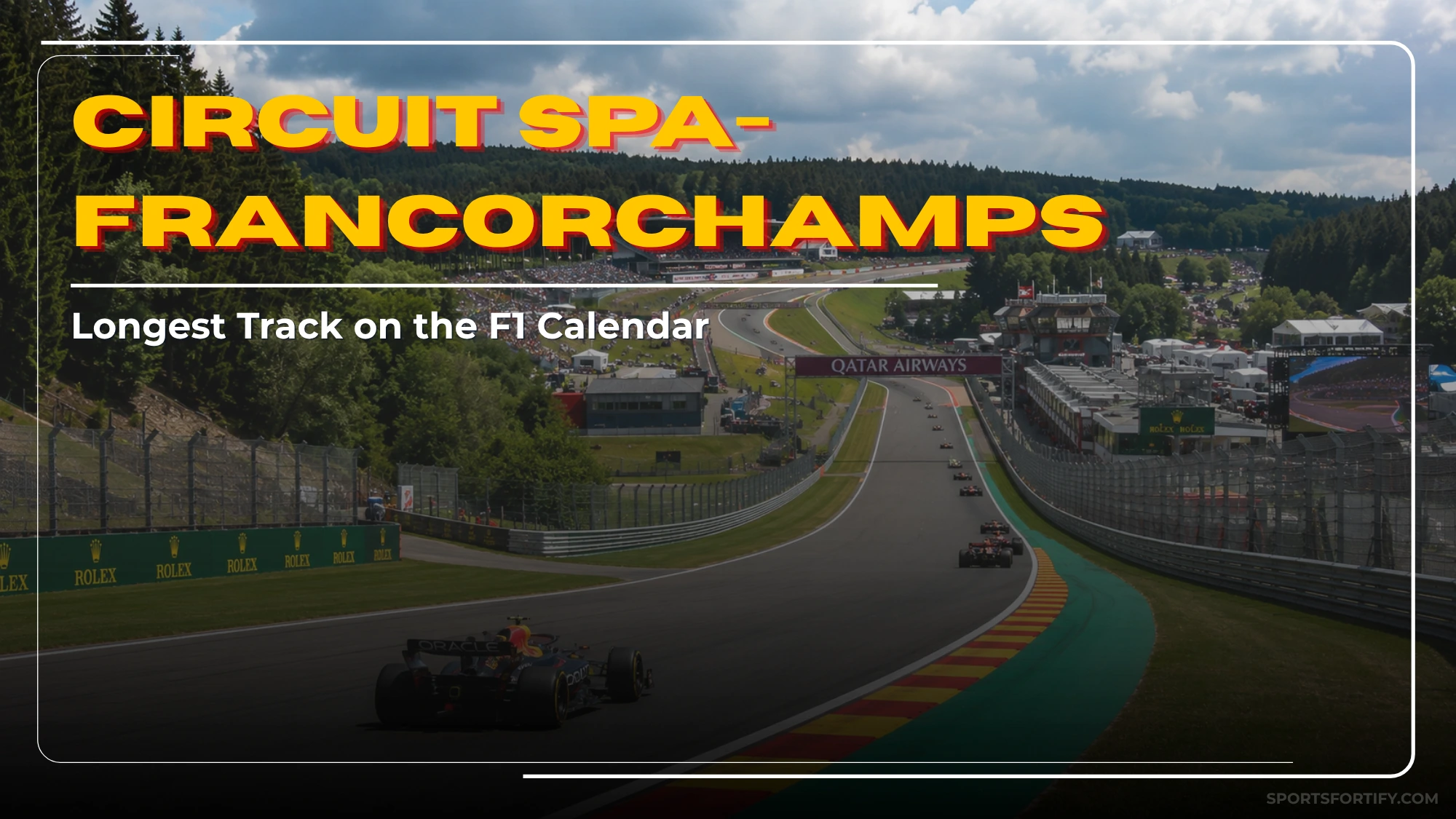
WHAT IS THE CIRCUIT OF SPA-FRANCORCHAMPS?
The Circuit of Spa-Francorchamps is a 7.004km Formula 1 track cut into the Ardennes forest in Belgium. Officially named Circuit de Spa-Francorchamps, it holds FIA Grade 1 certification and takes in over 70,000 spectators across a Grand Prix weekend. So this is not a small regional track. It carries a nickname few circuits earn, often called the most beautiful circuit in the world.
Spa opened in August 1921 as a triangular road circuit built from public roads near Francorchamps, Malmedy and Stavelot. The track joined the Formula 1 World Championship calendar in 1950 and has hosted the Belgian Grand Prix in most seasons since. Beyond Formula 1, Spa also runs the Spa 24 Hours, the WEC 6 Hours of Spa and the 8 Hours of Spa Motos across its full annual event calendar.
WHERE IS THE SPA CIRCUIT IN BELGIUM?
The Circuit of Spa-Francorchamps sits inside the Ardennes forest in the province of Liège, Belgium, between the villages of Francorchamps, Malmedy and Stavelot. Its coordinates place it at 50°26′14″N 5°58′17″E. The circuit address runs Route du Circuit 55, B-4970 Francorchamps, with a second listed address at Route du circuit 36, 4970 Francorchamps.
Getting there means planning around a rural forest road network rather than a city grid. The 2026 Belgian Grand Prix weekend runs July 17 to 19, and Bronze grandstand tickets start from just €100, among the most affordable entry points on the entire F1 calendar. That price point, combined with the camping culture around the circuit, makes Spa a genuine budget option despite its prestige.
HOW LONG IS THE CIRCUIT OF SPA-FRANCORCHAMPS?
Yes, Spa-Francorchamps is the longest circuit on the current F1 calendar at 7.004km per lap. A full Grand Prix distance covers 44 laps and 308.052 km. That lap length is roughly a third longer than most modern F1 tracks, which is why a Spa lap takes noticeably more time than a lap almost anywhere else on the schedule.
The circuit has not always run this length. Early configurations measured 14.9km, then 14.982km, then 15.820km across different eras of the public road layout. Even the shortened modern circuit has shifted slightly over time, moving through 6.947km, 6.985km and 6.9km configurations before settling at today’s 7.004km following the 2007 redevelopment.
CIRCUIT DE SPA-FRANCORCHAMPS HISTORY
Origins on the Ardennes Public Roads
Jules de Thier and Henri Langlois van Ophem designed the original triangular circuit using public roads through the Ardennes in 1921. The first race held there was a motorbike event, run at an average of 88.9 km/h. Then in 1922 the first car race followed, with Antonio Ascari among the early competitors on a 15km layout.
Baron Joseph de Crawhez pushed hard for the circuit’s creation and helped secure the roads through Francorchamps, Malmedy and Stavelot. The region itself carries deeper history. Malmedy and the wider Eupen-Malmedy area only became Belgian territory after the Treaty of Versailles and a 1920 plebiscite, having been German territory before the First World War.
Spa held a non-championship Grand Prix in 1924 at 14.9km. Then in 1925 it staged its first official Belgian Grand Prix as a round of the European GP series, with Alfa Romeo taking the win. That result set the tone for a circuit that would go on to define entire eras of Grand Prix racing.
From Full Circuit to Modern Layout
The old public road circuit ran up to 14.982km through the 1920s and 1930s, much of it unpaved dirt track before a wave of tarmacking through the late 1920s and into 1939. Spa entered the Formula 1 World Championship in 1950 still running close to its full public road length, with the old circuit staying largely intact through the 1950s, 60s and into 1970.
Driver safety became the defining issue by the late 1960s. Jackie Stewart’s 1966 crash at the notorious Masta Kink, a fast kink on the old public road section, left him trapped in his car in the rain. That crash pushed Stewart to become one of the sport’s most vocal safety campaigners. Even so, the old full circuit continued hosting F1 until 1970.
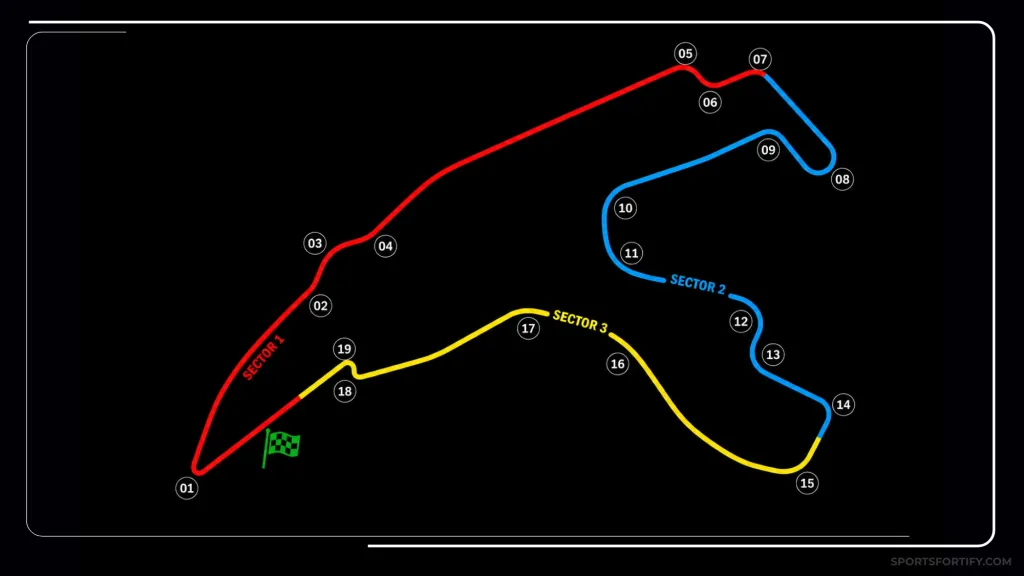
Once that happened, F1 stayed away from Spa for over a decade while safety works, a protective wall and a shorter circuit took shape. The modern 6.9km layout opened in 1979, and F1 returned for good in 1983. On top of that, the Bus Stop chicane, La Source hairpin and Raidillon complex all date from this modern era rather than the original public road design.
A 2007 redevelopment rebuilt the pit lane and pit infrastructure. Then a further 2022 redevelopment widened key sections and added new safety works around Eau Rouge and Raidillon, which shifted the circuit from 19 turns to its current 20. That change followed further Bus Stop reprofiling between 2021 and 2023, the last piece of the puzzle that shaped the layout drivers race on today.
KEY CORNERS AT SPA-FRANCORCHAMPS
Circuit Quick Facts
| Stat | Detail |
|---|---|
| 🏁 Circuit Length | 7.004 km |
| 🔄 Number of Laps | 44 |
| 📏 Race Distance | 308.052 km |
| ↩️ Number of Turns | 19 |
| ⚡ F1 Lap Record | 1:44.701 (Sergio Pérez) |
| 🏆 FIA Grade | Grade 1 |
| 👥 Spectator Capacity | 70,000 |
| 📅 First Grand Prix | 1950 |
| 🏗️ Circuit Opened | 1921 |
| 📍 Closest City | Liège |
| 🕐 Time Zone | CEST (UTC+2) |
| 💶 Currency | EUR |
Eau Rouge and Raidillon
Eau Rouge and Raidillon form one continuous corner complex and remain the most famous sequence in Formula 1. The combined corner runs uphill through a high-speed left-hander at well over 300 km/h. Because of this, it doubles as both a physical test and a psychological one, since a driver committing fully has almost no margin for error.
La Source and Les Combes
La Source is the slowest corner on the lap, a tight hairpin that opens the circuit right after the start line. From there, the track climbs through Eau Rouge before flattening out toward Les Combes, the circuit’s main overtaking spot heading into the middle sector. Rivage follows shortly after, a downhill right-hander that keeps the rhythm demanding.
Pouhon Blanchimont and the Bus Stop
Pouhon is a fast, sweeping double-left that tests a car’s high-speed balance more than almost any other corner at Spa. The lap then runs through the Fagnes and Campus sections before reaching Blanchimont, a high-speed left-hander taken flat by the fastest cars. The lap closes through La Chicane, better known as the Bus Stop, the final corner before the pit straight.
NOTABLE WINNERS AT SPA-FRANCORCHAMPS
Spa has crowned Grand Prix winners across a span running from the early 1950s through to 2025, and the list reads like a history of the sport itself. Juan Manuel Fangio and Nino Farina won here for Alfa Romeo in the championship’s early years, while Alberto Ascari added his name for Ferrari shortly after.
Jim Clark then took four consecutive Belgian Grand Prix wins between 1962 and 1965, a run that still stands out even among Spa’s legendary names. Ayrton Senna dominated here through the 1980s and 1990s, but it was Michael Schumacher who built the circuit’s most complete record, winning across multiple seasons through his career.
More recently, Kimi Räikkönen, Sebastian Vettel, Nico Rosberg, Damon Hill and Daniel Ricciardo have all added Spa wins to their résumés. Charles Leclerc’s 2019 win came during one of the most emotional weekends in the sport’s recent history. Max Verstappen, Lewis Hamilton, and the McLaren pairing of Oscar Piastri and Lando Norris, who took a 1-2 finish here in 2025, all carry Spa wins into the modern era.
SPA-FRANCORCHAMPS WEATHER
Spa sits under an oceanic climate with real continental influence, and that combination makes weather the circuit’s most unpredictable variable. Average highs reach around 31°C in summer, or 88°F, based on 1981 to 2020 climate normals. Rain arrives often enough that a fully dry session at Spa is never guaranteed even in July.
Because of this, grip levels can shift lap to lap as a dry track turns wet or a wet track starts to dry. Pack a waterproof jacket, a waterproof bag and waterproof footwear regardless of the forecast. Sunscreen and a hat still matter too, since sunshine hours can arrive just as quickly as the rain. Spare clothes are worth the extra bag space. Live conditions are trackable through weather tools like windy.com throughout the weekend.
HOW TO GET TO THE CIRCUIT DE SPA-FRANCORCHAMPS
The circuit address runs Route du Circuit 55, B-4970 Francorchamps, with contact available at +32 087 29 37 00. A secondary listed contact number is +32 87 22 44 66. Because the circuit sits deep in the Ardennes forest, mobile network coverage can be patchy in places, so downloading offline maps and offline tickets in advance is worth doing before travel day.
Cash and cards are both accepted on site, though food stalls and general circuit policy restrict glass containers and cooking equipment inside the grounds. Ear protection is worth packing given the trackside noise levels, especially close to the Eau Rouge and Raidillon grandstands. Non-alcoholic drinks are permitted through entry, and a clear meeting point is worth agreeing with your group in advance given the size of the site.
SPA-FRANCORCHAMPS GRANDSTANDS GUIDE
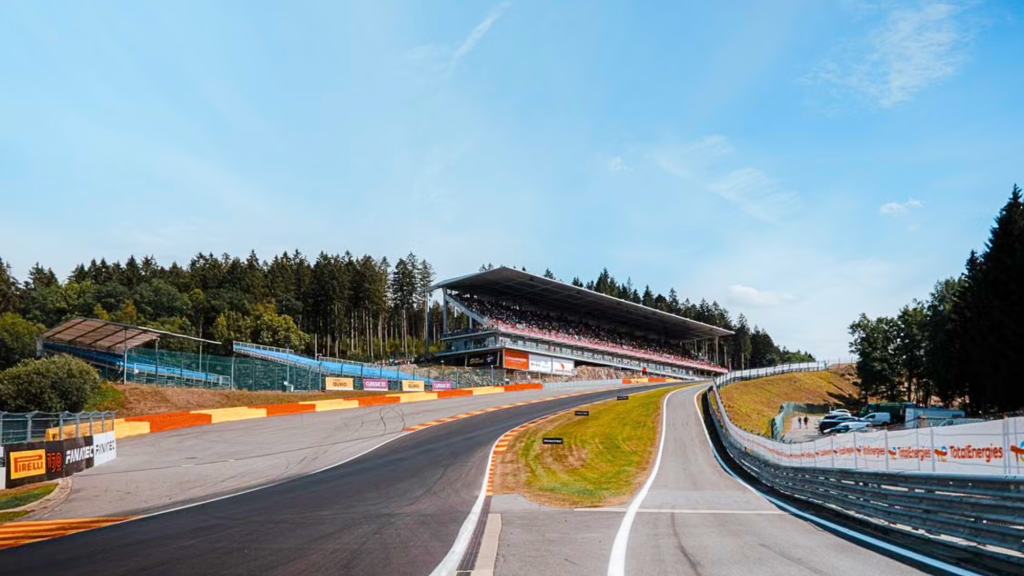
Spa’s grandstands spread across a circuit long enough that no single position covers more than a fraction of the lap, so choosing a spot means choosing a moment in the race. The Champions Club Eau Rouge and Gold 3/4 Eau-Rouge grandstands sit right at the circuit’s most famous corner complex, with the elevated Loge Raidillon giving a higher vantage point over the same climb.
The Combes Grandstand covers Les Combes, the circuit’s main overtaking zone, while the Pouhon grandstand gives panoramic sightlines across the fast double-left further round the lap. For the final chicane, Gold 6 Chicane puts fans right at the Bus Stop for late-race passing attempts. New covered grandstands are part of the wider €80 million upgrade at Spa, including a new Silver 7 Grandstand for the 2026 event, which means fans booking early get more shelter options than ever against the unpredictable Ardennes weather.
Camping remains part of the Spa identity in the same way it does at the Red Bull Ring. Options include Green camping, Yellow camping, Masta camping, Young Village and glamping for fans who want comfort without giving up the on-site experience. The 17-27 Area and Mezzanines add further standard viewing options for fans working with a tighter budget.
2026 UPDATES AT SPA-FRANCORCHAMPS
Spa heads into the 2026 Belgian Grand Prix, running July 17 to 19, off the back of its €80 million upgrade programme. Blanchimont has been resurfaced, and the Bus Stop chicane reprofiling completed between 2021 and 2023 is now fully bedded in. Extended night hours and a bigger Combes Fan Zone, complete with shops and simulators, are part of the 2026 fan experience.
Spa’s identity beyond Formula 1 keeps growing too. The CrowdStrike 24 Hours of Spa remains the circuit’s biggest endurance date outside the Grand Prix, alongside the ELMS 4 Hours of Spa and the FIM Endurance World Championship’s 8 Hours of Spa Motos. Even cycling gets its moment here through the 8H Velo Spa and the Raidillon Cycling Challenge. Aston Martin has even named a special edition Vantage S Spa-Francorchamps after the track, a small sign of how far the circuit’s reputation reaches beyond racing itself.
READ NEXT
Austrian Grand Prix 2026 Race Guide Red Bull Ring Circuit Guide Belgian Grand Prix 2026 Race GuideFREQUENTLY ASKED QUESTIONS
Yes, the Belgian Grand Prix is commonly called Spa after the Circuit of Spa-Francorchamps where it takes place. The official race name is the Formula 1 Moët & Chandon Belgian Grand Prix, but fans and media almost always refer to it simply as Spa.
Yes, at 7.004km per lap, Spa-Francorchamps is the longest circuit on the current Formula 1 calendar. A full race distance covers 44 laps and 308.052 km, and each lap takes noticeably longer than at any other current F1 venue.
Yes, Ayrton Senna won at Spa-Francorchamps multiple times during his career, and his performances there through the 1980s and into the 1990s remain among the most celebrated drives in the circuit’s history.
The Spa circuit is located in the Ardennes forest in the province of Liège, between the villages of Francorchamps, Malmedy and Stavelot. Its full address is Route du Circuit 55, B-4970 Francorchamps, Belgium.