WHAT IS THE RED BULL RING?
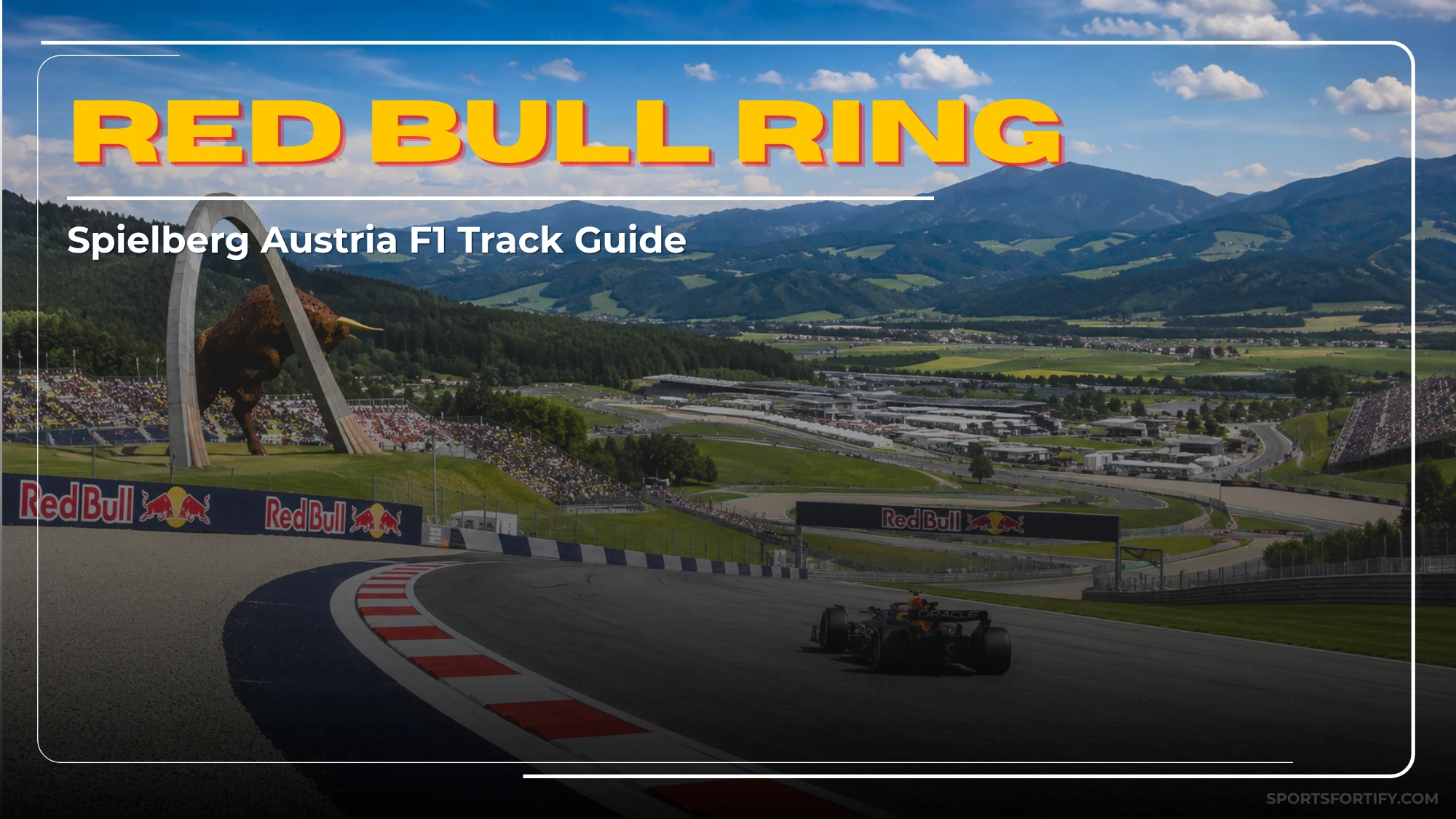
The Red Bull Ring hosts the Austrian Grand Prix. Located in a scenic Styrian natural bowl, the 4.326 km Red Bull Ring is one of F1’s shortest and most exciting circuits, featuring high-speed straights and corners that produce the calendar’s fastest lap times. It is a full mechanical sports complex built into the Austrian countryside, surrounded by the Styrian mountains. No other venue on the F1 calendar combines alpine scenery with this kind of raw race action.
The Red Bull Ring has a character that traditional European race tracks with international city glamour cannot replicate. The sea of orange from travelling fans camping at the track, the European vibe that carries from the Belgian GP at Spa, and the music festival-like atmosphere make every Austrian GP weekend feel like a summertime event. The sound of Formula 1 cars cutting through the natural bowl carries across the Styrian hills. It is old school Grand Prix experience in a modern racing shell.
WHERE IS THE RED BULL RING?
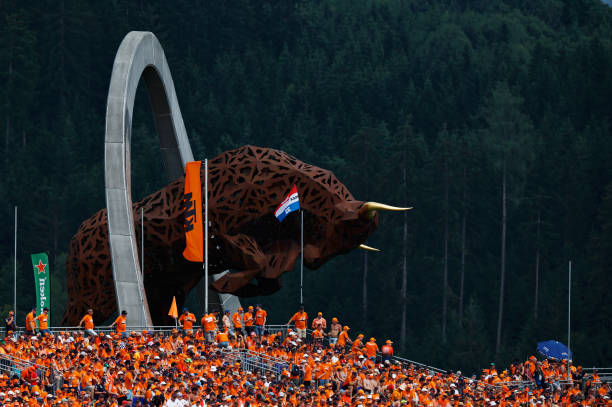
The Red Bull Ring is located in Spielberg, in the mountainous province of Styria in south-eastern Austria. The circuit sits in the Styrian mountains roughly 50 km from Graz and approximately 200 km from Vienna. The Flughafen Graz is the closest airport. Shuttle buses from the Murtal region run throughout the 2026 Austrian Grand Prix weekend, with the long-distance service running across all three days for a flat fee of €35. Camping on the event grounds is also available for fans coming from outside the region.
HOW LONG IS THE RED BULL RING?
The Red Bull Ring measures 4.326 km per lap. A full Grand Prix distance covers 71 laps and 306.452 km in total. The circuit has just 10 corners. Maximum speeds on the main straight reach 327.4 km/h. The current F1 lap record stands at 1:07.924, set by Oscar Piastri.
Red Bull Ring Circuit Stats
Circuit Quick Facts
| Stat | Detail |
|---|---|
| Circuit Length | 4.326 km |
| Number of Laps | 71 |
| Race Distance | 306.452 km |
| Number of Turns | 10 |
| F1 Lap Record | 1:07.924 Oscar Piastri (McLaren) |
| Max Speed | 327.4 km/h |
| Most F1 Wins | Alain Prost (3) |
| First F1 Race | 1970 |
| Closest Airport | Flughafen Graz |
| Time Zone | CEST (UTC+2) |
| Currency | EUR |
| Language | German |
| Average July Temp | 23°C |
RED BULL RING CIRCUIT HISTORY
The Osterreichring Era
Motor racing in Spielberg began in 1969 at the Zeltweg airfield circuit on the outskirts of the town of Spielberg. The Osterreichring opened in 1970 as a fearsome 5.942 km circuit of long and fast turns, three straightaways, and bursts of speed that were considered dangerous for single-seaters.
It hosted the Austrian Grand Prix from 1970 to 1987 and was a favourite among racers. Max Verstappen won five times at the circuit, a record that still stands for most wins at the Austrian Grand Prix.
Formula 1 abandoned the Osterreichring after 1987. The much-loved original track fell into disuse and the mechanical sports complex became a test circuit and training facility. There were rumoured plans to revert to the old track layout across various eras, but nothing materialised. The fearsome Osterreichring remained a memory. Its province of Styria would wait years before F1 returning to the Austrian countryside.
The A1-Ring Era
German race architect Hermann Tilke was engaged to turn the abandoned site into a modern replacement during the winter of 1995-96. Tilke partially demolished the original circuit, renovated the site, and created a shorter 4.326 km track that opened in 1996.
Jacques Villeneuve won the first race at the renamed A1-Ring, with Benetton and Ferrari also prominent across the era. Jean Alesi, Eddie Irvine, and Gerhard Berger all featured on the A1-Ring podium before the circuit disappeared from the calendar in 2003, with Mika Raikkonen winning the final race. F1 retirement from Austria followed once again in 2005.
The Red Bull Ring Returns
Red Bull owner Dietrich Mateschitz purchased the abandoned circuit and commissioned a full renovation that reopened the venue in 2011. Tilke was engaged again to transform and rebrand the complex. Formula 1 returned to Spielberg in 2014 after an 11-year absence from the Austrian Grand Prix, as the circuit appeared on the calendar as a permanent mainstay.
The redesigned Red Bull Ring kept the character of the original Osterreichring natural bowl setting while increasing overtaking opportunities and encouraging the bursts of speed that made the old circuit legendary. It has appeared on the calendar in consecutive seasons since its return
WHAT IS THE RED BULL RING LIKE?
The Red Bull Ring divides into two distinct halves. The first half covers the Grandstand Start-Ziel section and a pair of uphill right-handers that define the opening sequence. The circuit then goes through an exhilarating canyon through the infield before dropping downhill through a series of quick corners.
The track rewards power above all other qualities. It is very narrow in places, which concentrates race action and makes every hundredth of a second critical to lap time. Aston Martin’s Lance Stroll described the rhythm as addictive once drivers find it across practice sessions.
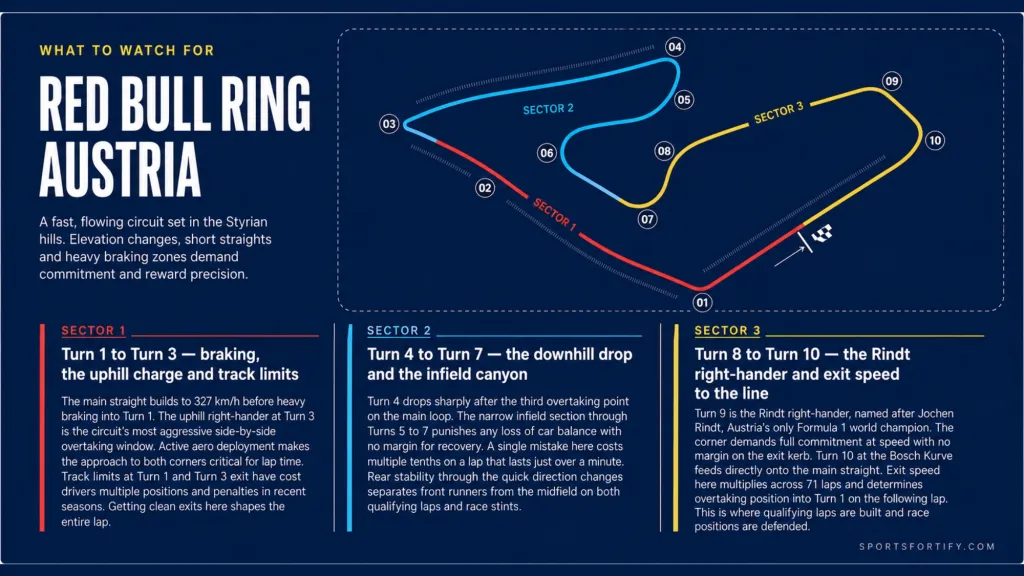
The very short lap means the circuit punishes mistakes with no recovery time. Drivers experience a regular toboggan ride sensation through the downhill section. The short and technical second half contrasts with the open first section.
Max Verstappen has dominated in front of his home Grand Prix crowd here partly because the circuit suits the Red Bull car and partly because the very good rhythm suits his aggressive driving style. The first career grand slam moments of several drivers have happened here because the intensity never drops across the full lap.
Three Straight Mode Zones and the Overtaking Opportunity
The 2026 regulations brought a complete overhaul to how overtaking works. The Red Bull Ring runs four Straight Mode zones, where the active aerodynamics open up on designated straights to cut drag and lift top speed for any car on track, not just the one behind. The traditional overtaking hotspots at Turn 3 and Turn 4 remain, but the overtaking battle now runs deeper than a wing flap.
Overtake Mode adds a second layer. A driver within one second of the car ahead at the detection point in the final sector earns an extra electrical power profile for the next lap, including an additional 0.5MJ to harvest and deploy. On a 4.326 km circuit with only 10 corners, that combination of extra speed on the straights and extra electrical firepower on demand makes race strategy unpredictable from the first lap through to the chequered flag.
The Rindt Right-Hander and Key Corners
The Rindt right-hander, named after Jochen Rindt, Austria’s first Formula 1 world champion, is the defining corner of the circuit. It demands full-speed commitment from drivers and separates the leaders from the grid. Turns 6 and 7 in the infield section test car balance and driver nerve simultaneously.
The Bosch Kurve final corner feeds directly onto the main straight. Exit speed there determines Straight Mode and Overtake Mode positioning on the following lap. Every single corner on this circuit connects directly to the outcome of the next one. The circuit’s history of dramatic moments at these corners shapes how drivers approach them.
Nico Rosberg and Lewis Hamilton collided on the last lap in 2016, fighting through the infield section at full race speed. Max Verstappen and Charles Leclerc tangled through Turn 3 in 2019 in a controversial contact that produced a penalty and a massive reaction from the crowd. The 2024 Austrian Grand Prix produced significant lap one incidents at corner entry that reshuffled the entire grid within seconds of the race start.
WHO OWNS THE RED BULL RING?
Red Bull owns the Red Bull Ring. Dietrich Mateschitz, the Austrian billionaire who co-founded Red Bull, bought the abandoned circuit and funded the full renovation that brought it back to the Formula 1 calendar in 2014. Red Bull branded the circuit under their name when it reopened in 2011 as the home of Red Bull Racing. The circuit operates as a year-round full mechanical sports complex and not just an F1 venue. Red Bull Racing uses the mountainous province of Styria as its spiritual home in Formula 1.
WHY IS IT CALLED THE RED BULL RING?
The circuit is called the Red Bull Ring because Red Bull owns it. The same site was called the Osterreichring in its original era and then the A1-Ring during its 1996 to 2003 period. Red Bull purchased the site, rebuilt it, and renamed it under their brand. The renaming also reflected the role of the venue as the home Grand Prix for Red Bull Racing. Spielberg sits in the mountainous province of Styria, the same Austrian region where Dietrich Mateschitz built the Red Bull brand from its earliest days.
RED BULL RING GRANDSTANDS GUIDE
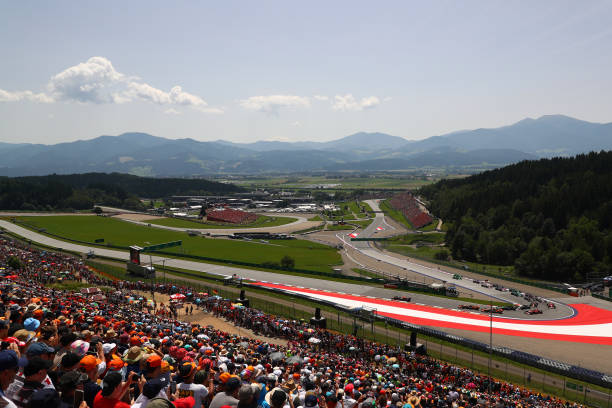
The Red Bull Ring grandstands cover the circuit from Turn 1 through to the Bosch Kurve and the start-finish straight. Each position gives a different angle on the race action. The undulating nature of the circuit and the idyllic natural bowl setting mean almost every grandstand has a view of multiple corners. The 2026 Austrian Grand Prix Pit Lane Walk ticket costs €50 and requires a valid weekend grandstand ticket. Limited availability means it sells out well ahead of June 26.
Best Grandstands for Overtaking Action
The T3 Grandstand sits at one of the four Straight Mode zones and gives a panoramic view of side-by-side action through the uphill right-hander. The Schonberg Grandstand at Turn 1 covers corner entry and exit on the opening corner, the most frequent site of lap one incidents in recent seasons.
The T8 Grandstand on the short downhill straight sits at a natural overtaking point between the infield section and the final corner run. The T9 and T10 Grandstands together cover the final corner sequence and the Overtake Mode activation zone, where a trailing driver with the electrical advantage fires down the main straight.
Best Grandstands for Atmosphere
The Start-Ziel Grandstand is a covered grandstand at the start-finish straight with 15 sections and access to the media centre side of the paddock. It delivers the strongest pre-race atmosphere of any position and covers all pit-entry action during strategy calls. The Nord Grandstand at the Bosch Kurve on the natural slope gives excellent photo opportunities and full-speed corner commitment shots.
The Red Bull Grandstand covers the pit-exit section at the main straight with active aero and Straight Mode activation views on every single lap. Coulthard and Hakkinen raced through this section in 1999 in one of the circuit’s most celebrated McLaren battles. Giant screens at every grandstand section run live race action throughout.
HOW TO GET TO THE RED BULL RING
The closest airport to the Red Bull Ring is Flughafen Graz, approximately 50 km from Spielberg. Vienna also serves the circuit for fans travelling internationally. Cheaper flights into Vienna are available and the national bus shuttle covers the transfer to the circuit on race weekend. Cycle lanes connecting car parks to the circuit make Spielberg one of the most cyclist-friendly venues on the F1 calendar. Bike parks and dedicated routes for cyclists run across the full event grounds.
Getting There from Vienna
Vienna sits roughly 200 km north of the Red Bull Ring. The journey by national bus shuttle takes around two hours. The international connections at Vienna Airport make it the practical choice for fans travelling from outside Europe. Arriving on Thursday avoids the worst of the weekend traffic into Spielberg. The Red Bull Ring App has updated maps and travel information for the 2026 event.
Getting There from Graz
Graz is the closest major city at around 50 km from Spielberg. The long-distance bus shuttle and local services run direct from Graz to the circuit across the full race weekend. Graz also has a motorsport museum worth visiting for fans exploring the region around race weekend. Arnold Schwarzenegger, Styria’s most famous son, has attended the Austrian Grand Prix multiple times and the region carries enormous local pride in its Grand Prix heritage.
RED BULL RING WEATHER
The Red Bull Ring sits 700 metres above sea level in the Styrian Alps. The area’s elevation moderates summer heat compared to lower-lying areas of Austria. Average July temperatures sit around 23°C, making conditions generally warm and pleasant for spectators spending long days in the grandstands.
The elevation of the Styrian mountains means brief showers and light rain arrive quickly even on otherwise clear and sunny days. Unpredictable mountain weather adds a layer of strategy to every Grand Prix weekend at Spielberg.
Pack sunscreen for the long days in the grandstands alongside a light rain layer for the sweltering heat that can turn into brief showers within an hour. The summertime weather at Spielberg rewards those who prepare for both conditions across all three days of the race weekend. Live weather data and updated conditions across the event are available in real time on the Red Bull Ring website.
FREQUENTLY ASKED QUESTIONS
The Austrian Grand Prix takes place at the Red Bull Ring because Red Bull owns the circuit. Dietrich Mateschitz, the Austrian co-founder of Red Bull, purchased the abandoned A1-Ring site and funded a full renovation that reopened it in 2011. Red Bull branded the circuit under their name and it has hosted the Formula 1 Austrian Grand Prix as the Red Bull Ring since 2014.
The Red Bull Ring is closest to Graz, the capital of Styria, approximately 50 km away. The circuit sits in Spielberg, a small town in the Murtal region of Styria in south-eastern Austria. Flughafen Graz is the nearest airport for fans travelling to the Austrian Grand Prix.
The Red Bull Ring is located in Spielberg, Styria, Austria. It sits 700 metres above sea level inside an idyllic natural bowl surrounded by the Styrian mountains in south-eastern Austria. The circuit is approximately 200 km from Vienna and 50 km from Graz.
Yes. The Red Bull Ring is a permanent Formula 1 circuit and a confirmed fixture on the F1 calendar. It has hosted the Austrian Grand Prix every year since its return in 2014. The 4.326 km circuit in Spielberg, Austria runs 71 laps on race day and holds the record for the shortest lap time on the current F1 calendar.