
Every F1 track splits into three timed sections called sectors. The colors next to each driver’s name show exactly how fast they went through each one. F1 sector colors are not decoration. They are the fastest way to read a session without watching a single lap live.
In 2026, sector times matter more than ever because of energy deployment issues we are seeing this year. Active aero has changed where cars gain and lose time on a lap. A driver who used to dominate one section might now struggle there instead. This guide breaks down every color, every rule, and what has actually changed this season.
WHAT IS A SECTOR IN F1?
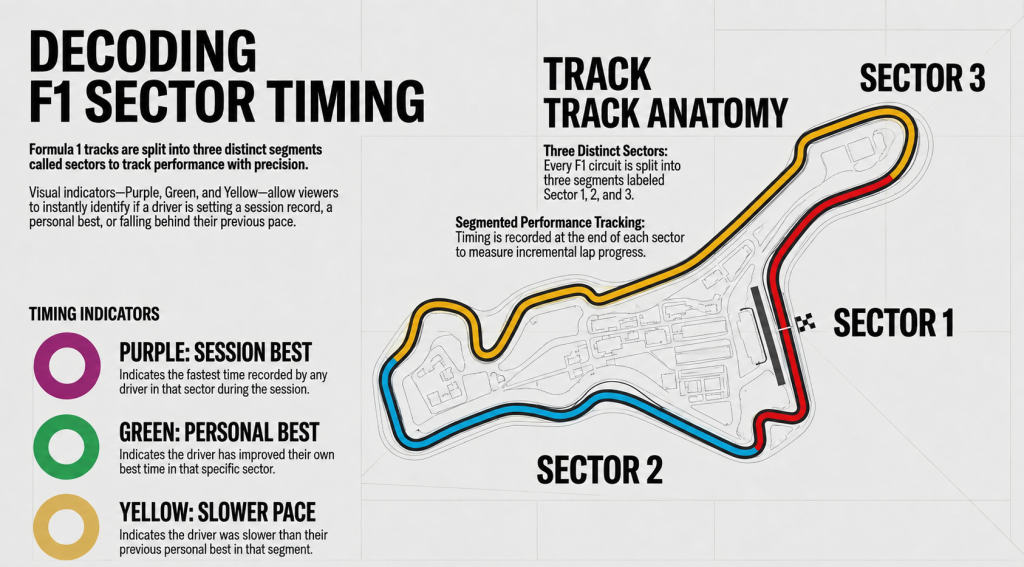
A sector in F1 is one of three roughly equal stretches of track. Every circuit divides a lap into Sector 1, Sector 2, and Sector 3. White lines and timing loops mark each boundary on the track surface. So when a car crosses each line, the system records a sector time automatically.
Teams and drivers watch this data constantly during Practice and Qualifying. It matters most on flying laps, where every tenth counts. Broadcasters show it on screen too, highlighting each sector in color the moment a driver crosses the line. A driver’s total lap time is simply the sum of all three sector times added together.
WHAT DO THE SECTOR COLORS MEAN IN F1?
F1 sector colors are purple, green, and yellow. Each one tells you something different about that piece of track. Purple means the fastest time recorded by anyone in that sector during the session. Green means a driver’s own personal best in that sector. Yellow means the driver went slower than their own personal best.
What Does A Purple Sector Mean In F1?
A purple sector means nobody has gone faster through that section during the entire session. It is the fastest time recorded in that sector, full stop. If Hamilton posts a purple Sector 1, that time becomes the target every other driver chases for the rest of the weekend.
What Does A Green Sector Mean In F1?
A green sector means the driver just set their own personal best for that part of the lap. It is not the outright fastest time overall, since someone else might still hold purple there. Even so, green tells you the driver is finding more pace than any previous lap.
What Does A Yellow Sector Mean In F1?
A yellow sector means the driver went slower than their own personal best in that section. It does not mean trouble on track. It simply means that lap was not as quick through that segment as one of their earlier attempts in the same session.
HOW ARE SECTORS DIVIDED IN F1?
Sectors divide by time, not by exact distance. So each one takes roughly the same duration to complete rather than covering the same length of track. Timing loops sit at each sector boundary and trigger the moment a car passes over them. That data feeds straight into the on screen graphics fans see during every session.
WHAT ARE F1 MINI SECTORS?
F1’s live timing system also splits each lap into much smaller mini sectors, sometimes called minisectors. These break Sector 1, Sector 2, and Sector 3 down further. You will see purple, green, and yellow color changes several times within a single sector instead of just once at the end.
Because of this, engineers and hardcore fans can pinpoint exactly which corner or straight cost a driver time. They are not limited to knowing which third of the lap. On a 2026 car running active aero, that detail matters even more. A single poorly timed wing switch can cost time in one mini sector while gaining it back in the next.
WHY DO F1 SECTORS MATTER?
Sectors matter because they let teams and drivers compare performance on the same part of the track, lap after lap. Say a driver loses three tenths to a rival in the middle sector alone. Engineers then know exactly where to look. That beats a single lap time with no context behind it. Even the strongest sector times can disappear once the tires start to fade. Understanding the different compounds and how they degrade is key
Broadcasters lean on sector timing for the same reason fans do. It turns an abstract lap time into a story. It shows where a driver gained and where they lost, often against their own teammate in the same car. On top of that, comparing strengths and weaknesses sector by sector across a season reveals patterns a single result never could.
HOW 2026 REGULATIONS ARE CHANGING F1 SECTOR TIMES
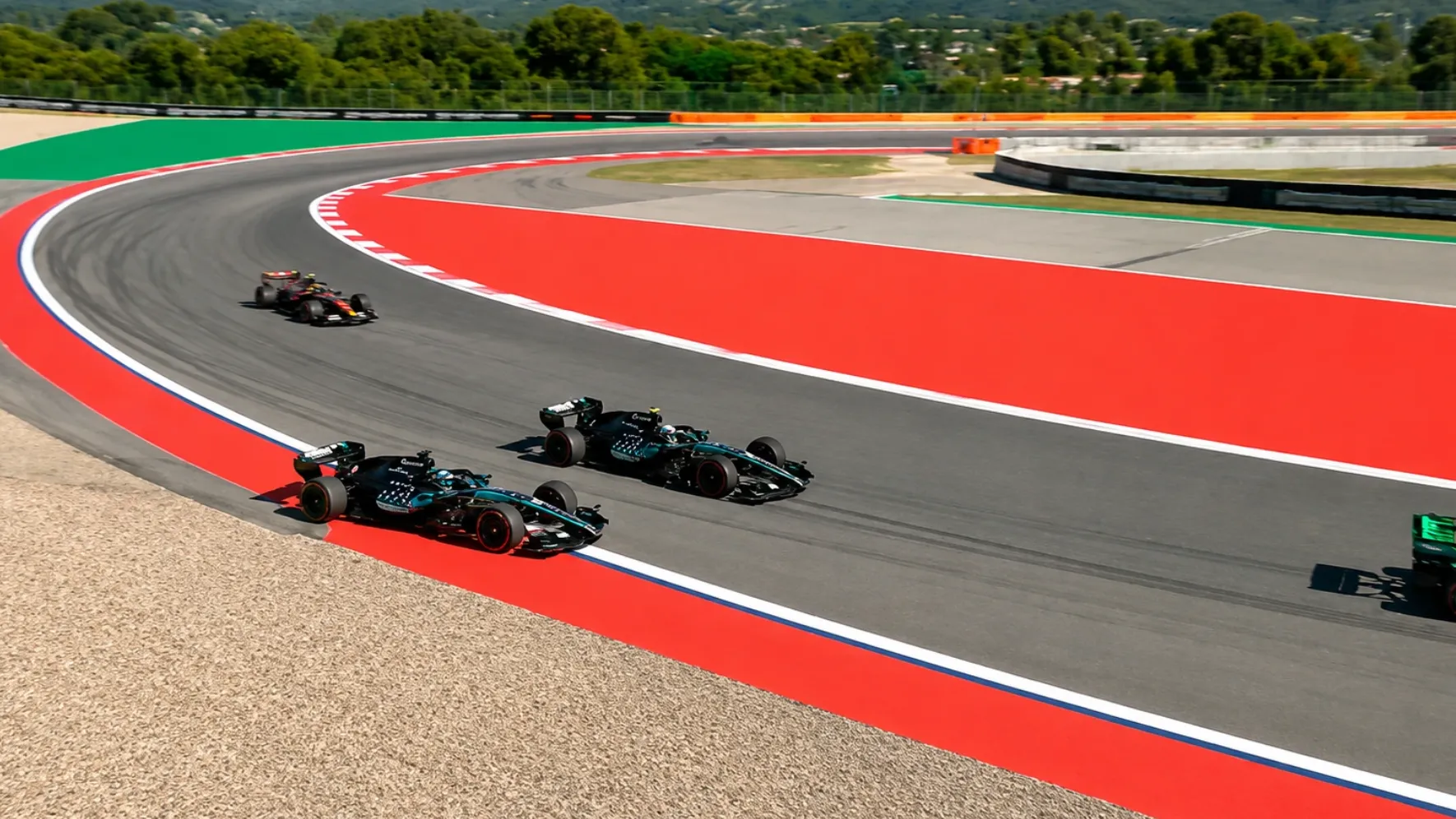
The 2026 cars run full-time active aerodynamics for the first time in F1 history. That has changed where sector time actually comes from. Front and rear wings now shift between Straight Mode and Corner Mode automatically. Straight Mode flattens the wings to cut drag and boost top speed. Corner Mode closes them again for grip.
This means a car that used to dominate a twisty middle sector might now gain more time on a sector built around long straights instead. The aero setup simply rewards different sections now.
Engineers also removed the MGU-H and pushed battery output from 120kW to 350kW. Energy deployment shapes sector times too. A driver who mistimes their electrical deployment can lose time in a sector even with a perfect driving line.
THE PURPLE SECTOR AND FASTEST LAP POINT
A purple sector alone guarantees nothing beyond bragging rights for that piece of track. But stringing together purple across all three sectors during a race can set the fastest lap of the race. That used to come with a genuine reward.
From 2019 to 2024, F1 awarded a bonus point for the fastest lap of the race, as long as the driver finished inside the top 10. If a driver set the fastest lap but finished 11th or lower, they got no bonus point. The bonus point was removed starting in 2025, so it no longer applies.
The same went for a driver who retired before the finish. That rule alone explained why teams sometimes chased a purple final sector late in a race, even from a car with nothing left to gain from track position.
Now when you hear sectors while watching a race you know how important these are for your driver.
FREQUENTLY ASKED QUESTIONS
Purple means the fastest time recorded by any driver in that sector during the session. Green means a driver’s own personal best in that sector. Yellow means the driver went slower than their own personal best in that section.
A purple sector is the fastest time set by any driver in that section of the lap during the current session. It stays purple until another driver beats it. Then the color transfers to the new fastest time.
F1 tracks divide into three timed sections called Sector 1, Sector 2, and Sector 3. Timing loops built into the track surface set each boundary. They split by time rather than exact distance, so the sections take a similar duration to complete.
A mini sector is a smaller subdivision within each of the three main F1 sectors. Live timing uses it to show exactly where on the lap a driver gained or lost time. It runs on the same purple, green, and yellow color system as the main sectors.


2 Comments