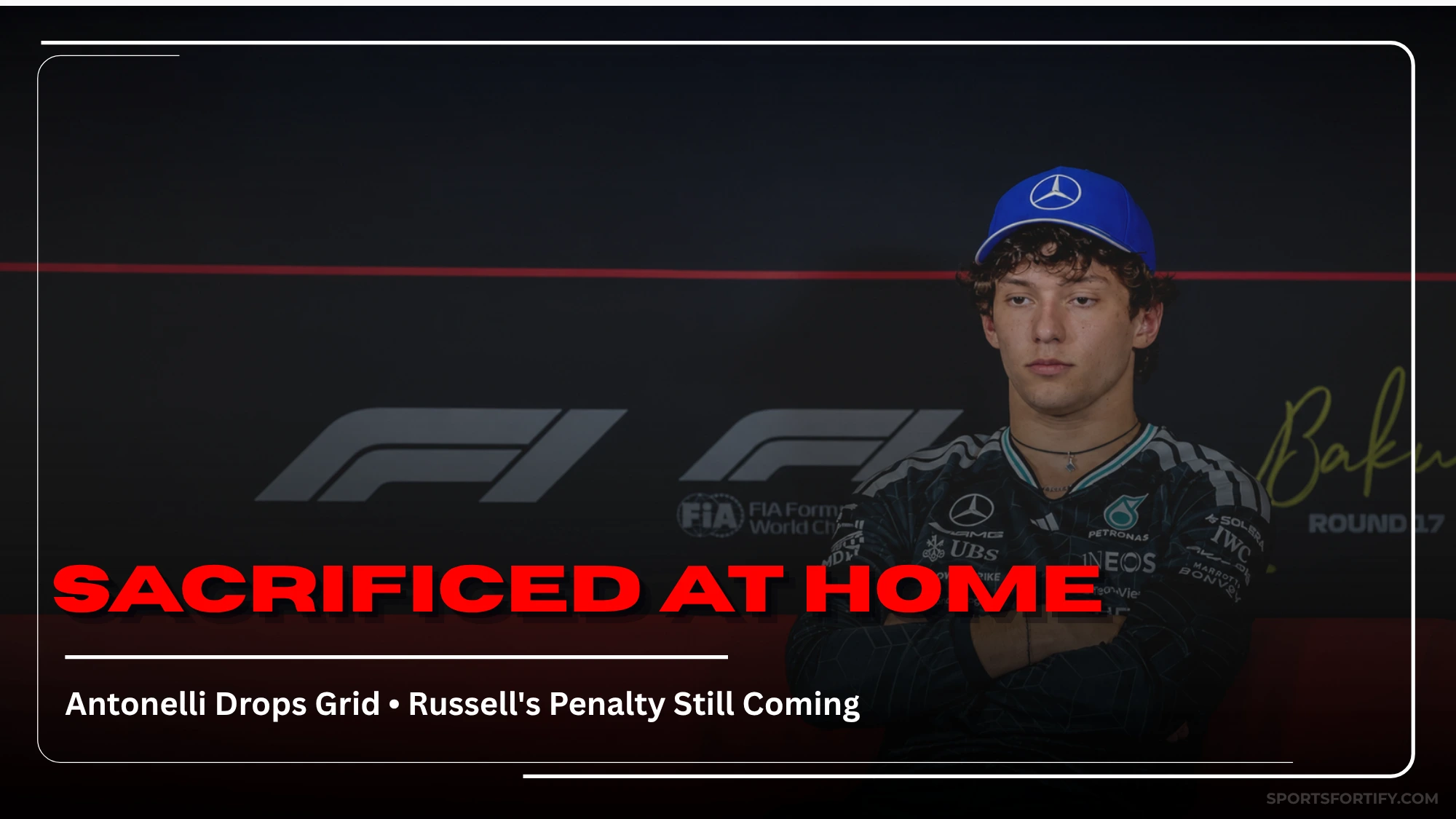
Mercedes has confirmed the Antonelli grid penalty will land at this weekend’s Italian Grand Prix, dropping the championship leader down the field in front of his own home crowd at Monza.
Here, team boss Toto Wolff explained the timing this week. He said the call came down to calculation, not sentiment. A battery failure in Spain had already used up Antonelli’s power unit allocation.
So Mercedes needed fresh parts, and that triggered the penalty automatically. Wolff said the numbers pointed to Monza as the best track to take it. He added that the model behind the choice ignores nationality and only weighs points.
But Russell also needs to serve an engine penalty before the season ends. Mercedes hasn’t settled on a race yet, and Wolff confirmed those talks are ongoing. That leaves a second grid drop hanging over the team. On top of that, it could land at any point across the remaining eleven rounds.
Even so, there’s a real question sitting underneath all this math. Wolff insists nationality doesn’t factor into the model, but Monza isn’t just any race for Antonelli. It’s his home crowd, his first Monza as a championship leader, and arguably the one weekend all season he’d want a clean shot at. So how sure is Mercedes that the calculation actually holds?
Because here’s the risk nobody’s addressed publicly yet. If Antonelli starts from further back and something goes wrong, contact, a bad restart, a slow first lap, there’s no obvious Plan B for salvaging his own home race. Mercedes is betting the fresh power unit is strong enough to recover positions regardless of grid slot. That’s a reasonable bet on pure pace. It’s a much shakier bet on a chaotic Monza start with the whole home crowd watching.
At the same time, this penalty news follows separate comments Wolff made about the team’s development budget. He spoke after the Dutch Grand Prix and admitted that Mercedes has less cost-cap room than its rivals. Mercedes simply hasn’t got the money to keep adding new parts, he said.
Because of this, the team is spreading updates evenly across the season instead. Beyond that, McLaren and Ferrari have both pushed harder on upgrades through the second half of the year. Mercedes, meanwhile, has stayed quiet since its last major package at the Canadian Grand Prix.
Taking a grid penalty at a driver’s home race is usually the last thing a team wants. Even so, Mercedes is doing it anyway. That decision says something about how much faith the team has in the new power unit. Still, faith in an engine and faith in a clean Monza restart are two different bets entirely. From there, a strong result could come even from further back on the grid, but Mercedes is leaving very little room for anything to go wrong.
Antonelli still holds a 59 point lead over Russell in the drivers standings, with eleven races left in the season. For more on exactly how grid penalties get calculated, see our grid penalty guide.


