Max Verstappen just had the kind of weekend that makes rival engineers wince. He took pole for the Bahrain Grand Prix in Malaysia with a 1:35.130, finishing 0.298s clear of Lewis Hamilton.
On Sunday he won the race ahead of Kimi Antonelli and Hamilton, after heavy rain, starting procedure problems and multiple Safety Cars. It was his first win of 2026, and the first for Red Bull’s own Ford-backed power unit.
Now look at the other side of the paddock. Mercedes drivers have won 11 of the 16 rounds so far, and the team leads the constructors’ standings by 151 points over Ferrari.
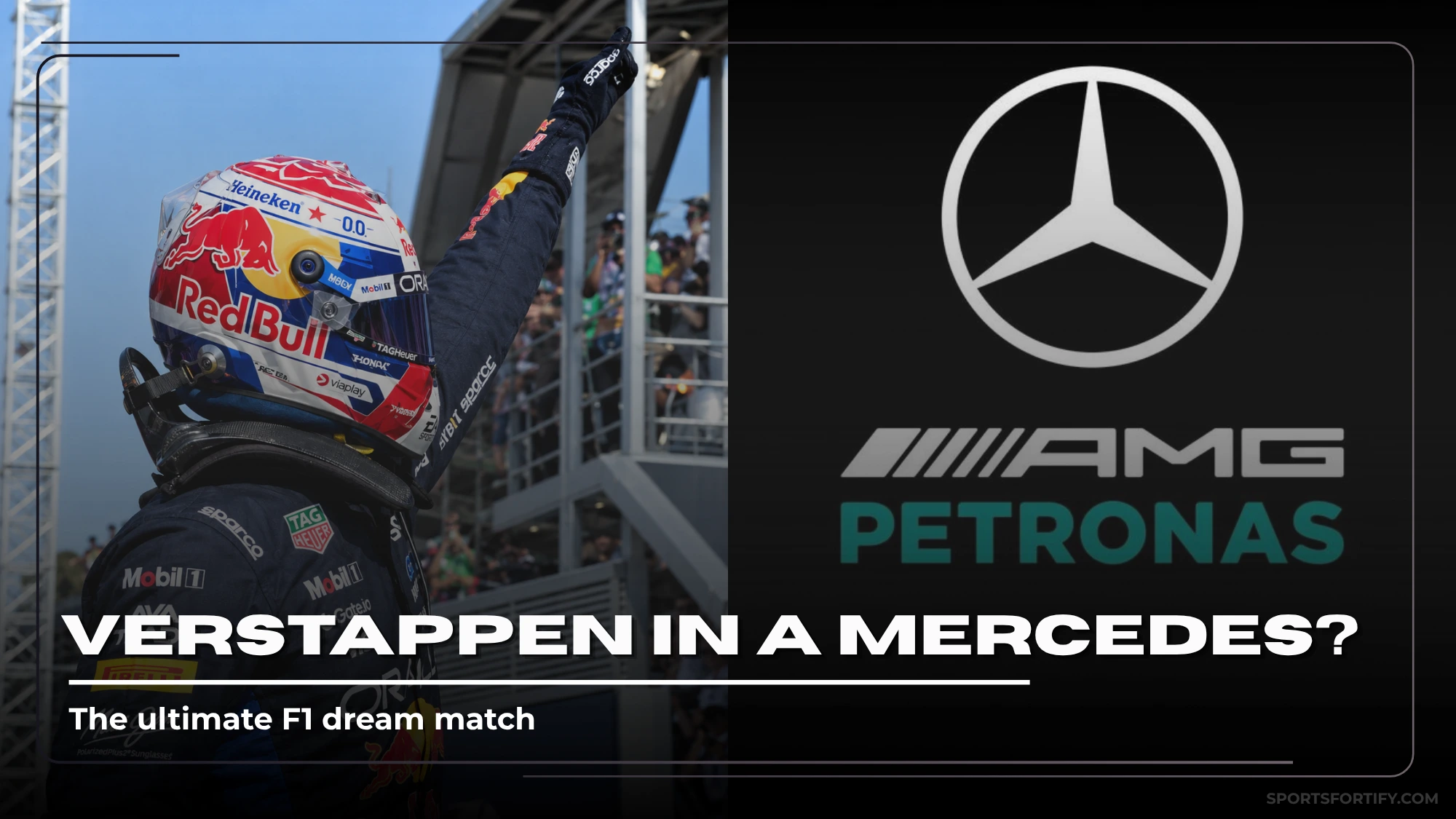
That makes the Max Verstappen Mercedes F1 question hard to ignore. What happens when the grid’s most clinical driver meets the best car? This is a thought experiment, but the 2026 rulebook gives us plenty to work with.
How Max Verstappen would fit the Mercedes W17
Verstappen has always wanted a car that turns in hard and does what he tells it. His 2026 Red Bull has not given him that consistently.
Early-season analysis pointed to poor rear end stability, with Verstappen making repeated steering corrections on corner entry. Red Bull team principal Laurent Mekies has since confirmed the car loses performance as a session or race develops, and warned the fix could take until 2027.
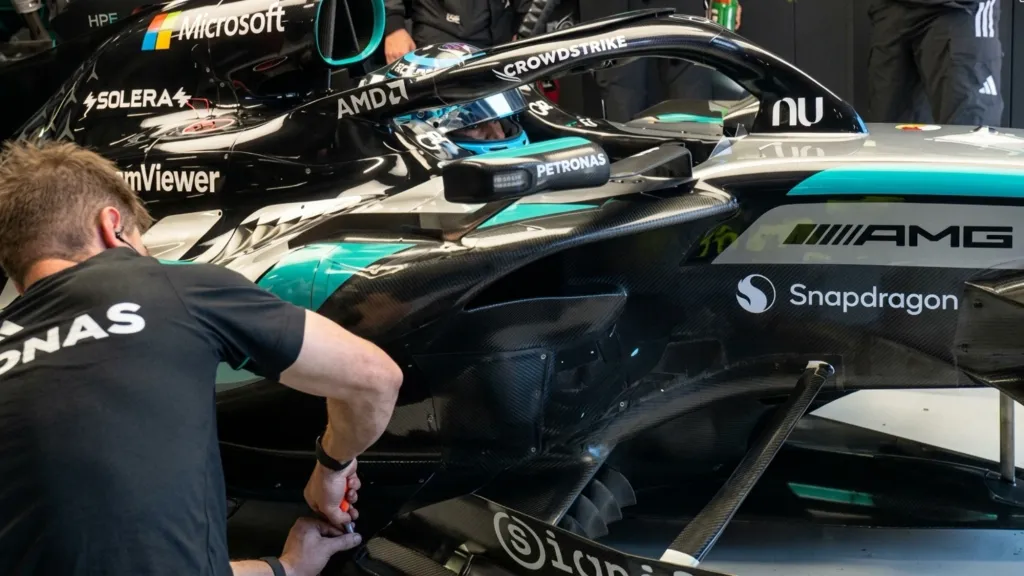
Start with what the W17 is. The 2026 rules cut the maximum wheelbase by 200mm to 3,400mm and the width by 100mm to 1,900mm. The floor is 150mm narrower, and minimum weight is 768kg, made up of 722kg for car and driver plus 46kg of estimated tyre mass.
The front tyres are 25mm narrower and the rears 30mm narrower. The venturi tunnels are gone, leaving a flat underside, and overall downforce is down about 30% and drag about 55%.
A shorter, lighter car with less downforce tends to be more nervous, and that is the area where Red Bull have struggled. Every team has the same dimensions, so the difference is how well each car copes with them. The results suggest Mercedes cope better than anyone, with a car stable enough to attack with. That matters for a driver who wants the nose to react and the rear to stay put.
Those two are not weak opposition. Antonelli leads the championship on 320 points, with Russell on 236. Antonelli has eight wins and six poles, while Russell has three wins and five poles. Mercedes also lost the pole to Verstappen on Saturday, and Russell qualified eighth, 0.741s off the top spot.
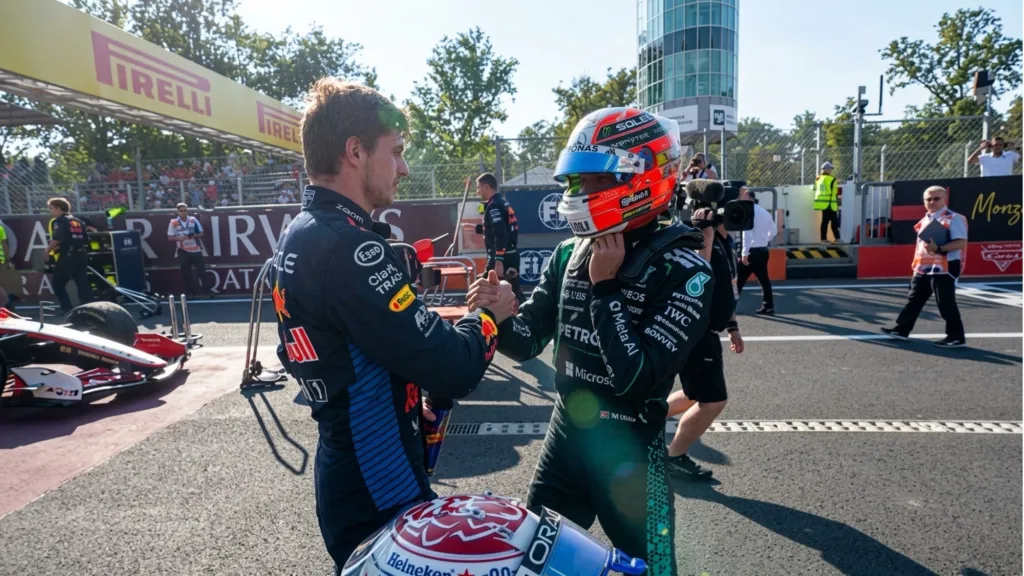
Verstappen has his own theory about how much the driver matters now. He argues the cars are numb to driver inputs, and points to Liam Lawson jumping into the Red Bull and being competitive straight away.
If he’s right, his advantage over Antonelli and Russell shrinks. I think Sepang is a decent argument against his own theory. He topped all three practice sessions and led Q1, Q2 and Q3, while Isack Hadjar, in the identical Red Bull, only managed third. A driver doesn’t do that in a car that ignores him.
Max Verstappen Mercedes F1 Reality
The W17 runs the M17 E Performance power unit. The combustion engine makes about 400 kW and the MGU-K adds 350 kW, which puts the total around 750 kW with nearly half of it electric. The MGU-H is gone. Braking energy recovery has doubled to 8.5 MJ per lap, but the battery only works within a 4 MJ window and fuel flow is capped by energy at 3,000 MJ per hour.
So the car is harvesting and deploying all the way round the lap. Energy management is the new skill, and Verstappen has never hidden what he thinks of it. He called these cars “Formula E on steroids” and said he enjoys driving flat out
He has adapted anyway. Red Bull’s Sepang pole was the team’s first with its own engine, so the idea that he can’t exploit an energy-heavy car doesn’t hold up. A Mercedes unit would hand him a more mature version of the same puzzle. It wouldn’t be flawless, though. Russell retired from third place on lap 50 of 56 with an engine issue.
Active aero is the second half of that puzzle. The two modes were first called X-mode and Z-mode, but the FIA renamed them Straight Mode for low drag and Corner Mode for high downforce.
Drivers have to decide when to open the wings, when to deploy and when to lift, all while defending or attacking. That is race craft with a new vocabulary, and Verstappen’s record of reading a race gives him a natural edge. I’d expect it to show most at tracks where long straights and energy harvesting zones pull against each other.
One more thing helps him. The electrical share of the power balance is due to drop from 47% to 42% next year and 40% in 2028. The cars are moving toward what he wants.
The paddock shockwave inside a Verstappen Mercedes garage
Imagine the Mercedes garage with Verstappen in it. Antonelli leads the championship and Russell is his closest challenger. Toto Wolff would suddenly be running a three-way fight inside one team, with the man who beat Hamilton to the 2021 title on the final lap in Abu Dhabi as one of the protagonists. Wolff has handled an in-house title fight before, with Hamilton and Rosberg, so it isn’t unthinkable. It would be tense.
The rest of the grid would feel it too. Ferrari are second in the constructors’ standings, McLaren third, and Red Bull fourth, 18 points behind McLaren.
Every team in that group is hoping Mercedes drop points somewhere. Adding the best racer on the grid to the fastest car removes most of that hope. I think the psychological effect on rivals would be bigger than the pace gain.
fantasy vs reality
Reality is much less dramatic. Wolff has ruled out a Verstappen move to Mercedes for 2027, and Verstappen has since extended his Red Bull deal through the end of 2030. For now, the closest we get to this match-up is watching him spoil Mercedes weekends from a Red Bull.
Still, I’d back him. Over a full season in a W17, I think Verstappen beats both Mercedes drivers more often than not, though narrowly, not by the margins of 2023.
The reason the Max Verstappen Mercedes F1 idea stays so uncomfortable for rival team principals is simple. In these rules a great driver can still make a difference, and Sepang just proved it again.