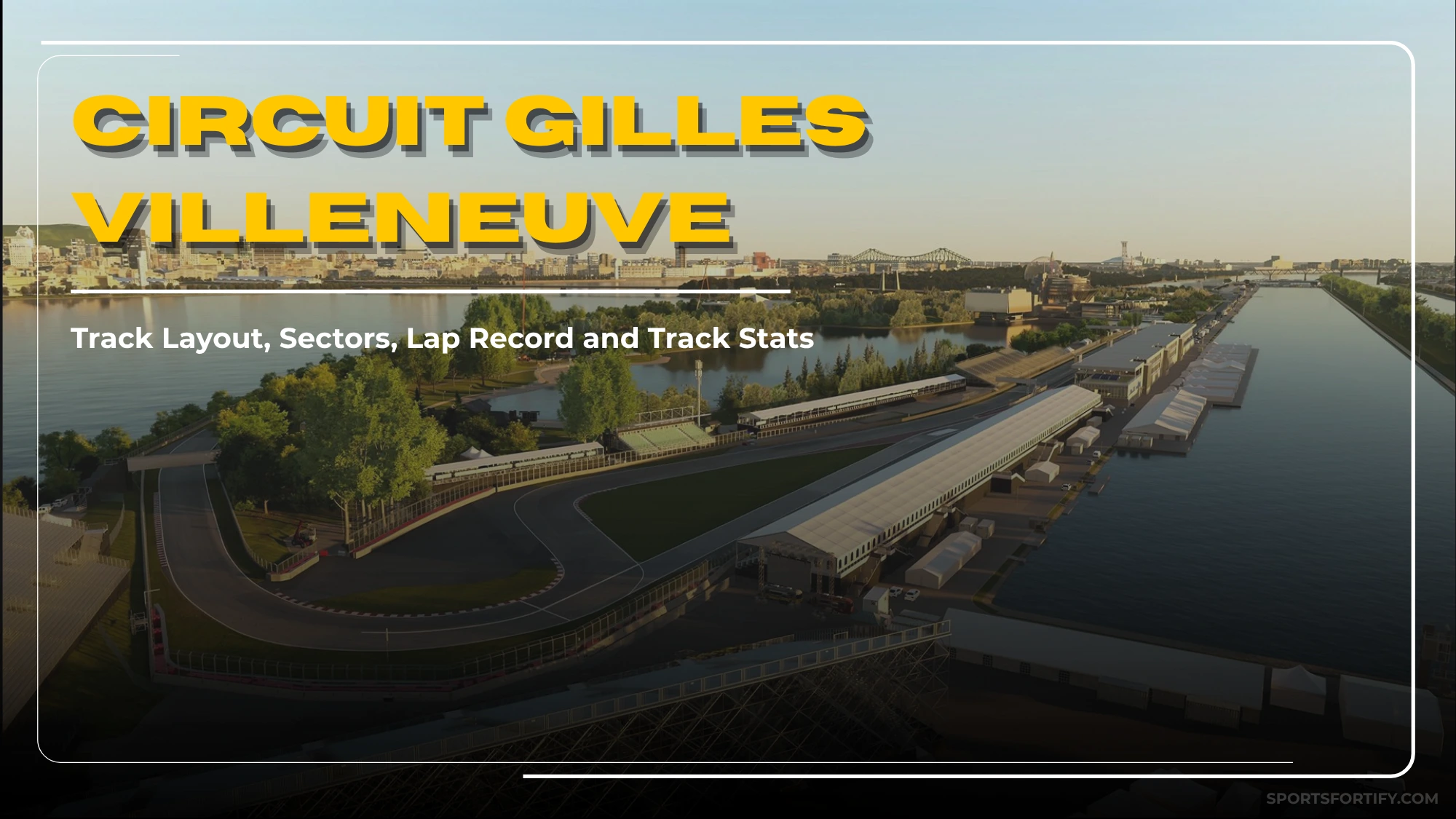
Circuit Gilles Villeneuve sits on an artificial island in the middle of Montreal. It has narrow walls, two long straights, and a corner that has ended world champions’ race weekends on the same afternoon. Every summer Formula 1 arrives here for the Canadian Grand Prix, one of the most unpredictable races on the calendar. That unpredictability is what makes Circuit Gilles Villeneuve different from every other venue the sport visits.
Where Is Circuit Gilles Villeneuve
Circuit Gilles Villeneuve sits on Île Notre-Dame, a man-made island in the St Lawrence River in Montreal, Quebec, Canada. The island was built using material excavated during Montreal Metro construction in the 1960s and originally hosted Expo 67 before becoming a racing venue.
Getting there by car on race weekend is slow. Most fans use the Montreal Metro instead. The Jean-Drapeau station on the Yellow Line drops you directly onto the island within walking distance of the circuit entrance. The metro runs additional services during race weekend to handle the volume of fans travelling in both directions.
The circuit is roughly 30 minutes from downtown Montreal by public transport. Hotels fill up months before race weekend so planning ahead matters significantly if you are attending in person.
Circuit Gilles Villeneuve Track Layout and Sectors
Circuit Gilles Villeneuve is 4.361 kilometres long. The layout combines two long straights with a series of slow tight chicanes that demand heavy braking and precise car placement. There are 14 corners split across three sectors.
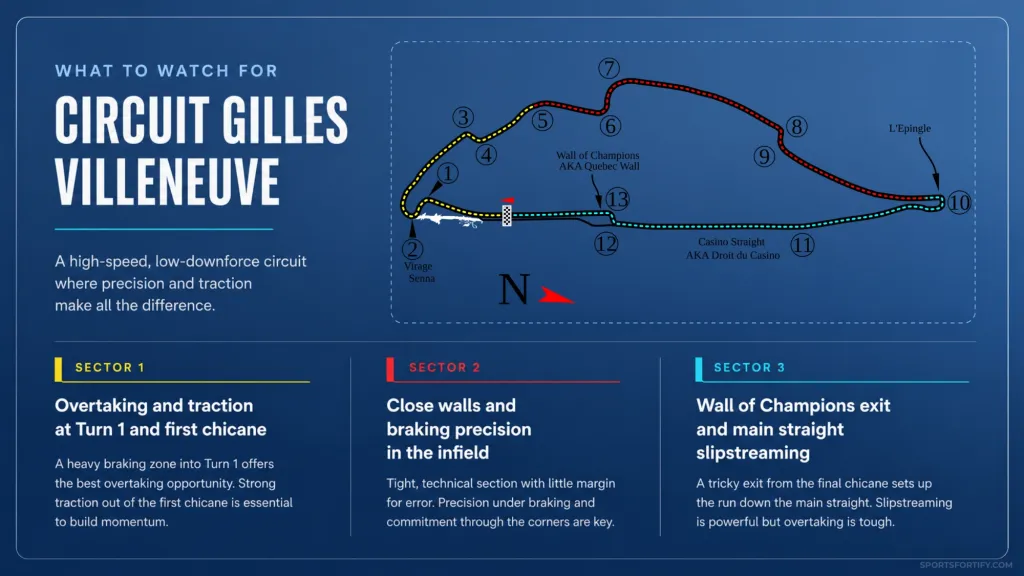
Sector one starts from the pit straight and runs through a fast right-hand kink followed by the first chicane. Good traction out of slow corners matters here and the entry into turn one is where overtaking sometimes happens on the opening lap before the field spreads out.
Sector two covers the infield section. The walls close in tightly through this stretch and the consequences of errors become severe. Unlike most modern circuits there are almost no gravel traps or runoff areas. Concrete barriers sit close to the track surface at almost every point and they do not move for anyone.
Sector three is where races are most often decided. It covers the final chicane and the long pit straight back to the start finish line. The exit of that final chicane feeds directly onto the longest straight on the circuit which makes the corner exit critical for both lap time and overtaking opportunity. This is also where the Wall of Champions sits waiting every year.
The Wall of Champions at Circuit Gilles Villeneuve
The Wall of Champions is the concrete barrier on the outside of turn 13 at the exit of the final chicane before the pit straight. It has collected some of the biggest names in Formula 1 history and it earns its reputation every single year.
In 1999 Michael Schumacher, Damon Hill, and Jacques Villeneuve all hit this barrier during the same race weekend. Schumacher crashed in practice. Hill and Villeneuve both hit the wall during the race itself. Three world championship winners hitting the same barrier at the same exit in the same weekend gave it the name it still carries today. Between them Schumacher, Hill, and Villeneuve held seven world championship titles at the time of those crashes.
The wall catches drivers who brake fractionally too late into the chicane or get a snap of oversteer on exit. At race pace the entry speed is high and the margin for error is almost nothing. It does not catch beginners. It catches people who push just a fraction too hard at exactly the wrong moment and that is what makes it genuinely dangerous.
Circuit Gilles Villeneuve Lap Record and Track Stats
- Current lap record: 1 minute 13.078 seconds – Valtteri Bottas, 2019 Canadian Grand Prix (set during the race, not qualifying).
- Race‑context note: The time is especially impressive because it was set with race‑fuel loads and used tyres, not light‑fuel qualifying conditions.
- Top speed: The main straight allows F1 cars to exceed 300 km/h before the Turn 3 hairpin.
- Braking performance: Cars decelerate from over 300 km/h to under 100 km/h in under two seconds, making this one of the heaviest braking zones on the F1 calendar.
- Race distance: The Canadian Grand Prix covers 305.27 km over 70 laps.
- Lap count context: Canada has one of the highest lap counts of the season due to the relatively short 4.361 km layout.
- Tyre‑management challenge: Tyres must last and remain predictable across 70 laps at a stop‑start circuit, which is harder to manage than at many other F1 venues.
Why the Canadian Grand Prix Track Produces Crazy Races
Three things make Circuit Gilles Villeneuve consistently unpredictable year after year.
The walls are the first factor. Most modern F1 circuits have wide runoff areas that let drivers make mistakes and carry on. Montreal has concrete barriers at almost every point. One mistake in the wrong place ends the race immediately. This keeps every driver alert for all 70 laps rather than just the difficult sections because there are no free ones.
The safety car record is the second factor. Canada produces more safety car periods than almost any other round on the calendar. When a car touches the barriers it needs recovery and recovery means a safety car. That compresses the entire field and resets every strategy call a team has made up to that point. Understanding how the safety car affects a race is more relevant here than anywhere else all season.
Weather is the third factor. Montreal in June is genuinely unpredictable. The 2011 Canadian Grand Prix ran for over four hours and included a lengthy red flag period for heavy rain. When conditions change at this circuit the walls and the safety car probability amplify the chaos considerably.
What the 2026 Cars Mean for Circuit Gilles Villeneuve
The 2026 regulations changed how F1 cars generate and deploy power through a lap. Circuit Gilles Villeneuve tests those systems harder than most circuits because of the stop-start layout repeating across 70 laps.
The long main straight rewards raw power unit performance at full deployment. The slow chicanes drain the battery immediately after through heavy braking and low-speed acceleration. That cycle repeats across the full race distance which means teams with efficient energy recovery through braking have an advantage that compounds over time.
Mercedes has shown strong energy management through the opening rounds of 2026. The new Active Aerodynamics system also gets used more frequently here than on smoother circuits because the transition between high drag mode on the straights and high downforce mode through the chicanes happens at almost every corner. Teams that have mastered that transition will find lap time that others miss entirely.
The 2026 Canadian Grand Prix preview covers what each team is targeting across the full race weekend and why front row position matters more here than at most other circuits. The 2026 qualifying rules explain exactly how Saturday shapes Sunday at Circuit Gilles Villeneuve.
FAQ
Circuit Gilles Villeneuve is on Île Notre-Dame in the Saint Lawrence River in Montreal, Quebec, Canada. The nearest metro station is Jean-Drapeau on the Yellow Line which takes you directly to the circuit entrance.
Circuit Gilles Villeneuve is 4.361 kilometres long. The Canadian Grand Prix covers 70 laps for a total race distance of 305.27 kilometres.
The circuit is named after Gilles Villeneuve, a Canadian Formula 1 driver who raced for Ferrari between 1977 and 1982. He died during qualifying at the Belgian Grand Prix at Zolder in May 1982. The Montreal circuit was renamed in his honour the same year.