F1 2026 Bahrain testing is done. Eleven days in the desert. And the picture it paints is brutal for some, electric for others. Melbourne arrives in two weeks. There is no more runway.
The 2026 regulations rewrote Formula 1 from the ground up. Smaller cars, active aerodynamics, hybrid power units delivering nearly 50% electrical output. And a field that had absolutely no historical blueprint to lean on. That is precisely what made F1 2026 Bahrain testing so revealing. Strip away the deliberate sand-bagging, the fuel loads, and the tyre guesswork, and four teams clearly seized the moment. Four others? They exposed fractures that Melbourne will only tear wider.
Consequently, what follows is not a celebration or a funeral. It is an investigation. Here is what the data, the lap counts, and the paddock whispers actually tell us.
| # | Team | Verdict | Fastest Lap | Key Driver | Analysis |
|---|---|---|---|---|---|
| 1 | Ferrari | Exceeded | 1:31.992 | Leclerc | Fastest lap of pre-season; 0.879s clear of the field. |
| 2 | Haas | Exceeded | 1:33.487 | Bearman | Most productive midfield team; 82-lap sim completed. |
| 3 | Cadillac | Exceeded | 1:35.290 | Bottas | Debut team comfortably within 107% pace territory. |
| 4 | Alpine | Exceeded | 1:33.421 | Gasly | Smooth Mercedes PU integration; P8 on final day. |
| 5 | Aston Martin | Disappointed | N/A | Stroll | Honda battery failure; only 6 laps on the final day. |
| 6 | Williams | Disappointed | 1:34.342 | Albon | Well off benchmark pace despite softer compounds. |
| 7 | Mercedes | Disappointed | 1:32.803 | Antonelli | Suspension/PU failures destroyed critical mileage. |
| 8 | Red Bull | Disappointed | 1:33.109 | Verstappen | Verstappen furious about the 2026 regulation concept. |
FERRARI — THE SCUDERIA ARRIVES ARMED
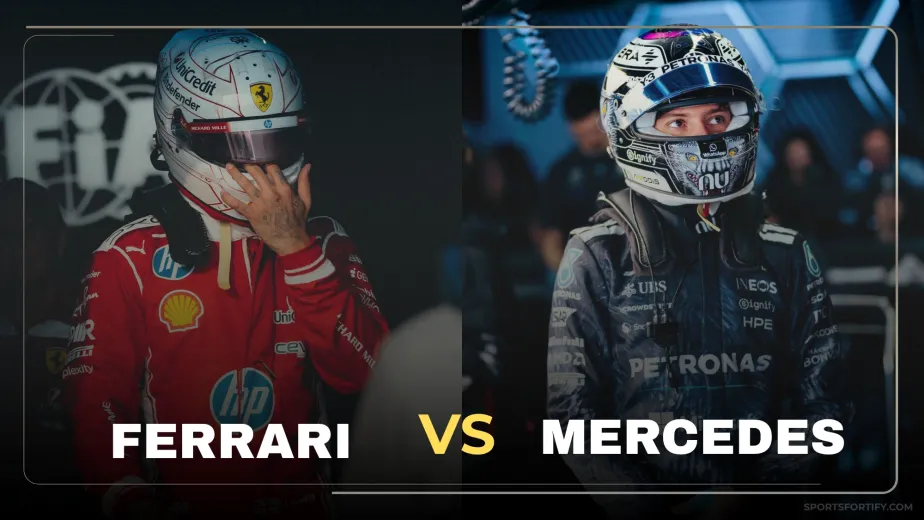
Charles Leclerc’s 1m 31.992s on the final afternoon in Bahrain ended pre-season testing by almost a full second clear of the field. That 0.879s margin over Lando Norris is the kind of gap that shuts paddock conversations down mid-sentence. Furthermore, Lewis Hamilton’s rapid race-start practice runs triggered serious discussion among engineers.
Ferrari appears to have optimised its power unit deployment sequence around a short start sequence, giving it a genuine edge into Turn 1 at Melbourne. This team did not arrive in Bahrain to collect data. It arrived to dominate a narrative. Leclerc set the fastest lap of the entire pre-season. Full stop.
Crucially, Team Principal Fred Vasseur has refused to discuss performance targets publicly. He is playing the oldest poker game in the paddock. But the lap times, completed on representative fuel loads and compound choices, do the talking for him. Ferrari’s combined mileage across both Bahrain tests placed them among the top three on reliability. Meanwhile, Lewis Hamilton settled into the SF-26 with unsettling ease. Opponents should be concerned.
HAAS — THE LEAST-RESOURCED TEAM MAKING THE LOUDEST NOISE
794 laps. Across both Bahrain tests. From Haas, a team operating on a fraction of Ferrari’s or Red Bull’s budget. That number alone demands respect. Ollie Bearman declared the final day of testing “by far the most productive,” and the internal consistency of the VF-26’s data runs reflected that.
Esteban Ocon completed a full race simulation on the final morning, clocking 82 laps without drama. This is a machine that works. Haas may lead the midfield pack into Melbourne. Nobody saw that coming.
Moreover, the consensus inside the paddock points to Haas and Cadillac trading blows for best-of-the-rest positions behind the top tier. When you consider that Haas is almost certainly the least-resourced outfit in this contest, that represents a staggering return on investment. The team has cracked something in the new regulations cycle. Expect them to exploit it aggressively early in the season.
CADILLAC — A DEBUT THAT SILENCED THE CRITICS
Every paddock veteran had a quiet fear about Cadillac. That fear was that a brand-new American squad entering under a completely alien regulations set would be embarrassingly slow. Potentially 107% territory and therefore locked out of qualifying altogether. Those fears collapsed under the weight of Valtteri Bottas’s lap times and over 1,700km of combined testing mileage across both Bahrain tests.
Consequently, Cadillac is not last in the pecking order. In fact, team principal Graeme Lowdon urged observers not to over-read the occasional technical niggles. The squad’s energy management learning curve is steep, but they are climbing it faster than most expected. A debut team ahead of an established constructor. That tells you everything about 2026.
ALPINE — MERCEDES POWER DELIVERING A QUIET REVOLUTION
Alpine absorbed a power unit switch from Renault to Mercedes for 2026 and emerged from Bahrain with 359 laps of smooth, consistent running. Pierre Gasly landed P8 on the overall timesheet on the final day, and the Enstone squad ran without the reliability nightmares that plagued their first Bahrain test a week earlier.
Gasly acknowledged “a lot to get up to speed with” on the new power unit. The fact that both he and the squad are hitting competitive windows despite that learning curve is impressive. Alpine should not be underestimated in the first third of this season.
“Aston Martin ended its final day of pre-season testing early, with more than two hours of running still available.”
ASTON MARTIN — HONDA’S CRISIS IS NOW THEIR CRISI
This is the story that the entire paddock is talking about. Aston Martin arrived at the second Bahrain test hoping to claw back ground after a first test where the AMR26 completed just 206 laps. The fewest of any team, and roughly half the tally of Williams, who had missed the Barcelona Shakedown entirely.
Instead, the Honda power unit delivered a battery-related failure that curtailed Fernando Alonso’s running on Day 2. On the final day, Lance Stroll managed just six laps before the plug was pulled. A battery shortage forced a severely limited run plan. Six laps. Six. On the final day of pre-season testing.
Lance Stroll admits the car is “four-and-a-half seconds” off the pace. That is not a gap. That is a canyon. F1 2026 Bahrain testing exposed Aston Martin as the most vulnerable team heading to Melbourne. Parallels with Honda’s disastrous 1998 partnership with Jordan are already circulating among senior engineers.
The gap between their simulation bench work at HRC Sakura and real-world circuit application is alarmingly wide. Unless Honda fixes this at speed, Aston Martin will spend the early season as a mobile case study in what happens when a power unit partnership collapses simultaneously with a regulation reset.
WILLIAMS — PRODUCTION DELAYS COMPOUNDING INTO A POINTS CRISIS
Williams missed the Barcelona Shakedown due to production delays. That put them immediately on the back foot before a single lap had been completed in anger. They arrived in Bahrain playing catch-up and completed the fifth-highest lap count in Test 2. But the performance runs told a damaging story.
Carlos Sainz and Alex Albon were consistently running on softer tyre compounds than those around them, yet still posting times well adrift of the midfield benchmark. When a team burns softer rubber to close a pace gap and still fails to close it, that is an underlying car problem. Not a setup issue.
Alex Albon’s own admission that the team is “not where we want to be” confirmed what the timing screens already screamed. Team Principal James Vowles spoke of matching the development rate of midfield rivals. Currently, they are not matching it. They are chasing it.
MERCEDES — TEST ONE DAMAGE LINGERS
Mercedes arrived in Bahrain following a smooth Barcelona run and immediately triggered alarms. Suspension failures, then power unit failures in the first Bahrain test slashed their mileage at the worst possible moment.
They recovered somewhat in the second test, with Kimi Antonelli setting the second-fastest time of the entire pre-season at 1m 32.803s. George Russell was measured but cautious, flagging reliability as an ongoing target area. The W17 showed genuine pace, but Mercedes burned critical data-gathering time in Test 1 that rivals spent learning. That deficit carries into Melbourne.Pace without mileage is a promise without evidence. Mercedes needs both.
RED BULL — VERSTAPPEN IS ANGRY AND THE CAR KNOWS IT
The new Red Bull Ford power unit turned heads throughout F1 2026 Bahrain testing. Impressive energy deployment on the straights. Consistent reliability across both weeks. Running for 670 combined laps across Red Bull and Racing Bulls. But Max Verstappen’s public frustration with the 2026 regulations concept, cars he finds fundamentally unsatisfying to drive, is a distraction that championship campaigns cannot afford.
Furthermore, Isack Hadjar lost Wednesday morning running in the second test to technical issues. Red Bull’s pace appears genuinely competitive, but the gap to Ferrari looks real. Verstappen is racing a regulation set he resents. That psychological friction, at his level, matters.
Two weeks remain before Melbourne. For four teams, that is just enough runway to fine-tune. For the other four, it is nowhere near enough time to fix what Bahrain just exposed.