Sakhir, Bahrain. The Formula 1 paddock felt tense during pre-season testing. Testing usually brings excitement and fresh starts, but the new F1 2026 start procedure put everyone on edge. Drivers suddenly faced a harsh reality: even getting the car off the line had become stressful and potentially dangerous.
A major part of the problem stemmed from missing technology. The Heat Motor Generator Unit previously acted as an electronic safety net, smoothing out launches and stabilizing torque delivery. Without it, modern turbos now demand a strong surge of exhaust gases to build power while the car sits stationary. To compensate, drivers must hold their engines at a screaming 13,000 RPM for ten full seconds before lights out. That high-rev window keeps the turbo spooled and prevents an immediate power drop when the race begins.
Piastri sounds the alarm
Oscar Piastri emerged as the most vocal critic of the changes. During a tense press conference, he labeled the new system a “recipe for disaster,” and his concern felt genuine. His McLaren teammates echoed those fears, warning that the margin between a perfect launch and a complete stall had grown dangerously thin.
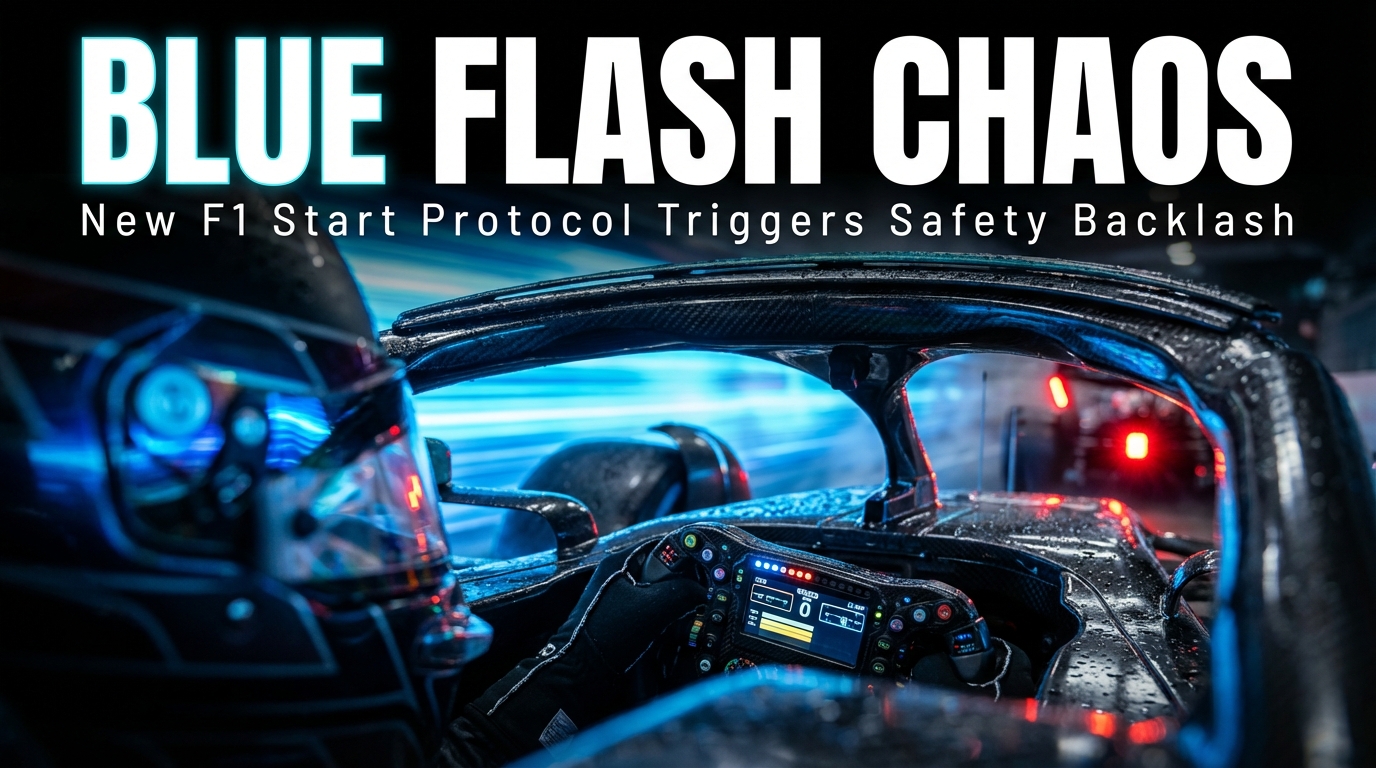
If the F1 2026 start procedure fails and a car stops dead on the grid, the pack behind could slam into it at 200 km/h. That risk feels immediate—not theoretical. The FIA attempted to calm those concerns. On the final day of testing in Bahrain, officials trialed a new system called “Blue Flash.” Digital boards lit up blue for five seconds to signal the start of the waiting window.
On paper, the fix sounded logical. In practice, several drivers argued that the flashing boards added yet another distraction inside an already overloaded cockpit. Many still believe the sport must simplify the entire process rather than layer on more signals.
Colapinto and the anti-stall trap
- Franco Colapinto became the first high-profile casualty of the new system. During a practice start in his Alpine F1 Team, he triggered anti-stall almost immediately because the turbo failed to reach optimal pressure.
- George Russell described his own attempts as the “worst ever,” admitting he never found a consistent launch point throughout the session.
- Meanwhile, Lewis Hamilton looked noticeably more comfortable in his Ferrari. That contrast fueled speculation that Ferrari’s smaller turbo design delivers a genuine early-season advantage.
- Behind all of this sits Article 5.4.12, which bans electrical assistance from the MGU-K below 50 km/h. The rule leaves teams little room to maneuver—and regulators show no intention of softening it.
Thermal runaway risks
The danger extends beyond launch technique. Sustaining 13,000 RPM for ten seconds dumps extreme heat into cooling systems, especially under the Bahrain sun. Engineers now worry about uncontrolled fuel ignition inside the combustion chamber, particularly with the new 2026 biofuels that heat rapidly in high ambient temperatures. Teams must choose between protecting the start or protecting the engine. No championship contender should face that trade-off weeks before the season opener in Melbourne.
The push for rolling starts
Whispers inside the paddock suggest the GPDA has urged the FIA to adopt temporary rolling starts. That solution would bypass the F1 2026 start procedure while engineers develop safer software calibrations. FIA leadership, however, appears reluctant. A switch would signal that the new regulations—designed to mirror advanced road-car relevance—have created a system too complex for safe racing.
The 2026 season opener may hinge on the first three seconds of the race. If a front-row car stalls, the resulting collision could reshape the entire championship before Turn 1. The FIA now has only weeks to refine the Blue Flash protocol and restore driver confidence. Until then, every driver on that grid prepares for lights out knowing the risk remains unresolved.