
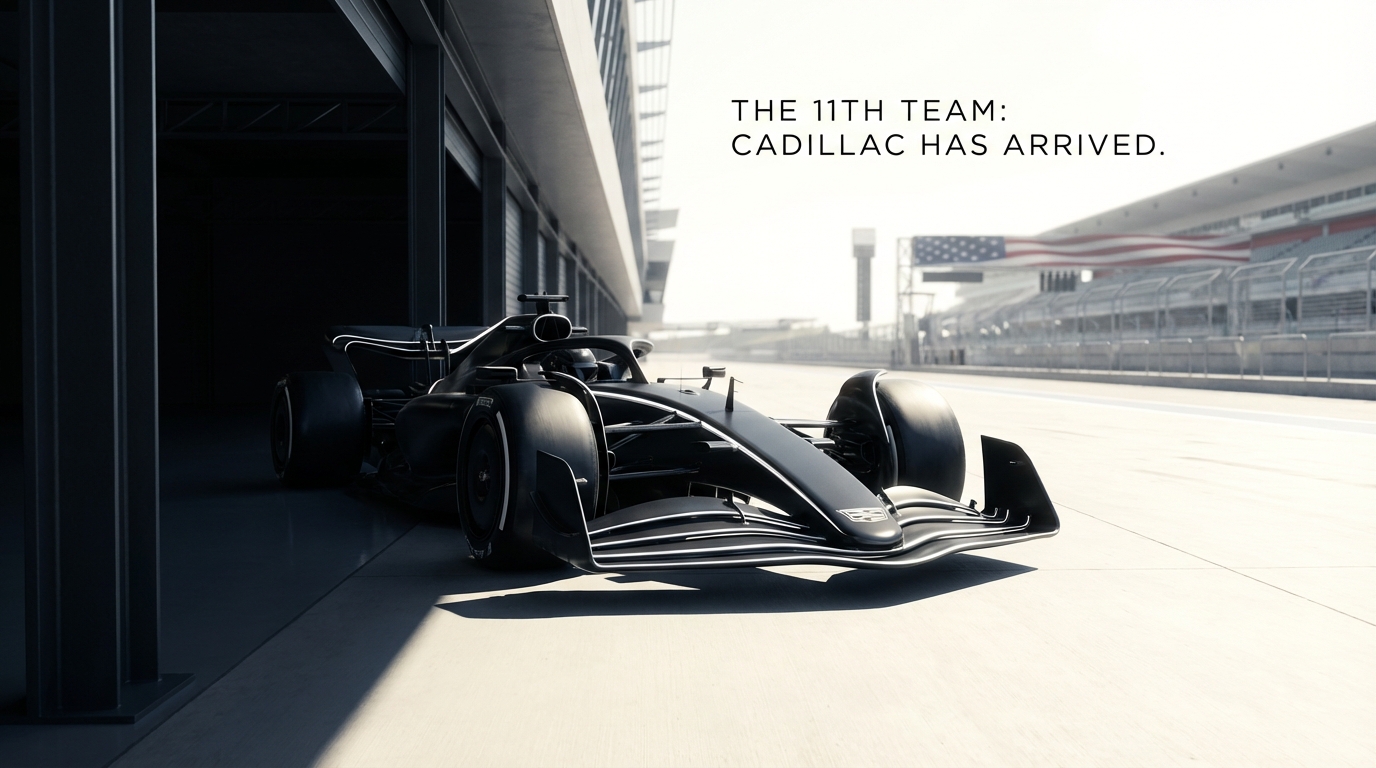
After a rollercoaster of rejections, negotiations, and high-stakes politics, Formula 1 has agreed in principle to let an American giant join the circus—here is everything you need to know about the grid’s newest arrival.
For years, the Formula 1 paddock has been an exclusive club, locked tight at ten teams. Getting past the velvet rope seemed impossible for newcomers. However, the landscape has shifted dramatically. The Cadillac F1 11th team is no longer just a rumor or a rejected proposal; it is an incoming reality.
Formula 1 announced in late 2024 that they have reached an agreement in principle with General Motors (GM) to admit the Cadillac F1 11th team to the grid in 2026. This is a massive moment for motorsport, marking the first time a major American manufacturer will enter F1 as a full works team. If you have been following the saga, you know this wasn’t easy.
From Rejection to Acceptance: The Long Road to the Grid
To understand why this entry is such a big deal, you have to look at the drama that preceded it. Originally, this bid was spearheaded by Andretti Global, led by Michael and Mario Andretti, with Cadillac attached as a partner. They passed the FIA’s technical checks with flying colors, but when they took their proposal to Formula One Management (FOM)—the commercial rights holders—they were met with a firm “no.”
FOM argued that an 11th team wouldn’t add enough value to the championship. They were skeptical that a new entrant could be competitive immediately and worried about “diluting” the prize money fund for existing teams.So, what changed?
General Motors decided to flex its muscles. Instead of just being a sponsor sticker on an Andretti car, GM committed to becoming a full Power Unit (engine) manufacturer. This turned the bid from a “privateer team” into a “works manufacturer entry.” In the eyes of F1 and Liberty Media, a Cadillac F1 11th team backed by the full engineering might of General Motors offers undeniable commercial value that a standard racing team simply cannot match.
Why the Cadillac F1 11th Team Matters for 2026
The year 2026 is shaping up to be one of the most significant in Formula 1 history. New regulations are coming into play regarding both the cars and the engines. The cars will be smaller and lighter, and the engines will rely more heavily on electrical power and sustainable fuels.
Entering a new team during a massive regulation overhaul is actually a strategic masterstroke. It levels the playing field slightly. While Red Bull, Ferrari, and Mercedes are relearning how to build a fast car under new rules, the Cadillac F1 11th team will be starting from the same blank sheet of paper.
However, there is a catch regarding the engine. While GM has registered as a power unit supplier, their custom engine likely won’t be ready until 2028. This puts the team in a unique position for their first two seasons (2026 and 2027), where they will likely need to use a customer engine—rumored to be Ferrari or Honda—badged as a Cadillac or running as a stop-gap solution before the true GM heart beats inside the car.
Key Details of the General Motors Entry
There are a lot of moving parts to this entry. It isn’t just about painting a car silver and gold and showing up in Bahrain. The logistics of building a Formula 1 team from scratch are mind-boggling.
Here are the critical components of the GM and Andretti Global collaboration:
- The Operational Hub: The team has established a satellite base at Silverstone in the UK to tap into European talent, while maintaining a headquarters in Fishers, Indiana.
- The Power Unit Plan: GM is developing a bespoke engine for 2028, making them a true works team alongside Ferrari, Mercedes, Alpine, Audi, and Honda.
- The Price of Entry: The “anti-dilution fee”—the money paid to existing teams to compensate for a smaller slice of the prize pie—is expected to rise significantly from the original $200 million, potentially up to $600 million or more.
- Leadership Changes: Michael Andretti has transitioned away from the daily operational ownership role of Andretti Global, a move that many insiders believe smoothed the political waters with F1’s leadership.
- Driver Speculation: While no contracts are signed, the team has openly stated a desire to put an American driver in the seat, with IndyCar star Colton Herta being the most frequent name mentioned.
The Politics of the Paddock: Existing Teams vs. Expansion
If you watched Drive to Survive, you know that F1 team principals rarely agree on anything. When the idea of F1 2026 grid expansion first floated, the reaction from the existing ten teams was hostile. Toto Wolff (Mercedes) and others argued that an 11th team would cause logistical nightmares at smaller tracks and reduce the financial health of the current grid.
Formula 1 is desperate to cement its growth in the United States. They have added races in Miami and Las Vegas, but they have lacked a home-grown team that can fight for wins. Haas is American-owned, but they operate largely out of Europe and buy parts from Ferrari. The Cadillac F1 11th team promises something different: American engineering might.
The existing teams eventually softened their stance because GM promised to “grow the pie.” The theory is that the arrival of a brand as massive as Cadillac will bring in new sponsors, higher TV ratings in North America, and more merchandise sales. If the pie gets bigger, it doesn’t matter if you have to slice it into eleven pieces instead of ten; everyone still eats well.
What This Means for the Fans
For the average fan, this is fantastic news. A twenty-car grid has felt a little light in recent years, especially compared to the crowded grids of the 1990s. Adding two more cars creates more on-track action, generates deeper storylines, and opens new opportunities for young drivers whom a lack of seats currently blocks from the sport.
Furthermore, the rivalry potential is huge. We are looking at Cadillac vs. Ferrari. GM vs. Mercedes. These are automotive battles that have existed in the marketplace for decades, now transferring to the race track.
It also validates the American fanbase. For years, Formula 1 has labeled US fans as nothing more than a ‘growth market. Having a team like Cadillac, potentially with an American driver, signals that the US is now a core pillar of the sport’s identity, not just a cash cow.
A New Era Dawns
The confirmation of the Cadillac F1 11th team is a watershed moment for Formula 1. It proves that the sport is healthy enough to expand and attractive enough to lure in the world’s largest automakers. While the political battles were fierce, the outcome is a win for racing.
Come 2026, when the lights go out, there will be two more cars roaring toward Turn 1. They will carry the weight of American expectation and the heritage of General Motors. The grid is expanding, the stakes are rising, and for the first time in years, Formula 1 is finally opening its doors to new challengers.


2 Comments