
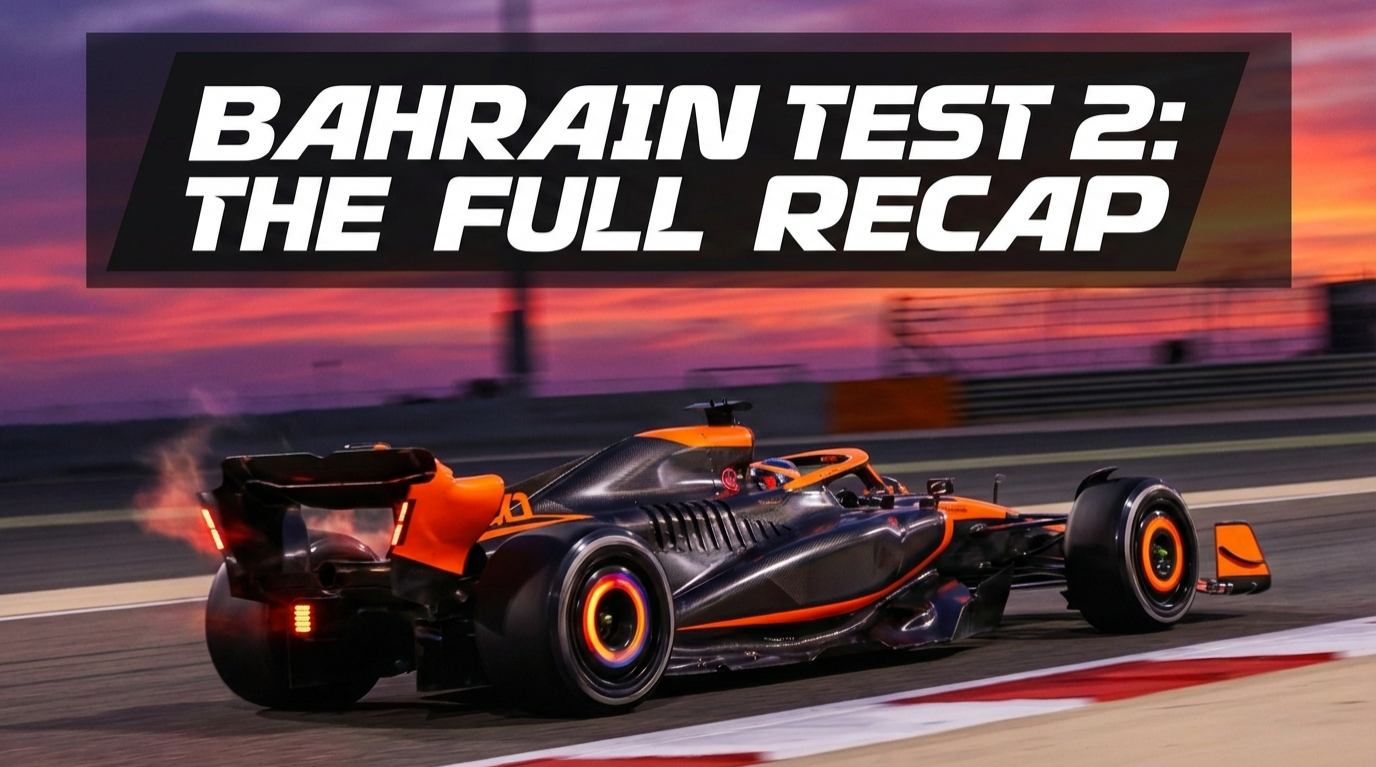
Leclerc drills a 1:33.739 to lead the field, Antonelli proves he belongs at the front — but the bigger story is exploding off-track, where an engine loophole threatens to reshape the entire 2026 season before it even begins.
Full Day Combined — Feb 18, 2026 — Top 3
When Charles Leclerc rolled out of the Ferrari garage on February 18 and drilled the fastest lap time of Bahrain Test 2 — a blistering 1:33.739 — the entire paddock stopped and took notice. But if you think F1’s 2026 pre-season simply comes down to who’s quickest, you haven’t been paying attention. Bahrain Test 2 delivered equal drama on the track and off it, and the 2026 pecking order remains as murky as the Saharan dust that rolls across the circuit at sundown.
Leclerc Leads and Ferrari Looks Dangerously Ready
Ferrari played it unusually quiet through the opening stages of 2026 testing. Fred Vasseur brought a deliberate “Spec-A” car to the first Bahrain test, avoiding any performance showboating while rivals argued publicly about who to fear. Consequently, the scarlet cars spent that opening week quietly racking up laps and harvesting data.
Then Day 1 of Test 2 arrived, and Leclerc essentially said — right, enough of that.The Monégasque driver seized the fastest time across the entire morning session — and the fastest anyone had gone across both test weeks — completing 70 laps with impressive mechanical reliability. Crucially, Ferrari arrived with a freshly upgraded rear wing package and new aerodynamic elements, signalling a clear shift from data-gathering mode into genuine race-prep territory.
Meanwhile, Lando Norris slotted into P2 with a 1:34.052, and despite sitting 0.313 seconds back, the McLaren camp looked visibly relaxed. Norris explored long-run pace and different fuel loads throughout the day, suggesting the papaya orange car carries more performance than the timesheet reveals. McLaren, as reigning constructors’ champions, traditionally hide their best until lights go out in Melbourne.
Antonelli Is the Real Deal — and Everyone Knows It
One driver’s name keeps appearing in every post-session debrief this pre-season — Kimi Antonelli. The 18-year-old Italian, who grabbed Lewis Hamilton’s seat at Mercedes after the seven-time world champion completed his sensational switch to Ferrari, clocked a 1:34.158 in the morning session — third fastest on a genuinely competitive timesheet. Moreover, he did so with 69 laps under his belt, demonstrating not just raw speed but race-worthy consistency.
For context, Antonelli drilled a 1:33.669 during the first Bahrain test — setting the benchmark that every rival has been chasing since. His early maturity behind the wheel of one of F1’s most complex cars ever, featuring a near-50/50 hybrid power unit and active aerodynamics, silenced any lingering doubts about his readiness for this level.
The Engine War That Could Change Everything
Here is where things get genuinely explosive. During the second Bahrain test week, the FIA triggered a 10-day vote among the five power unit manufacturers, proposing a change to how engineers measure compression ratios. That sentence might sound dry. The implications absolutely are not.
F1’s 2026 regulations dropped the maximum compression ratio — essentially how tightly an engine squeezes its fuel-air mixture — from 18:1 down to 16:1. Regulators designed this change to make new power units more accessible for newcomers like Cadillac and Audi. However, the critical loophole lies in the fact that officials currently measure this ratio at ambient temperature — when the engine sits cold and stationary in the garage.
Mercedes found a clever way to satisfy the 16:1 limit during those cold static checks, then allow the ratio to climb toward the old 18:1 figure once the engine reaches operating temperature on track. Ferrari, Audi and Honda fired a joint letter at the FIA demanding action. Engineers estimate this approach delivers up to 13 extra horsepower — roughly four tenths of a second per lap.
The FIA now proposes that from August 1, 2026, teams must demonstrate compliance both at ambient conditions and at 130°C operating temperature. The vote goes to the five manufacturers — Mercedes, Ferrari, Audi, Red Bull Powertrains and Honda — and needs a supermajority to pass. Toto Wolff remains defiant, insisting Mercedes designed the engine in open dialogue with the FIA and the regulations are “crystal clear.” The outcome will define the entire first half of the season.
Red Bull and Cadillac Are Struggling Where It Hurts
While Ferrari cruised through the morning and Mercedes fought its political war, two teams spent significant portions of Day 1 in the garage. Red Bull’s Isack Hadjar completed just 13 laps after a water system issue struck the RB22 early in the day. Max Verstappen sat out entirely, conserving himself for Thursday.
For a team carrying four world championships and a brand-new in-house power unit to prove, reliability problems this late in pre-season carry real psychological weight. The Red Bull Ford Powertrains engine impressed during Test 1, delivering spectacular energy deployment on the straights. But question marks keep mounting.
Cadillac faced a different but equally significant challenge. F1’s 11th team scraped together just 59 laps between Sergio Perez and Valtteri Bottas — a sensor failure hit first, then a total loss of telemetry followed. Aston Martin endured their own nightmare when Lance Stroll veered into the gravel at Turn 11 and triggered a red flag, ending his afternoon after seven laps.
Fernando Alonso had already lost his morning to an engine-related issue, managing just 28 laps — and Stroll himself confirmed the AMR26 sits roughly four seconds off the pace on current settings. For Cadillac, teething issues form part of any debut team’s expected learning curve. But Australia is weeks away, not months.
The Verdict — No One Is Safe
The 2026 F1 pecking order is a mess, and that’s exactly what makes it brilliant. Three days of testing remain. The FIA vote lands soon. And on March 8, the lights go out in Melbourne. If pre-season tells us anything, 2026 won’t hand us a clear favourite. It’s going to hand us a war.
Team Verdicts — Who’s Actually Ready for Melbourne?
Race-ready reliability, fresh aero upgrades and Leclerc at his confident best. The SF-26 looks like the benchmark in 2026 so far — and Ferrari are keeping plenty in reserve.
Blistering pace — George Russell topped the full day at 1:33.459 in the afternoon — but the engine controversy hangs over everything. Speed is not their problem right now.
Norris and Piastri consistently productive, logging 124 laps on Day 1 alone. The reigning champions are saying nothing — which is exactly what champions do when they feel comfortable.
Impressive power unit in Test 1, but reliability issues have returned. Verstappen sits out days strategically — smart, but the pressure to validate their in-house engine is real.
Lance Stroll red-flagged, Alonso limited to 28 laps. Adrian Newey’s AMR26 has a very narrow operating window. Lance Stroll himself noted the team appears roughly four seconds off the pace.
Teething reliability issues continue, but the team is building knowledge rapidly. Australia will likely mean starting at the back — that was always the plan. The real story is 2027.


1 Comment