WHAT IS THE MADRING CIRCUIT
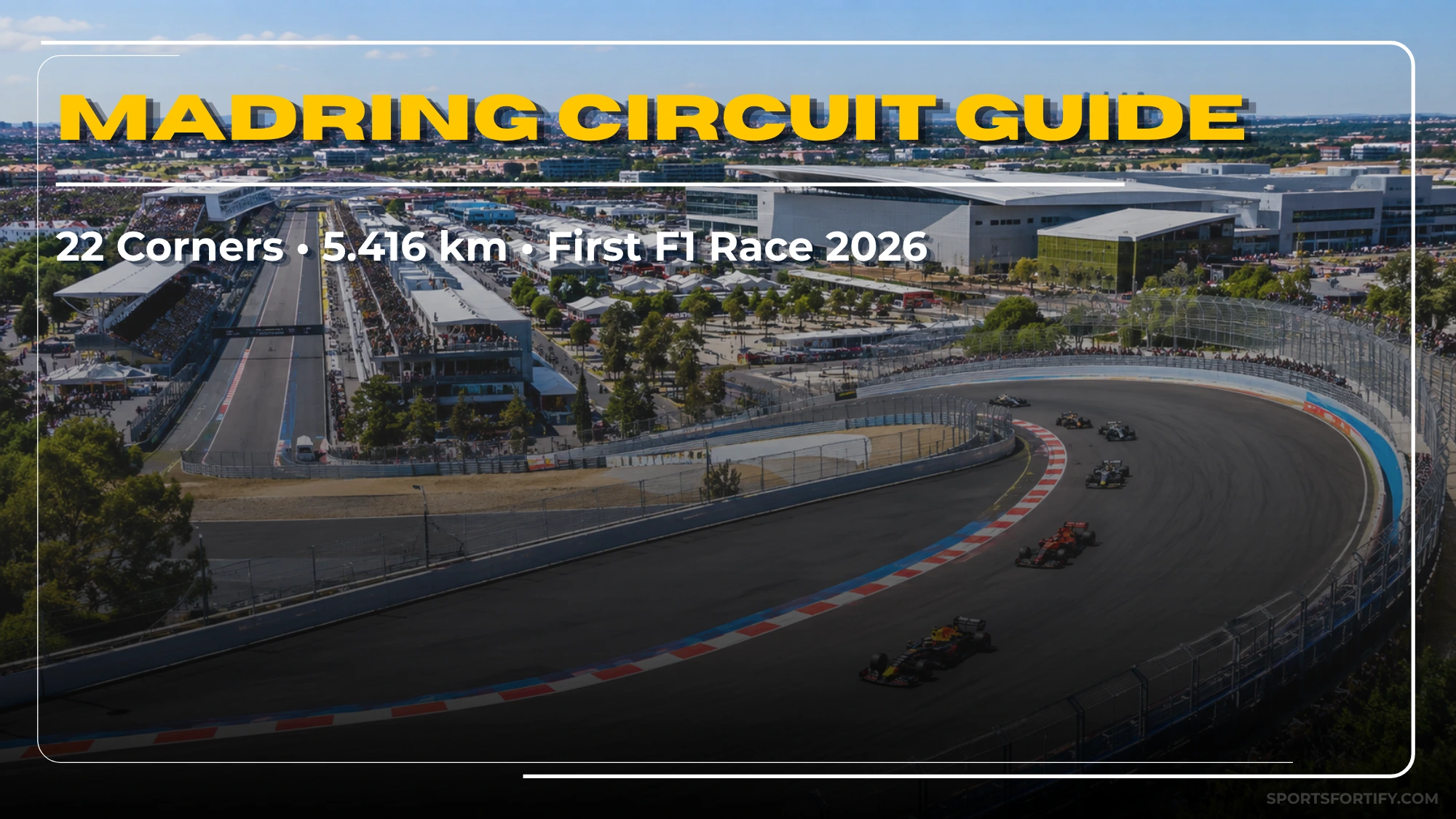
MADRING is Formula 1’s brand new circuit in Madrid, hosting the 2026 Spanish Grand Prix for the very first time. Nobody on the current grid has raced here before. So every lap this weekend writes a genuinely new chapter, with no lap record, no pole history, and no setup data for teams to lean on.
Call it a street circuit and you’d be technically wrong. MADRING mixes purpose-built sections with public roads, sitting somewhere between Monaco’s tight city racing and a permanent facility like Barcelona. F1 itself describes it as a combination of public roads and private land. That mix gives MADRING long high-speed sections most street circuits never get close to.
WHERE IS THE MADRING CIRCUIT
MADRING sits in the Valdebebas and IFEMA district of Madrid, close to Adolfo Suárez Madrid-Barajas Airport. The circuit wraps around the IFEMA Madrid exhibition centre, with sections pushing onto public roads nearby. It also sits close to the Real Madrid training centre, giving the area a mix of sport and convention-centre infrastructure most F1 venues don’t have.
Organisers have pushed hard on transport access. F1 estimates around 90 percent of fans could reach the circuit by public transport, and the whole site sits just minutes from the airport.
MADRING CIRCUIT KEY FACTS
MADRING Key Facts
| 📍 Location | Madrid, Spain |
| 🆕 First F1 Race | 2026 |
| 📏 Circuit Length | 5.416 km |
| 🔄 Corners | 22 |
| 🏎️ Race Laps | 57 |
| 📐 Race Distance | 308.524 km |
| ↩️ Direction | Clockwise |
| 📅 Race Date | September 13, 2026 |
| 🏟️ Circuit Type | Hybrid / Semi-Urban |
| 🎯 Signature Corner | Turn 12, La Monumental |
| 📐 Maximum Banking | 24% |
| 🚀 Top Speed | ~340 km/h |
| ⛰️ Elevation Change | 26 m |
| 🚇 Tunnel | Yes, before Turn 18 |
| ⏱️ Lap Record | Not yet set |
MADRING CORNER BY CORNER
The lap opens on a 589-metre main straight, cars hitting around 320 km/h before a brutal braking zone into Turn 1, one of five official overtaking spots on the track. Turn 3, Hortaleza, launches the field into the fastest stretch of the lap, where Turn 4 gets taken flat at 340 km/h before Turn 5 brutally kills that speed down to 80 km/h.
From there, Turns 6 and 7 climb through Subida de las Cárcavas, cresting blind at the circuit’s highest point before a downhill drop into Turn 8, El Búnker, named for nearby Civil War fortifications. Turns 10 and 11, La Chicane, set up the circuit’s signature moment.
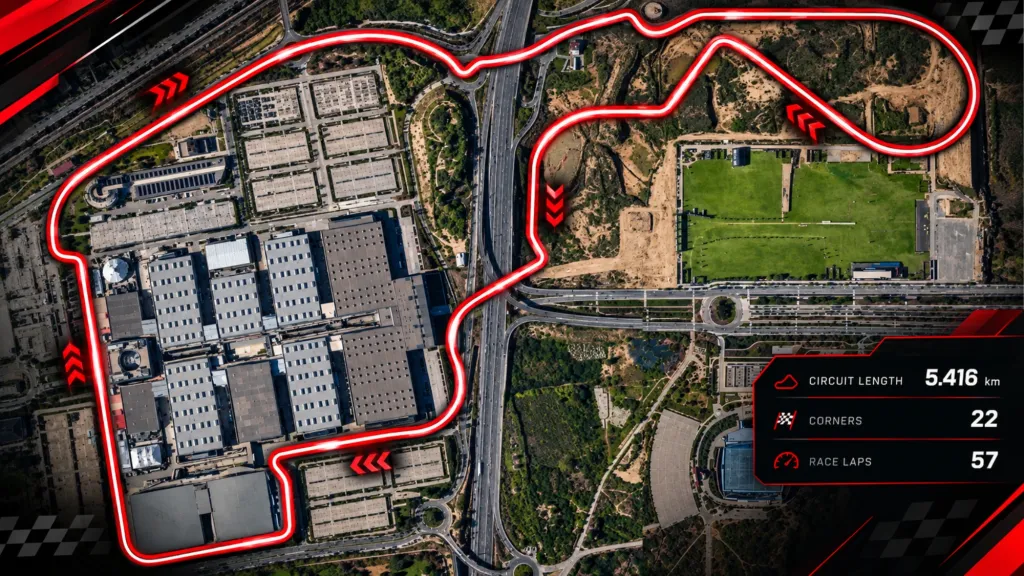
That’s Turn 12, La Monumental, a 550-metre banked corner named for its bullring shape, the longest banked corner on the entire 2026 calendar. Cars exit above 300 km/h straight into another heavy braking zone at Turn 13. Turns 14 through 16, Las Enlazadas de Valdebebas, run flat out before Turn 17 brings the next big overtaking chance.
Turn 18 sits right after the circuit’s tunnel, linking the Valdebebas side to the IFEMA section. Turns 19 and 20 bring fast running alongside the exhibition halls before another braking zone. Turns 21 and 22 close the lap, with Turn 22, El Parque, feeding straight back onto the main straight, so exit speed here shapes the entire following 589 metres.
LA MONUMENTAL EXPLAINED
La Monumental’s 24 percent figure is a gradient, not an angle in degrees. Converted, that works out to roughly 13.5 degrees, still among the steepest banking in modern F1. Zandvoort’s famous banked corner hits around 18 degrees at its steepest point, but La Monumental makes up the difference through sheer length instead.
Drivers spend around six seconds committed inside this one corner. Carlos Sainz has suggested cars could enter around 180 to 200 km/h and keep accelerating the whole way through. That’s real, sustained tyre load rather than the short, sharp hit most banked corners produce.
BEST OVERTAKING OPPORTUNITIES AT MADRING
Madring’s own circuit information names five official overtaking zones. Turn 1 drops from 320 to 100 km/h. Then Turn 5 falls from 340 to 80 km/h. Next, Turn 13 brakes from over 300 down to 140 km/h. Turn 17 slows cars from 280 to 100 km/h. Turn 20 brings drivers down from 260 km/h into a tight right-hander. That list comes directly from the circuit’s own material, not a guess based on the track map.
TYRES AND RACE STRATEGY AT MADRING
Pirelli brings the C2, C3, and C4 compounds to Madrid, its hard, medium, and soft range for this circuit. The real story sits inside La Monumental. A 550-metre banked corner doesn’t give tyres the usual short, sharp hit of lateral load. It gives them a sustained six-second squeeze instead, raising real questions about tyre temperature across a full stint. Two-stop strategies are already being floated as a possibility, though nobody’s raced here yet to confirm it.
WHAT MAKES MADRING DIFFERENT FROM BARCELONA
Barcelona rewards decades of accumulated setup data. MADRING gives teams none of that. This is a track with no previous winner, no pole record, no lap record, and no historical tyre data to lean on. Compare that with our Spanish Grand Prix 2026 Barcelona guide, and the gap becomes obvious. Even with simulation work, a Ferrari filming day in July, and an FIA Formula 3 test in August already banked, the first real F1 weekend will still teach teams things no simulator fully captures.
MADRID SPANISH GP 2026 SCHEDULE AND TIMING
For the full three-day session schedule and worldwide race start times, see our Madrid Spanish Grand Prix 2026 Race Guide.
FAQ
The MADRING circuit has 22 corners across 5.416 km. An earlier design-stage proposal listed 20 corners and 5.474 km, but that figure belongs to an older, since-revised layout, not the final circuit.
MADRING sits in the Valdebebas and IFEMA district of Madrid, close to Adolfo Suárez Madrid–Barajas Airport and the Real Madrid training centre.
Not technically. MADRING mixes purpose-built track with public roads, which makes it a hybrid or semi-urban circuit rather than a pure street circuit like Monaco.
There isn’t one yet. This weekend marks the first F1 race ever held at the circuit.
MADRING measures 5.416 km, based on F1’s current official circuit page. The race runs 57 laps for a total distance of 308.524 km.