
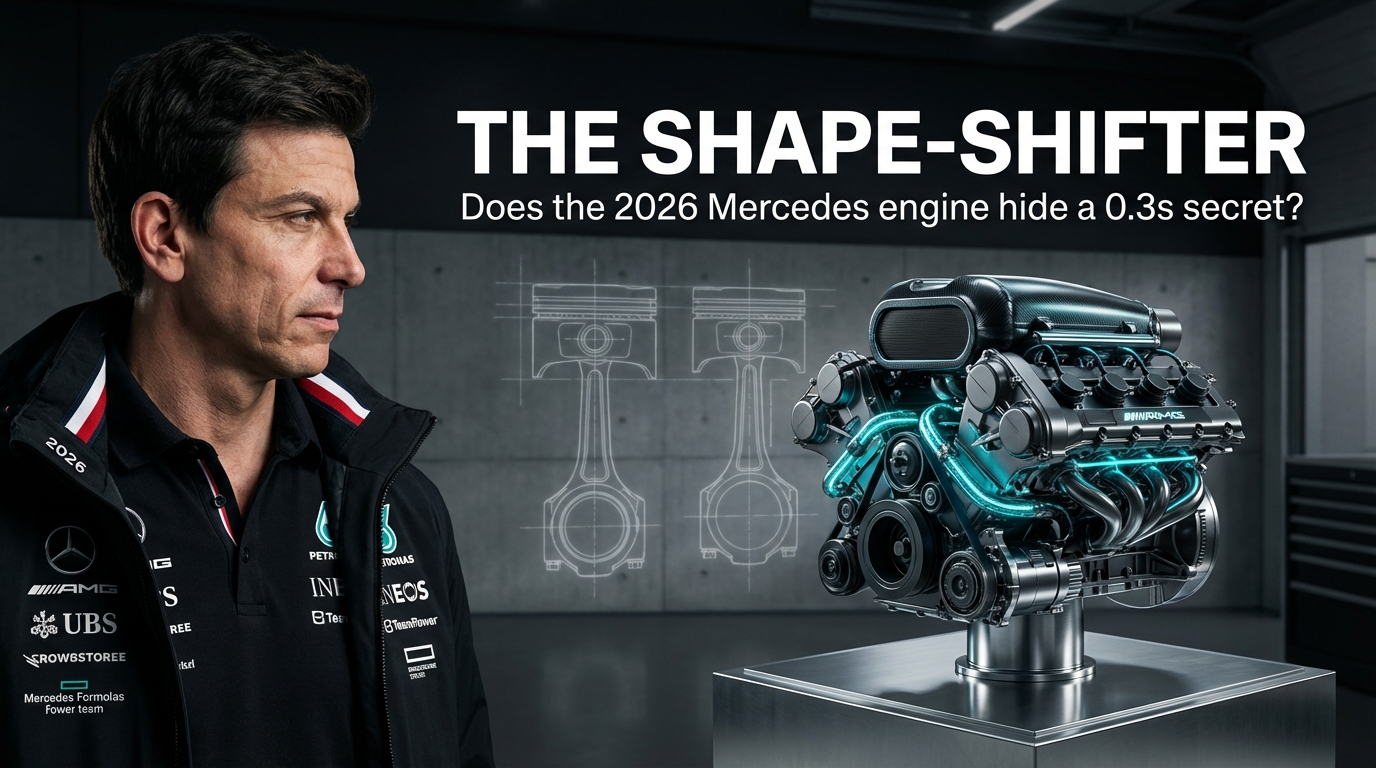
The Formula 1 paddock is in a state of civil war as Ferrari and Audi lead a charge against a suspected Mercedes 2026 engine loophole that could be worth three-tenths of a second per lap.
As we stand in February 2026, the sport is on the precipice of its most significant regulatory shift in over a decade. Yet, instead of celebrating the arrival of sustainable fuels and 1,000-horsepower hybrid monsters, the conversation is dominated by a singular, polarizing piece of engineering. The Mercedes 2026 engine has become the lightning rod for a dispute that threatens to land in the hands of the stewards before the first light turns green in Melbourne.
The technical trick behind the compression ratio row
At the heart of this storm is a concept that sounds like a university physics lecture but carries the weight of a world championship—the compression ratio. For the 2026 cycle, the FIA mandated a drop in the maximum geometric compression ratio from 18:1 to 16:1. This was a deliberate move to simplify development for newcomers like Audi and Red Bull Powertrains.
However, engineers at Brixworth appear to have played a different game. While the Mercedes 2026 engine passes the official FIA static test at ambient temperature with a perfect 16:1 score, rivals claim it is a “shape-shifter” once it hits operating heat.Through the clever use of material science and 3D-printed pistons, Mercedes has allegedly developed a system where thermal expansion effectively closes off “pockets” or changes the combustion chamber volume as the engine gets hot.
This design allows the unit to creep back toward that old 18:1 limit during a race, generating a massive efficiency and power boost that designers specifically drafted the regulations to prevent. It is the ultimate “grey area” play—legal in the garage, but potentially non-compliant on the Mulsanne Straight.
Why Ferrari and Audi are forming an unlikely alliance
It is rare to see Maranello and Ingolstadt singing from the same hymn sheet, but the threat of a Mercedes 2026 engine walkover has unified the grid. Ferrari, Honda, and Audi have penned a joint letter of concern to the FIA, demanding that officials change how they take these measurements. Their argument is simple—the spirit of the law states 16:1 is the limit, and using temperature as a cloak to hide extra performance violates the catch-all clause that cars must comply with regulations at all times.
The tension is palpable because these teams have spent hundreds of millions of dollars developing their own units under a strict cost cap. If Mercedes has found a way to run a “hot” ratio that no one else can replicate without a total redesign, the 2026 season could be over before it begins.
Red Bull’s position is even more curious, as they were initially suspected of the same trick but have recently pivoted to support the protestors. This suggests they either couldn’t get their version to work reliably or realized the Mercedes 2026 engine implementation is vastly superior.
Toto Wolff and the art of the defensive counter-attack
Never one to shy away from a paddock scrap, Toto Wolff has been characteristically blunt. Speaking at the launch of the W17, he dismissed the accusations as nothing more than pre-season jitters from teams who haven’t done their homework. According to the Silver Arrows, they have been in constant dialogue with the FIA throughout the development of the Mercedes 2026 engine to ensure every bolt and piston meets the letter of the law.

Wolff’s confidence stems from a very specific legal reality. The FIA’s own documentation specifies that the compression ratio is checked under static conditions at ambient temperature. If the governing body changes the rules now, they risk a massive legal challenge from Mercedes, who designed their entire architecture around the existing testing protocols. It is a classic F1 stalemate—one side claims cheating, the other claims superior innovation, and the referee is caught in the middle.
The FIA’s impossible dilemma before Melbourne
The governing body is currently walking a tightrope with no safety net. FIA Technical Director Nikolas Tombazis has held multiple meetings with the Power Unit Advisory Committee in the last week, but a “quick fix” is almost impossible. You cannot simply ask a manufacturer to change the internal architecture of a V6 engine three weeks before the Australian Grand Prix.
The FIA has already homologated the power units, effectively freezing their designs for the season. If officials introduce a new ‘hot’ measurement test now, the Mercedes 2026 engine will likely fail, potentially disqualifying nearly half the grid—including McLaren, Williams, and Alpine.
However, if they do nothing, they risk a season of total dominance that could alienate fans and sponsors alike. The rumor in the paddock is a “2027 compromise”—allowing the current designs for this year but closing the thermal expansion loophole for the following season. It is a solution that satisfies no one and leaves the 2026 championship under a permanent cloud of suspicion.
What this means for the 2026 championship battle
If the current status quo holds, George Russell and Kimi Antonelli could be heading into Melbourne with a distinct advantage. Early data suggests the “thermal trick” could be worth up to 17 seconds over a full race distance. In a sport where milliseconds decide titles, that gap feels like an eternity. We are seeing a repeat of the 2014 era, where Mercedes arrived with a power unit so advanced it made the rest of the field look like they were standing still.
The true test will come during the Bahrain tests later this month. If the Mercedes-powered cars are consistently topping the speed traps while showing bulletproof reliability, expect the “secret letters” to turn into formal protests. Formula 1 intended the 2026 season to be a fresh start, but teams have quickly turned it into a high-stakes game of legal poker.
Experts still debate whether the Mercedes 2026 engine represents a masterpiece of engineering or a clever piece of rule-bending, but the unit has already ensured that controversy will define the 2026 season as much as the racing itself.


2 Comments