
Six weekends a year, F1 drivers race twice. The first race is shorter, sharper, and happens on Saturday. The second is the main Grand Prix on Sunday. Understanding how both fit together makes the whole weekend ten times more enjoyable to follow.
The F1 sprint weekend is one of the most exciting formats in the sport right now. New fans often find it confusing because it packs two separate races into a single weekend.
What Is an F1 Sprint Weekend
A standard F1 weekend includes three practice sessions, one qualifying session, and one Grand Prix. An F1 sprint weekend works completely differently. It replaces most of the usual practice time with a tighter, faster schedule that includes an extra mini-race called the Sprint.
Think of it as getting a bonus match before the main event. Two separate races happen across the same weekend, and each one has its own starting grid, its own battles, and its own points up for grabs. The Sprint format first appeared in 2021 with just three trial events. By 2026, it had grown into a settled six-weekend format that feels like a permanent and popular part of the season.
That second race is shorter and takes place before Sunday. It rewards the top eight finishers with real championship points.
What actually happens during a standard race weekend follows a completely different structure, so understanding the contrast helps new fans follow sprint weekends much more easily.
What Does the Sprint Weekend Schedule Look Like
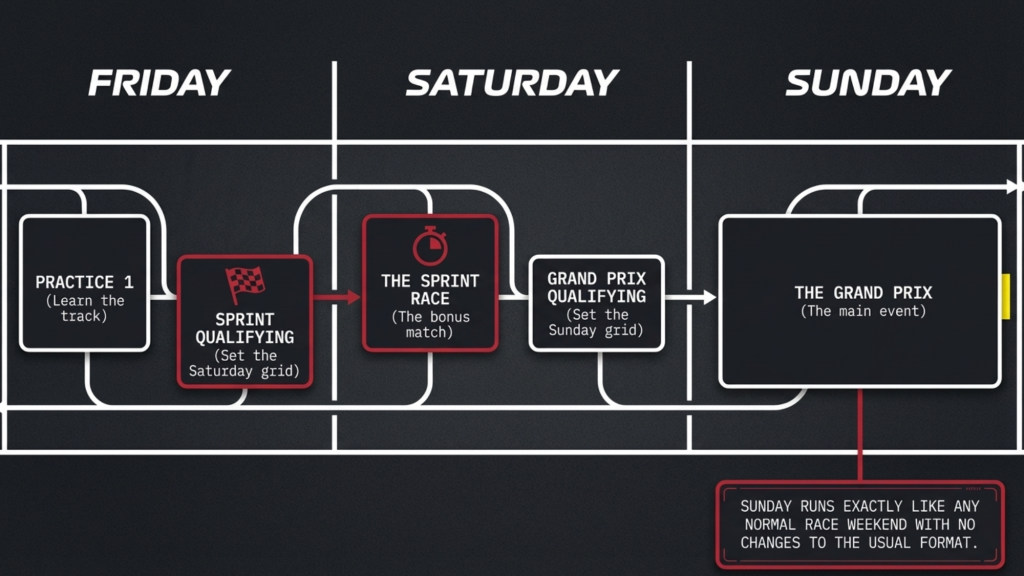
The schedule moves fast across three days. On Friday, teams get just one practice session to learn the track. Sprint Qualifying follows later that same afternoon to decide who starts where on Saturday. On Saturday morning, the Sprint Race takes place, covering roughly 100 kilometres in around 30 minutes.
Then, later that same afternoon, full Qualifying sets the grid for the Sunday Grand Prix. Sunday runs exactly like any normal race weekend with no changes to the usual format. Every session carries more pressure because there is very little room to fix mistakes once the weekend is underway.
Each day has something important at stake, which makes sprint weekends feel more intense for drivers and fans alike.
How Does Sprint Qualifying Work
Sprint Qualifying follows a knockout format, just like regular Qualifying but shorter and sharper. It runs across three stages called SQ1, SQ2, and SQ3.
SQ1 lasts 12 minutes and eliminates the four slowest drivers. SQ2 runs for 10 minutes and cuts the field further. SQ3 then runs for just 8 minutes to decide the top ten starting positions for the Sprint Race.
Tyre rules also apply here. Drivers must use Medium tyres in SQ1 and SQ2, then switch to Soft tyres for SQ3. The fastest driver in SQ3 earns pole position for the Sprint.
Every lap matters in Sprint Qualifying because the sessions are so short that a single mistake can end any chance of a strong Sprint result.
How Are Sprint Points Different From Race Points
Sprint points and Grand Prix points use completely different scales. Sprint totals are much smaller, so one sprint win cannot swing the championship alone. However, across six sprint weekends in a season, those extra points add up quietly and often separate championship rivals by a meaningful gap when the final races arrive.
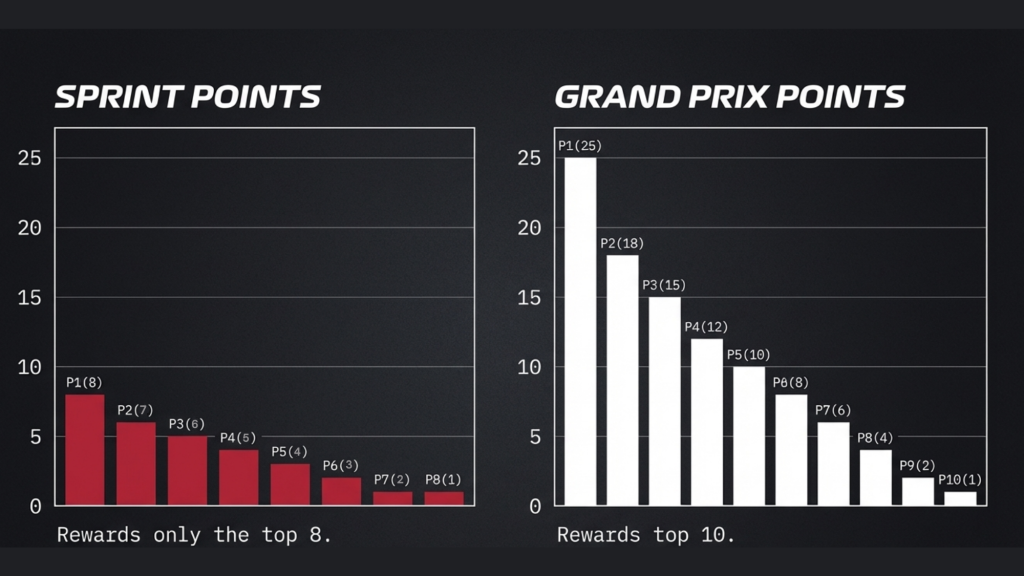
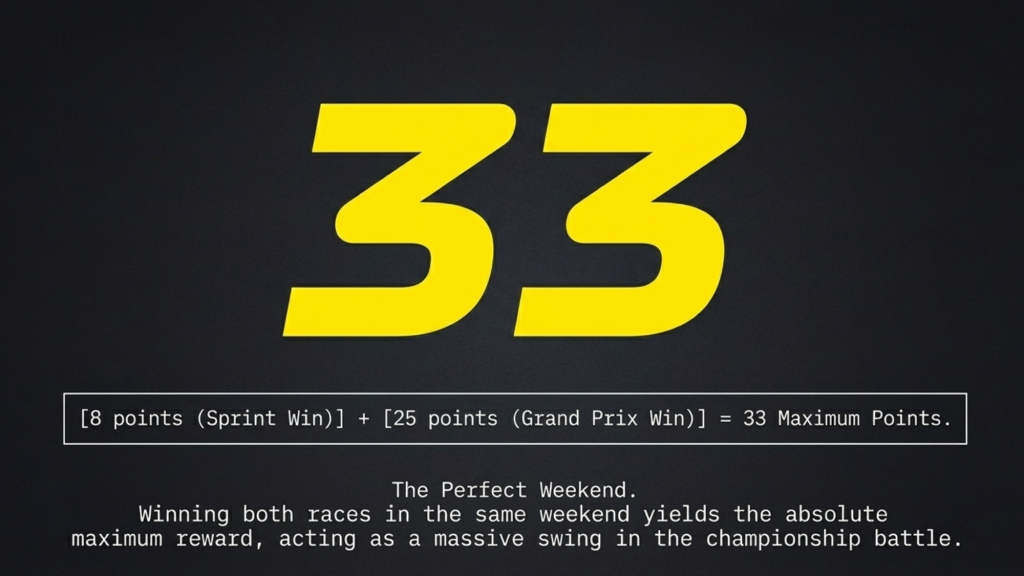
The points system awards different totals for the Sprint compared to the Grand Prix, so winning both the Sprint and the Grand Prix at the same weekend is the best possible result a driver can have. A Sprint win pays out 8 points and a Grand Prix win adds 25 on top.
That brings the total to 33 points from a single weekend. To put that in perspective, a driver who skips both podiums entirely walks away with nothing. Those 33 points can swing the championship picture dramatically, especially when rivals have a bad weekend at the same round.
Why Sprint Weekends Change Team Strategy
Strategy becomes much harder on an F1 sprint weekend. Normally, teams use three practice sessions to test setups, try different tyre compounds, and gather data from the track. On a sprint weekend, they get just one hour to do all of that before competitive running begins.
Once Sprint Qualifying starts, parc fermé locks the car setup in place through the Sprint Race. However, 2026 brought one important change. Teams are now released from those restrictions after the Sprint Race completes, giving engineers a brief window to adjust the car before Grand Prix Qualifying later that same afternoon.
That release window after the Sprint is new and important. It means teams can react to what they learned from the Sprint Race before committing their car to the Grand Prix setup.
Which 2026 Races Are Sprint Weekends
Six weekends in 2026 use the F1 sprint weekend format. Those rounds are China, Miami, Canada, Britain at Silverstone, the Netherlands at Zandvoort, and Singapore. Canada, Zandvoort, and Singapore are hosting their very first Sprint weekends ever in 2026, while Silverstone returns to the format for the first time since the very first Sprint event back in 2021.
Six weekends across the 2026 calendar use the sprint format and they spread throughout the season rather than bunching together, which means teams face these high-pressure rounds at very different stages of the championship fight.
Drivers who score consistently in Sprint Races often build a quiet but important points buffer that proves decisive when the title battle reaches its final rounds.
FAQ
No. The Sprint Race is completely standalone. A separate Qualifying session runs on Saturday afternoon after the Sprint finishes, and that session alone decides who lines up where on Sunday.
The Sprint winner earns 8 points. Points go to the top eight finishers, starting at 8 for first place and dropping down to 1 point for eighth.
No mandatory pit stops exist in the Sprint. The race covers only 100 kilometres, which is too short for tyre changes to make any strategic sense. Drivers run flat out from start to finish on a single set of tyres, unless a puncture or damage forces them to stop.


5 Comments