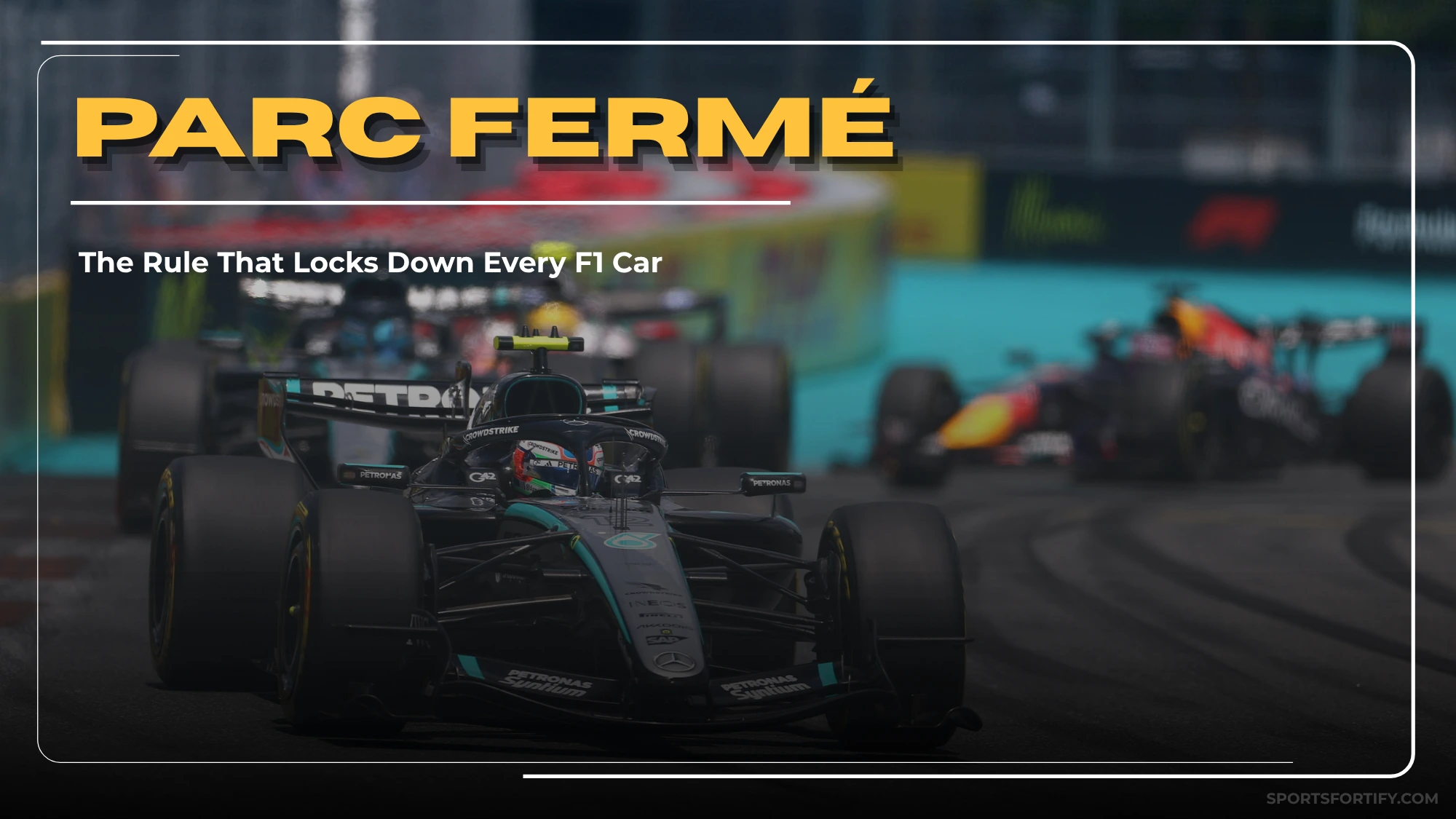
The moment qualifying ends, a padlock goes on every car in the field. Engineers step back. Mechanics clear the area. The cars sit in a supervised zone where even one unauthorised adjustment can trigger a penalty that erases everything built on Saturday. That zone is parc fermé. Parc ferme F1 rules separate the teams that prepared properly from those that gambled and lost before Sunday even begins.
What Does Parc Ferme Mean in F1
Parc fermé is a French phrase that translates to “enclosed park” or “closed park.” In Formula 1, it refers to a strictly controlled secure area where cars must remain after qualifying ends. No team member can touch a car inside parc fermé without a steward watching and direct authorisation from the FIA. The phrase has been part of motorsport regulations for decades and applies at every round of the calendar.
Think of it as a sealed evidence locker. Whatever goes in is what must come out for race day.
When Does Parc Ferme Start in an F1 Race Weekend
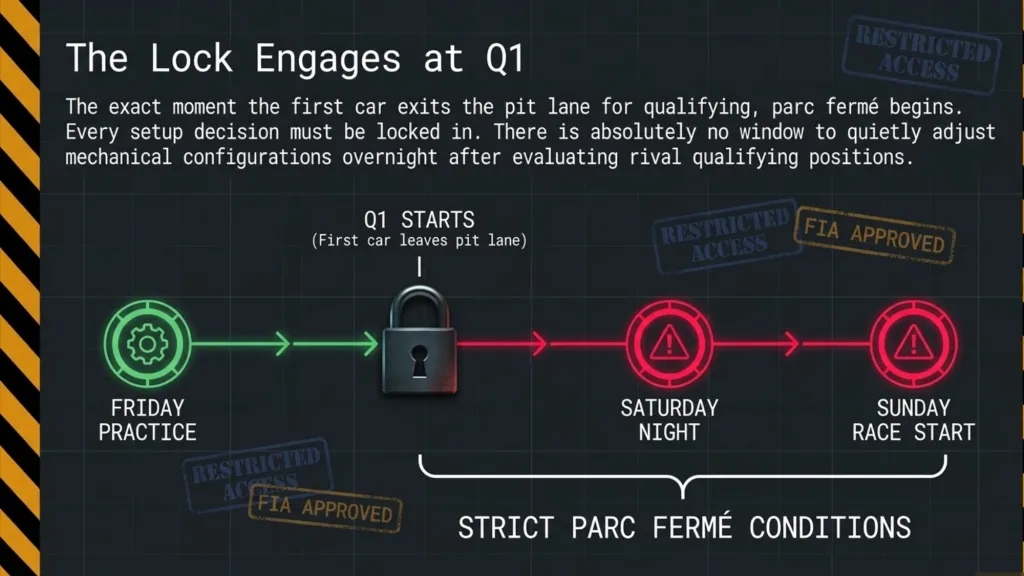
Parc fermé conditions begin the moment the first car leaves the pit lane for qualifying. Importantly, this means teams must lock in every setup decision before Q1 starts. Whatever mechanical configuration the car carries into qualifying must remain in place through to the race start on Sunday afternoon. There is no window to quietly adjust things overnight after seeing where rivals qualified.
On a sprint weekend the timeline shifts. Parc fermé starts after sprint qualifying and carries through the sprint race, with a limited working window before the main grand prix.
What Are the Parc Ferme Rules in F1
Parc ferme F1 regulations exist to level the playing field between qualifying and race day. Every team faces the same restrictions regardless of budget. The FIA stewards supervise all overnight work on the cars. Consequently, the car that qualifies on Saturday is essentially the same specification that lines up on the grid on Sunday. This prevents teams from building a pure qualifying car and then secretly rebuilding it for the race.
This stops teams from running an aggressive low-fuel setup to grab pole and then fitting a completely different race package overnight.
Which Car Adjustments Are Actually Permitted
Not everything is frozen completely. However, the list of permitted changes is deliberately short. Teams can switch to their chosen race tyres, adjust the front wing within approved limits and carry out repairs on genuine qualifying damage. Meanwhile, anything beyond that list requires written FIA permission and approval is only granted for genuine safety concerns. Performance-based requests get refused regardless of how politely teams ask.
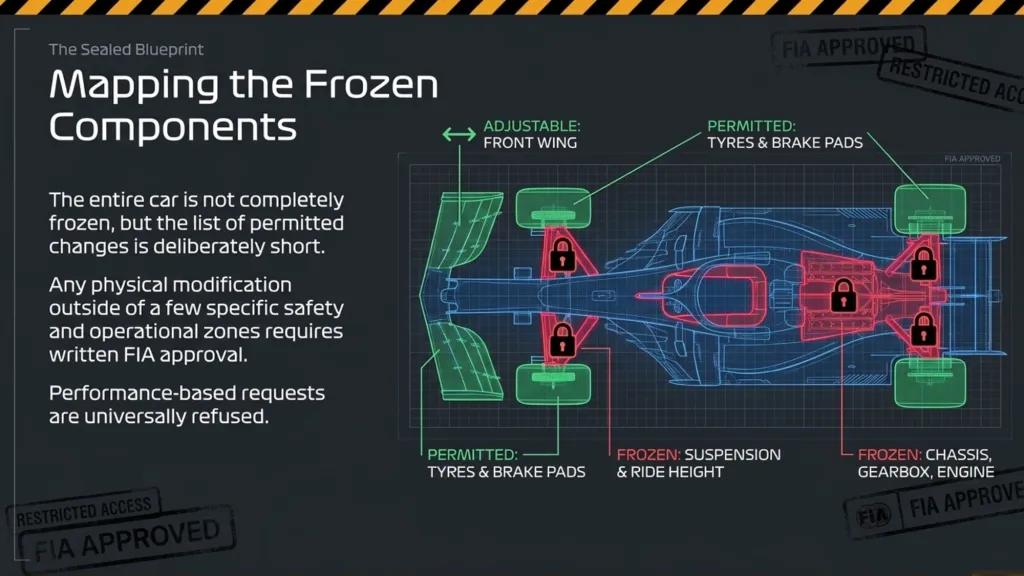
Here is exactly what teams can and cannot do under parc fermé.
Permitted without steward approval:
- Tyre changes to the chosen race compound
- Front wing angle adjustments within the allowed range
- Repairs to bodywork or components damaged during qualifying
- Brake pad replacements
- Fuel and basic fluid top-ups
Not permitted without FIA approval:
- Suspension geometry or ride height changes
- Gearbox ratio modifications
- Aerodynamic component swaps
- Engine specification changes beyond declared parameters
- Any setup changes aimed at improving race performance
How Does Parc Ferme Affect Race Strategy in F1
Parc fermé forces teams to make one of the most pressured decisions of the weekend before they even know where they will start. Every setup choice made in qualifying reflects what the team expects race conditions to be. Additionally, because tyre selections lock in under parc fermé, teams must predict Sunday’s weather and track evolution on Saturday morning. Get that calculation wrong and the race strategy collapses before the lights go out.
This is why teams sometimes qualify with a slightly conservative setup. A car that starts fourth with a strong race configuration is often better placed than one that takes pole and spends 50 laps destroying its tyres.
What Happens If You Break Parc Ferme in F1
Breaking parc ferme F1 rules brings one of the most punishing self-inflicted penalties in motorsport. An unauthorised modification does not earn a time penalty or a grid drop. Instead, the car takes a pit lane start and loses its qualifying position entirely. Furthermore, a car that qualifies from pole can find itself lining up behind every other car before the formation lap even begins.
Interestingly, teams sometimes choose this penalty deliberately. If a critical component fails overnight, accepting the pit lane start and fixing the problem properly can be the smarter call than starting from the grid with a car that might not last ten laps.
Teams also face parc fermé pressure when weather changes between sessions. Rain does not automatically unlock additional setup freedom. Any modification request still needs steward approval, and the FIA only grants it when safety is genuinely at risk. Chasing a performance advantage in changing conditions still gets refused, no matter how reasonable the argument sounds.
FAQs
The term comes directly from French and means “enclosed park” or “closed park.” F1 inherited the phrase from European motorsport tradition and it has remained in the official FIA regulations ever since. The name describes the physical secure area where cars are held between qualifying and the race.
Parc fermé begins when the first car exits the pit lane for qualifying and ends when the race starts on Sunday. That typically covers all of Saturday evening and Saturday night. On a sprint weekend the duration is shorter and the permitted working windows sit between specific sessions.
Engine changes are possible but they come with consequences. Any significant power unit component swap triggers either a pit lane start or a grid penalty depending on what gets replaced. Teams sometimes accept this willingly when a reliability concern makes the component change the safer option for the full race distance.