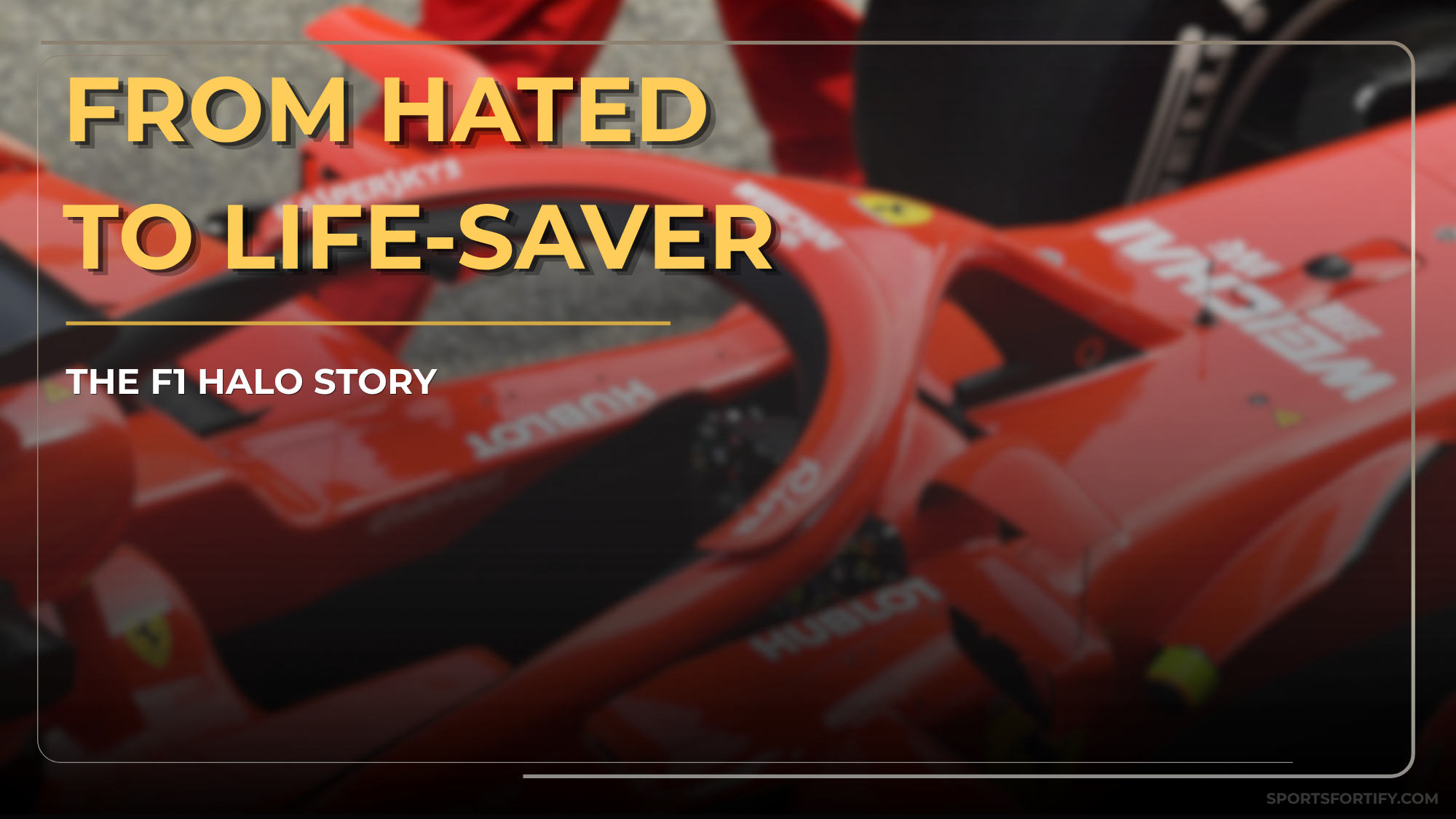
When Formula 1 introduced a titanium safety device in 2018, fans called it ugly. Drivers said it “abused the DNA” of racing. Several years later, the F1 Halo has been credited with saving multiple drivers lives.
Drivers said it ruined the sport. Yet that same device has now saved at least five drivers from certain death. Fast forward to today, and the same device has been directly credited with preventing serious injuries and saving multiple drivers.
So what exactly is the Halo? How did it go from motorsport’s most hated addition to its most celebrated safety innovation?
What Is the F1 Halo Device?
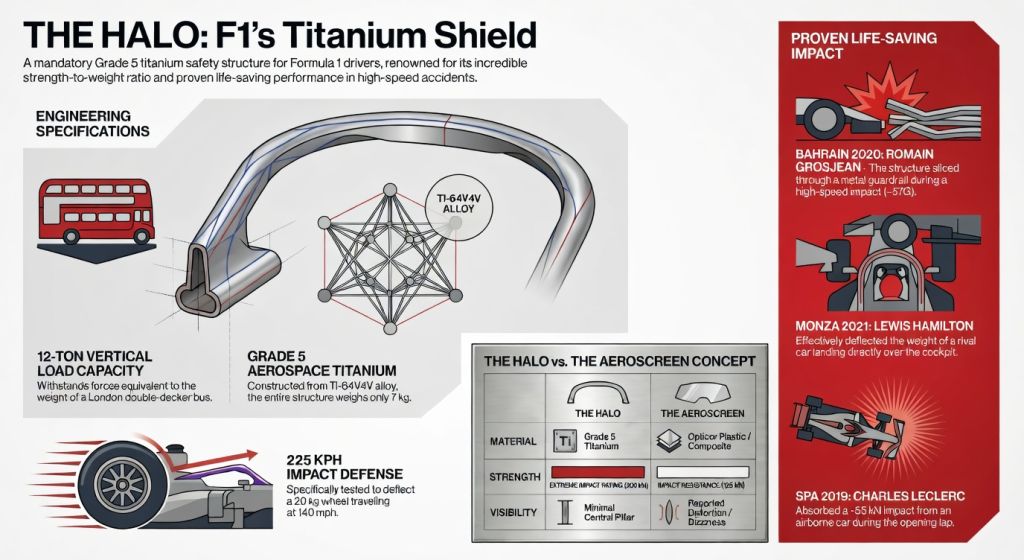
The Halo is a curved bar made from grade 5 titanium. It sits above and around a Formula 1 driver’s cockpit. Picture an upside-down U-shape that extends from behind the driver’s head. It connects to the car’s chassis at three reinforced mounting points. The device weighs approximately 7 kilograms. It acts as a protective barrier between the driver’s head and any external objects or impacts.
Don’t let its relatively light weight fool you. The F1 Halo can withstand loads equivalent to the weight of a London double-decker bus. That is roughly 12 tons of force. In FIA crash tests, it must withstand approximately 125 kilonewtons of vertical force. That load must be maintained for at least five seconds without any part failing.
The concept emerged from years of FIA safety research. They found that objects striking a driver’s head ranked among the most life-threatening scenarios in open-cockpit racing. Mercedes presented the initial Halo design in 2015, beating out Red Bull’s alternative “Aeroscreen” concept. After extensive testing, the FIA settled on the Halo. Tests included firing Formula 1 wheels directly at prototype cockpits. The design was then rolled out across all FIA-regulated racing series.
Why Fans and Drivers Initially Hated It
The resistance to the Halo wasn’t just about looks, though that was certainly a major factor. The criticisms fell into three main categories: aesthetics, philosophy, and practical concerns.
For many, the visual impact was jarring. Formula 1 cars had featured sleek, open cockpits since the inaugural world championship in 1950. The Halo fundamentally changed that iconic silhouette. Social media exploded with mockery when teams unveiled their 2018 cars. Fans created memes comparing the device to everything from toilet seats to shower shoes.
The practical concerns seemed legitimate too. Multiple drivers worried the Halo would obstruct their vision, particularly during crucial moments like race starts or wheel-to-wheel combat. There were fears it would make emergency extraction more difficult if a car caught fire. Sebastian Vettel tested an alternative transparent shield but abandoned it after one lap. He complained of dizziness and distorted vision.
The Moment Everything Changed
The first season with the Halo saw immediate validation. But one incident would silence critics more than any other. That was Romain Grosjean’s horrific crash at the 2020 Bahrain Grand Prix.
On lap one, Grosjean’s Haas car shot off the track at over 220 kilometers per hour. It speared directly into the steel Armco barrier. The impact split the barrier in two. The front half of the car punctured through while the rear section sheared off. Then came the flames. An enormous fireball engulfed the wreckage as fuel ignited.
For several agonizing seconds, TV cameras showed only fire and twisted metal. Commentators fell silent. Then, impossibly, a figure emerged from the flames. Grosjean had survived, climbing out largely unassisted despite the intense heat and suffering only burns to his hands.
The Halo had done two critical things. It prevented the barrier’s top edge from striking Grosjean’s head as the car speared through. It also created enough clearance for him to escape the burning wreckage. Without it, according to multiple safety experts, the accident would almost certainly have been fatal.Incidents of this severity force immediate race neutralisations through safety car or virtual safety car procedures that reshape the entire outcome of a Grand Prix.
Grosjean later put it plainly. “I wasn’t for the halo some years ago,” he said. “But I think it’s the greatest thing we brought to Formula 1. Without it, I wouldn’t be able to speak to you today.”
Life-Saving Incidents That Silenced Critics
Grosjean’s escape was spectacular, but it was far from the only time the Halo proved its worth. Since its introduction in 2018, the device has been credited with protecting drivers in multiple serious accidents:
- Charles Leclerc, 2018 Belgian Grand Prix: Fernando Alonso’s McLaren was launched into the air and landed directly on top of Leclerc’s Sauber. The F1 Halo absorbed the impact of Alonso’s wheel, which left visible tire marks on the titanium structure. Leclerc, who had previously expressed doubts about the device, immediately credited it with potentially saving his life.
- Lewis Hamilton, 2021 Italian Grand Prix: During the collision, Verstappen’s Red Bull mounted the Mercedes. The rear wheel ended up directly over Hamilton’s cockpit. The wheel rode along the Halo structure before the cars separated. Hamilton stated clearly, “Thank god for the Halo. That ultimately saved me.”
- Zhou Guanyu, 2022 British Grand Prix: Zhou’s Alfa Romeo flipped upside down at the start. It skidded across gravel at high speed, launched over a tire barrier, and ended up wedged against catch fencing. All of this happened while inverted. The Halo prevented his head from contacting the track surface throughout the ordeal.
- Tadasuke Makino, 2018 Formula 2 Spain: Just weeks after the Halo’s introduction, another vehicle landed on top of Makino’s car at over 250 kilometers per hour. FIA analysis concluded the device “likely prevented contact between the tire and the driver’s head.”
- Multiple junior series incidents: The Halo has also protected drivers in Formula 2, Formula 3, and W Series crashes. One example is a 2023 F1 Academy incident at Monza, where Chloe Grant’s car flew over Bianca Bustamante’s cockpit.
Initial FIA simulations suggested the Halo would improve driver survival rates by 17 percent in certain crash scenarios. Over seven years, the Halo has been credited with preventing serious injury or death in multiple incidents across F1 and junior series. Those crashes span multiple racing series. Most recently at the 2026 Japanese Grand Prix, Oliver Bearman’s 50G impact at Suzuka proved the F1 halo continues protecting drivers in the current era.
From Controversy to Universal Acceptance
The transformation in attitudes toward the Halo has been remarkable. Drivers who once opposed it are now its strongest advocates. Toto Wolff, Mercedes team principal, initially said the Halo had “terrible aesthetics.” He changed his tune after it saved Charles Leclerc. He called it “worth it” despite its looks.
The aesthetic concerns have gradually faded too. Teams eventually integrated the Halo into their overall designs rather than treating it as an afterthought. The device has become part of the car’s visual language. Some teams have even turned it into prime real estate for sponsor logos.
Visibility concerns proved largely unfounded. Drivers reported that within a few laps, they barely noticed the Halo’s presence. When focused on driving at 300 kilometers per hour, the central pillar simply isn’t in their relevant field of vision. For anyone still building their understanding of how Formula 1 works beyond individual safety features, the broader fundamentals of the sport connect everything together.
The Halo is now mandatory in Formula 1, Formula 2, Formula 3, Formula E, and IndyCar. IndyCar uses it as the structural frame for their Aeroscreen variant. It has fundamentally changed the safety standards for open-cockpit racing worldwide.
The Legacy of Looking Past Appearances
The story of the F1 Halo is a powerful reminder that innovation often faces resistance. This is especially true when it disrupts tradition or aesthetics. But it’s also a story about being willing to change your mind when evidence proves you wrong.
Today, no serious person in motorsport argues against the Halo. The device once called ugly and unnecessary has saved multiple lives and prevented countless serious injuries. When Zhou Guanyu walked away from his terrifying Silverstone crash in 2022, Carlos Sainz put it simply. “The Halo probably saved two lives today.”
The next time you watch a Formula 1 race, look at that curved titanium bar arcing over the cockpit. Beneath the carbon fiber and sponsor logos sits one of motorsport’s greatest safety achievements. It may have been controversial. It may have changed the sport’s appearance. But the F1 Halo has fulfilled its purpose. It keeps the people we watch race alive to race another day.
FAQ
Head injuries remained the biggest vulnerability after the 1980s. The cars got safer everywhere else but the driver’s head stayed fully exposed. After Jules Bianchi died in 2015, the FIA had enough. The Halo went mandatory in 2018
A tiny bit, yes. But drivers say within a few laps they completely forget it’s there. At 300 km/h, your brain has bigger things to focus on.
Strong enough to hold the weight of a double-decker bus. It weighs just 7 kg but can take 12 tonnes of force without bending. They literally fire a wheel at it at 250 km/h during testing. It has to survive that to pass.