
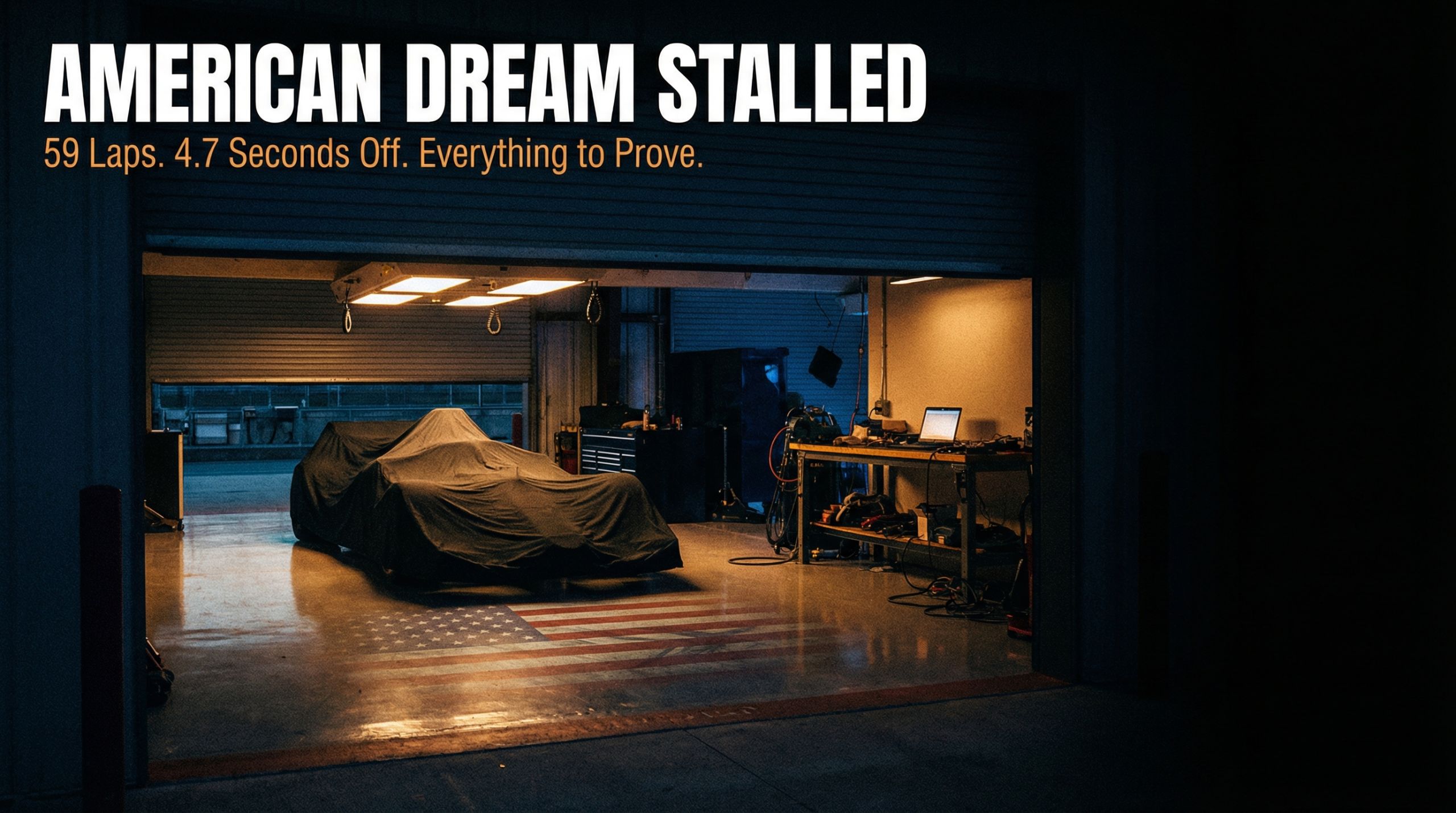
The American dream managed 24 laps before reality intervened. Cadillac F1 2026 arrived at Bahrain as the grid’s celebrated eleventh entry. By sunset, Sergio Perez had posted a 1:38.191. That sat a full 4.732 seconds behind session leader George Russell’s 1:33.459. Combined with Valtteri Bottas’s troubled afternoon stint, the team scraped together just 59 laps across both drivers.
The newest team on the grid is also the most fragile. The clock to Melbourne is already running.
4.7 Seconds Behind Russell Demands Honest Answers
Russell seized the day’s benchmark with a clean 1:33.459. Meanwhile, Perez’s best effort sat 4.732 seconds adrift. In Formula 1 that gap suggests fundamental deficiencies that compound under competitive pressure.
However, context matters here. Perez completed only 24 laps during his morning session. Bottas managed roughly 35 in the afternoon before engineers pulled the car. The combined 59 laps fell dramatically short of every other constructor’s output. For comparison, Max Verstappen completed 139 laps in the same conditions.
The gap to Russell is alarming. The data deficit behind it is even worse.
Ferrari Power Meets Cadillac Chassis and They Barely Communicate
This is the critical technical detail most headlines miss entirely. Cadillac F1 2026 does not build its own power unit. The team runs Ferrari’s 2026 power unit package. The original Cadillac F1 entry announcement confirmed the Ferrari customer deal alongside GM’s long-term manufacturing plans.Consequently, the electrical sensor failures that plagued testing are not Ferrari engine problems. They are integration failures between a proven power unit and an unproven chassis.
The Cadillac chassis and Ferrari electronics struggled to communicate throughout the day. Phantom sensor readings cascaded across multiple systems. Temperature data contradicted itself. Brake-by-wire signals flickered unpredictably. These problems point directly at the interface layer where Cadillac’s bespoke architecture meets Ferrari’s electronic systems.
Furthermore, the 2026 regulations demand flawless electronic harmony. The redesigned MGU-K pushes significantly more electrical energy through the drivetrain than any previous generation. Additionally, every active aero surface adjustment relies on real-time sensor data flowing without interruption. When sensors deliver ghost signals, the entire aerodynamic system operates blind.
Ferrari’s power unit works. Cadillac’s chassis exists. The marriage between them needs urgent fixing.
A Rear-End Failure Strangled Both Drivers
Beyond the electronics, a major rear-end mechanical failure further limited the team’s output. The issue first surfaced during Perez’s morning running. It then persisted into Bottas’s afternoon session, ultimately forcing engineers to end the day entirely.
Furthermore, this failure emerged under controlled pre-season conditions. Not aggressive qualifying simulations. Not race-distance stress loads. The car was running conservatively. The loads were manageable. Yet the rear end still broke.
When a new team cannot accumulate laps, it cannot learn how the car works. Every minute spent in the garage is a minute lost for understanding the new 2026 regulations. Cadillac is chasing stability while rivals chase lap times. That gap compounds daily.
The Grid Already Looks Daunting
The deficit sharpens against the broader 2026 picture. Russell’s Mercedes topped the sheets convincingly. The Red Bull Ford cars demonstrated strong reliability.That reliability was hard-won after the Red Bull 2026 engine suffered its own dramatic meltdown earlier in testing. Several established midfield teams completed well over 100 laps per driver without significant drama. Meanwhile, Cadillac F1 2026 sits at the bottom of every meaningful metric. Pace. Mileage. Reliability.
The sweeping 2026 regulation reset was supposed to compress the grid. It was supposed to hand newcomers a fighting chance. Bahrain’s evidence suggests the opposite for this particular newcomer.
- Top teams completed 130 plus laps daily while Cadillac struggled to reach 59 combined across both drivers.
- The 4.7 second gap to Russell represents a deficit that would put the team near the back row at every circuit.
- Sensor errors and battery delays consumed hours of potential track time that cannot be recovered.
- The rear-end mechanical failure persisted across both driver sessions suggesting a design-level problem not a one-off component failure.
- Perez brings nearly 300 Grand Prix starts of experience. Bottas carries a decade of frontrunning knowledge. Driver talent is not the problem. The car is.
Five Days Became Zero and Melbourne Arrives Next
Testing is over. The Cadillac team had five remaining days to validate fixes, accumulate mileage and rebuild confidence. The Ferrari integration issues demanded immediate software and wiring solutions. The rear-end problem required a root cause investigation.
Cadillac boss Graeme Lowdon told fans to stay calm. However, the $200 million investment bought a grid slot, a Ferrari power unit and two experienced drivers. What it has not yet bought is a machine that functions as a cohesive whole.
Nobody inside the garage expected perfection. But 59 laps and a 4.7 second deficit fell well below even the most conservative internal projections. The Bahrain heat stripped away every layer of optimism. The engineering response over the coming days defines whether this American dream survives its opening chapter or becomes the paddock’s most expensive cautionary tale.
Melbourne will answer that question brutally.


1 Comment