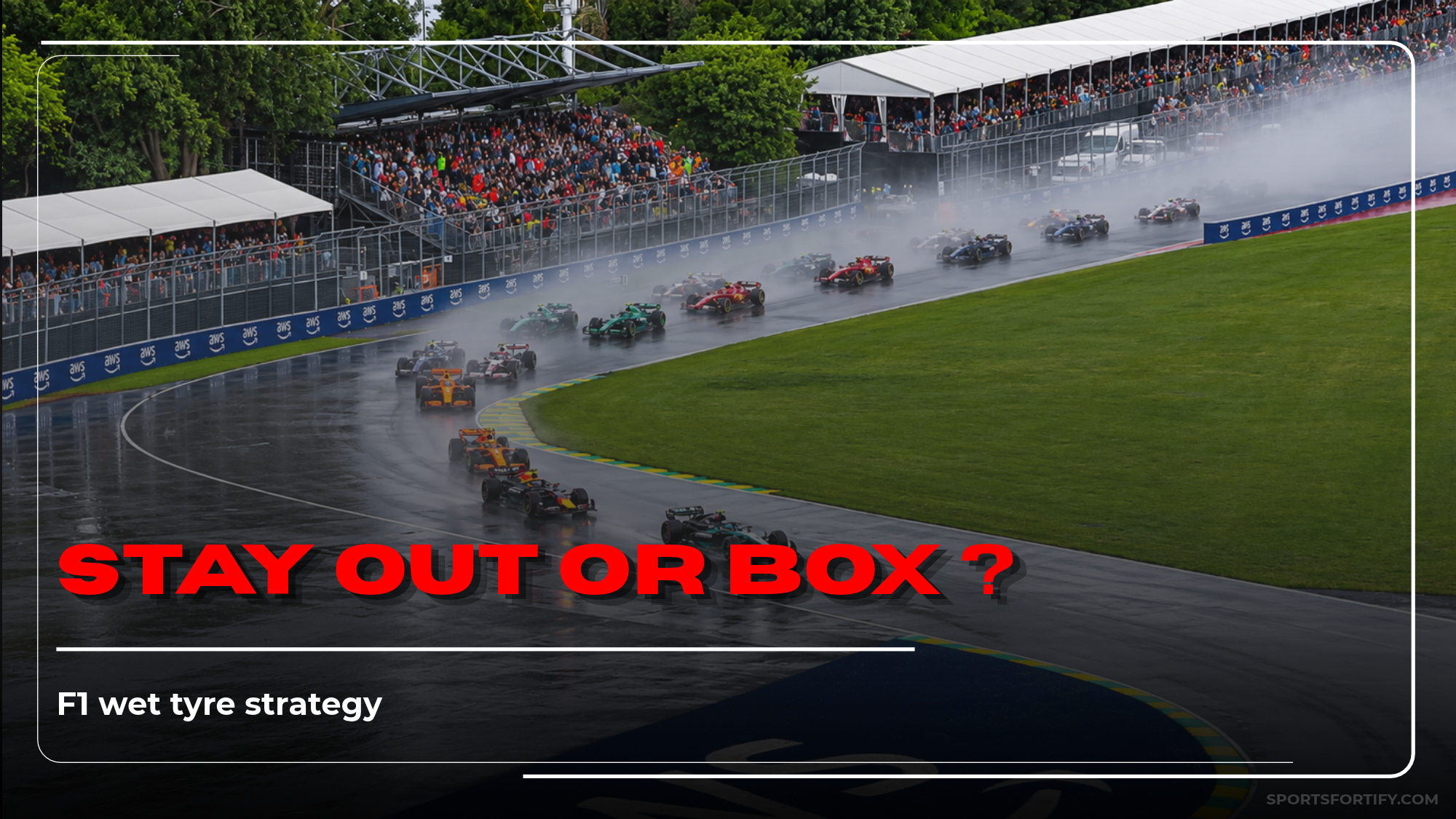
The sky over Interlagos collapsed in 2024. Qualifying was postponed. Norris sat on pole. Verstappen started 17th.
The radio crackled:
“Box.”
“Stay out.”
“Box.”
Norris committed and pitted. Seconds later the red flag flew. Everyone else received a free tyre change.
By lap 43 Verstappen led. He won by 19.4 seconds. The pole-sitter finished sixth.
One decision. One moment of timing. An entire race rewritten.
That single red-flag window is the purest illustration of how wet races, and the F1 wet tyres that decide them, operate on a completely different set of rules from dry ones. In the dry, strategy is a calculated exercise in tyre degradation, undercuts, and fuel loads. In the wet, strategy becomes a series of irreversible bets against a moving target, namely the weather, the drying line, and the next safety car or red flag.
WHY WET RACE STRATEGY FEELS COMPLETELY DIFFERENT
Dry races give teams multiple opportunities to correct mistakes. You can undercut, overcut, or adjust on the next stop. Wet races punish hesitation and reward courage at the exact moment the track is changing. Once you commit to intermediate tyres or full wet tyres, you cannot easily go back without losing a large amount of time. The window is narrow and the cost of being wrong is massive.
This is why free stops under safety cars or red flags become disproportionately powerful when teams are forced onto F1 wet tyres. A single well-timed stop can leapfrog half the field because the performance gap between the correct tyre and the wrong one is far larger than anything seen in dry conditions.
The team that understands this leverage often wins races they had no business winning on pure pace alone.
Pirelli’s analysis from the 2026 Las Vegas Grand Prix underlines the point. In FP2 the circuit moved slowly from full wet to intermediate. Pirelli’s chief engineer Simone Berra said neither tyre showed graining, even during the crossover, yet teams still refused to risk slicks because painted lines stayed slippery and the cold would have made it hard to bring dry tyres up to temperature. The crossover was never clean.
Lewis Hamilton, speaking after the same session, said Ferrari found “a couple of good findings” in the wet-to-intermediate transition. He also pointed out that nobody had run slicks yet, so teams would have to react fast in the single hour of practice left. Ferrari deputy team principal Jerome d’Ambrosio said the team would try to squeeze race and qualifying runs into that one hour.
Source Formula1.com on Hamilton and Ferrari’s wet practice running
That captures the hidden cost of wet practice. Teams spent Thursday collecting data that may prove only partially relevant if Friday and Saturday stay dry and cold. The risk is that engineers over-index on wet balance findings and arrive at a dry setup that is compromised. Pirelli’s own chief engineer said both sessions were of little value for the rest of the weekend.
HOW TEMPERATURE CHANGES EVERYTHING ON INTERMEDIATE TYRES
Las Vegas adds another layer that most wet analyses ignore, and that is temperature. The track is already low-grip and high-speed. Pirelli recorded an air temperature of 11°C and a track temperature of around 15°C in FP2, and at those levels intermediate tyres struggle to generate and hold heat.
This is why the current generation of Pirelli F1 wet tyres and intermediate tyres drew criticism after Interlagos this month. Verstappen said both the intermediate and the full wet feel like a rock once they cool down. Norris said cold tyres felt horrible on the laps to the grid, and Sainz said the intermediate is weak at the rear in mixed conditions.
Part of the reason is timing, since Pirelli had to design the 2026 wets before the real cars existed, and revised wet tyres are now planned for 2027. Pirelli has defended the current tyres, with its motorsport director saying the intermediate performed in line with expectations.
Those concerns resurfaced in Las Vegas, where drivers likened the wet track to an ice rink. In the dry, teams manage a relatively predictable degradation curve. In cold wet conditions they are fighting two enemies at once, standing water and thermal loss. The result is a narrower operating window and a higher chance that the first team to gamble correctly wins the race.
What Are Intermediate Tyres In F1 Actually Designed For?
Intermediate tyres sit between full wets and slicks and are meant for a damp but drying track. In theory the crossover is clear. In reality, especially in cold conditions, that crossover becomes a grey zone where driver feel matters as much as the data on the pit wall screens.
FP2 in Las Vegas showed how messy that grey zone is. Pirelli reported that all drivers except Gasly, Colapinto and Bottas began the session on full wets and then moved to intermediates, while those three ran intermediates the whole time. Charles Leclerc did nine laps on full wets and then added 17 on intermediates. Nobody moved to slicks.
Here is how the three tyres compare in these conditions.
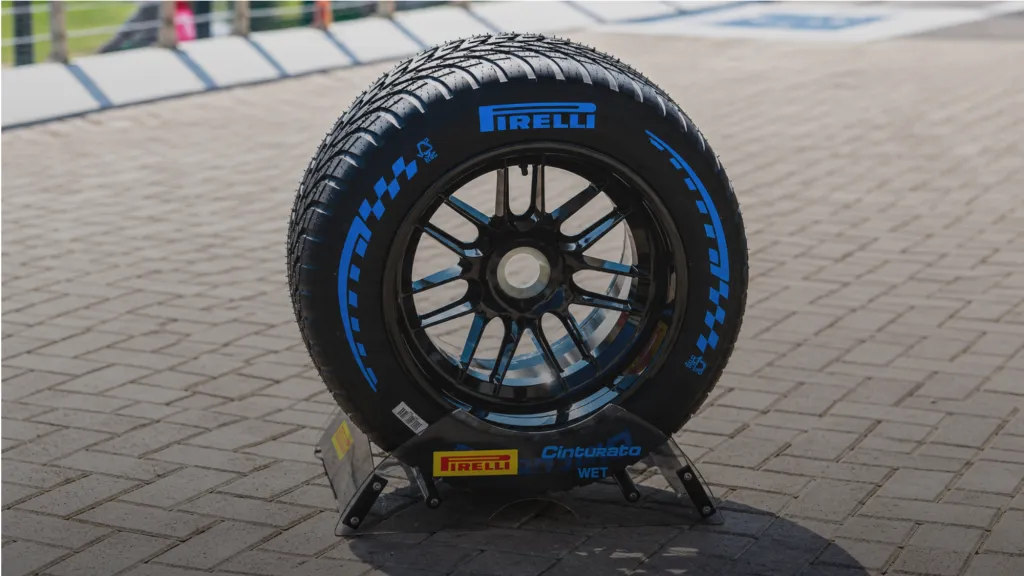
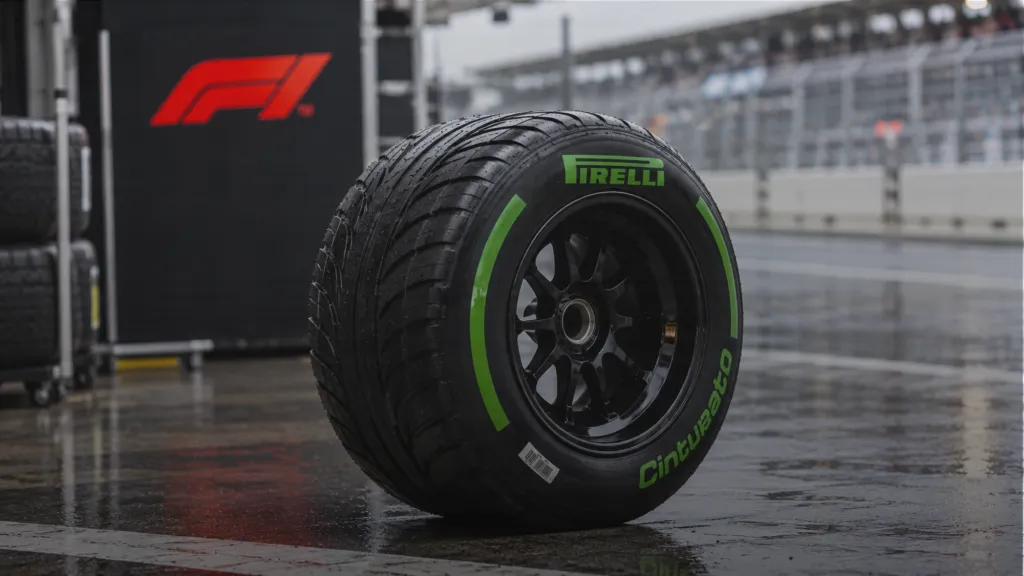
Full wet (blue) is for standing water. It clears the most water, so it is the wrong tool once the track starts to dry.
Intermediate (green) is for a damp or drying track. It needs heat to work and it wears faster once the racing line dries.
Slick is for a track that is almost dry. It needs heat too, and painted lines stay slippery for longer.
THE THREE FACTORS THAT ACTUALLY DECIDE WET RACES
Three factors consistently outweigh pure car performance when the rain falls.
- Timing of the switch relative to a safety car or red flag, because the free stop erases the advantage of anyone who pitted early
- Ability to keep intermediate tyres in their narrow temperature window, because a cold intermediate has very little grip
- Willingness to accept short-term risk for long-term position, because the safe call rarely wins a race that changes every lap
The Interlagos example is extreme but not unique. The same pattern appears whenever the weather refuses to settle. The team that treats the wet race as a series of binary bets rather than a continuous optimisation problem is usually the one that comes out ahead.
How Do F1 Wet Tyres Work In These Conditions?
The full wet is built for standing water, with deep grooves that clear large volumes of water. The intermediate is a compromise with shallower grooves that still clear some water while offering more contact patch once the track starts to dry. The problem arrives when the track is neither fully wet nor fully dry, and the air temperature is low. That is exactly the scenario Las Vegas showed in Thursday practice.
Do Wet Tyres Still Matter If Las Vegas Stays Dry?
On race day they may not, because Pirelli’s chief engineer said the forecast for both qualifying and the race showed no risk of rain. The cold still matters though. Tyre warm-up becomes the main question, and Thursday’s wet running is only useful to the extent that teams can carry something from it into dry conditions. If rain does arrive, the free stop rule and the narrow working window mean the team that reads the moment best will gain the most.
Source Pirelli press release on FP2 in Las Vegas
Dry strategy is chess.
Wet strategy is poker with a weather radar instead of cards.
And in Las Vegas the forecast may say dry, but the cold means every team is still playing against the thermometer.
What do you think of Pirelli’s current wet tyres? Let us know in the comments below.