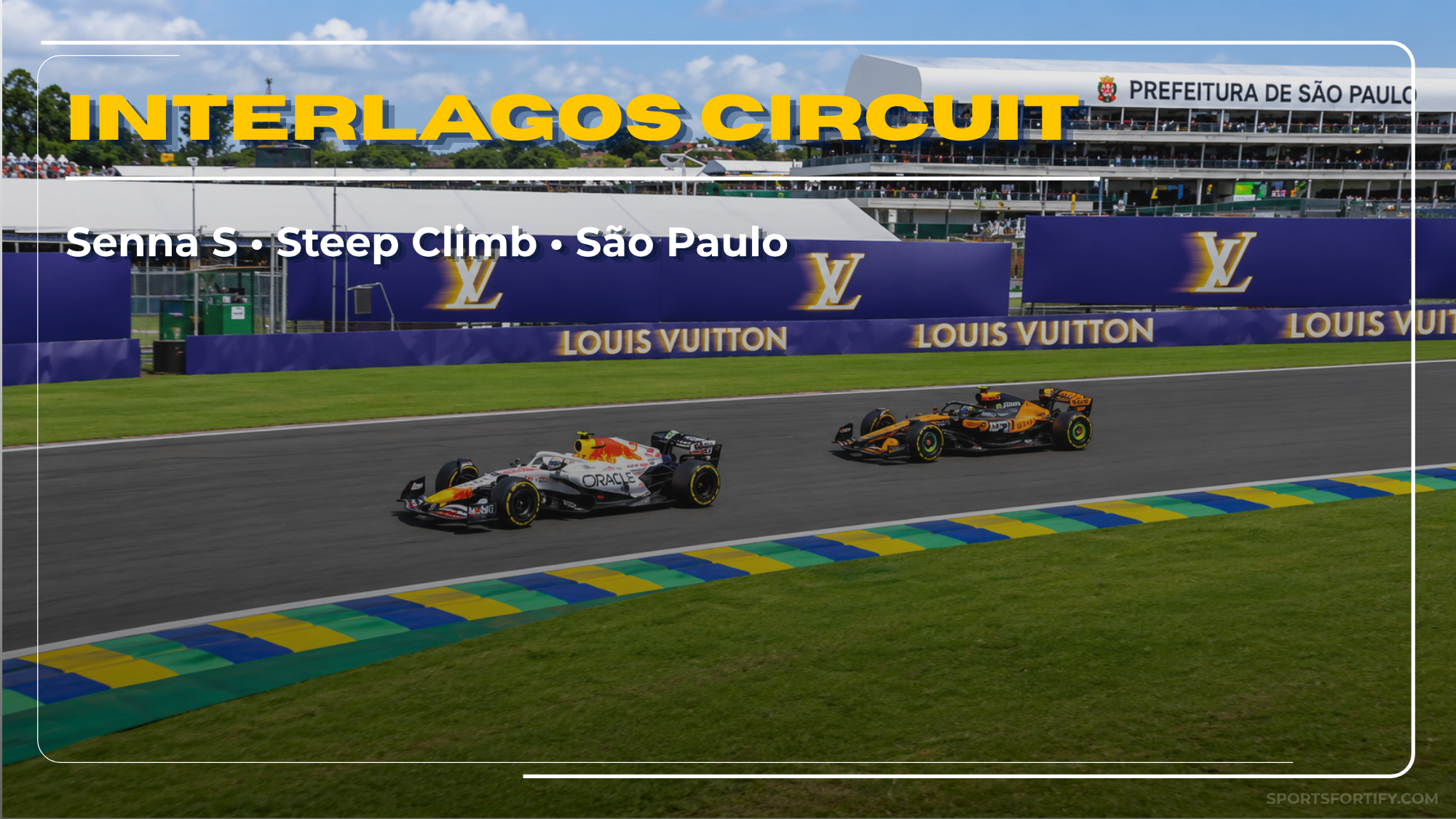
The Interlagos circuit is one of the oldest and most demanding tracks in Formula 1. Its official name is the Autódromo José Carlos Pace. So this guide covers its location, its corner names, and its history. It also explains why the lap climbs and drops so sharply.
WHERE IS THE INTERLAGOS CIRCUIT
The Interlagos circuit is in the Interlagos district of southern São Paulo, Brazil. The name means “between the lakes.” Fans and drivers usually just say Interlagos. The address is Av. Sen. Teotônio Vilela 261.
A CPTM train station sits nearby. That makes race day travel easier than at many circuits. For session times and start times in your country, see our São Paulo Grand Prix 2026 race guide.
KEY CIRCUIT STATISTICS
Interlagos Key Facts
| 📍 Location | São Paulo, Brazil |
| 🏗️ Opened | 12 May 1940 |
| 🆕 First F1 Championship Race | 1973 |
| 📏 Circuit Length | 4.309 km |
| 🔄 Corners | 15 (10 left, 5 right) |
| 🏎️ Race Laps | 71 |
| 📐 Race Distance | 305.879 km |
| ↩️ Direction | Counterclockwise |
| 🗻 Altitude | ~780 to 800 m |
| ⛰️ Elevation Change | ~43 m |
| ⏱️ Race Lap Record | 1:10.540 Bottas, 2018 |
HOW LONG IS THE INTERLAGOS CIRCUIT
The Interlagos circuit measures 4.309 km (2.677 miles) per lap. A full Grand Prix covers 71 laps and 305.879 km. That makes it one of the shorter tracks on the calendar. Even so, the lap packs in plenty of elevation. The original layout ran almost twice as long.
INTERLAGOS CIRCUIT ELEVATION AND ALTITUDE
The Interlagos circuit sits roughly 780 to 800 metres above sea level. The lap also climbs and drops about 43 metres. Sources give figures between 40 and 56 metres, but the hills define the track either way.
That altitude is modest next to Mexico City, which sits about 2,240 metres up. See our Mexico City Grand Prix 2026 race guide for how that changes the racing. So engines and cooling systems feel the thin air far less at Interlagos.
INTERLAGOS CIRCUIT CORNER NAMES EXPLAINED
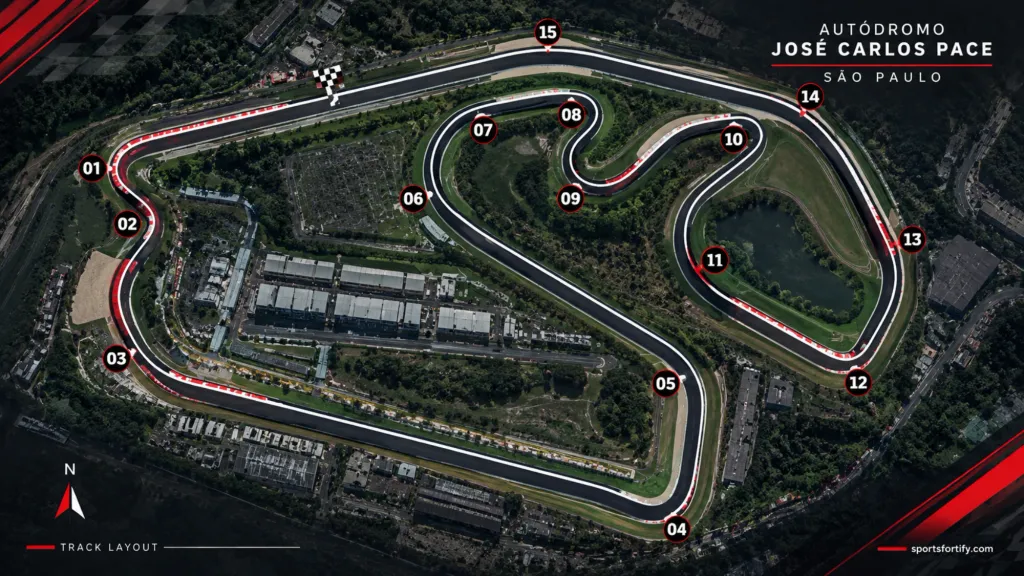
Turn numbers vary between sources. So this list follows the lap in order, with each name translated from Portuguese.
- Senna S (Turns 1 and 2) is a downhill left-right at the end of the pit straight.
- Curva do Sol (Sun Curve) is a fast, sweeping left onto the back straight.
- Descida do Lago (Lake Descent) brings heavy braking at the end of that straight.
- Ferradura (Horseshoe) is a tight right-hand horseshoe.
- Laranjinha (Little Orange) is a medium-speed right.
- Pinheirinho (Little Pine) is a left that sets up the slowest corner.
- Bico de Pato (Duck’s Beak) is a tight hairpin and one of the slowest points on the lap.
- Mergulho (Dive) is a downhill left.
- Junção (Junction) is the left that launches the long climb.
From Junção, the track climbs steeply back to the start-finish line through the grandstands. Drivers stay on full throttle for the whole run. So a strong exit from the final corner decides much of the lap. The Senna S is a classic example of the esses corner type.
WHAT IS THE INTERLAGOS CIRCUIT LIKE TO DRIVE
The Interlagos circuit is a short, hilly lap that punishes small mistakes. It runs counterclockwise, and most corners turn left. That puts extra strain on drivers’ necks.
The lap also mixes long full-throttle sections with slow corners like Bico de Pato. Because of this, setup becomes a compromise between straight-line speed and grip.
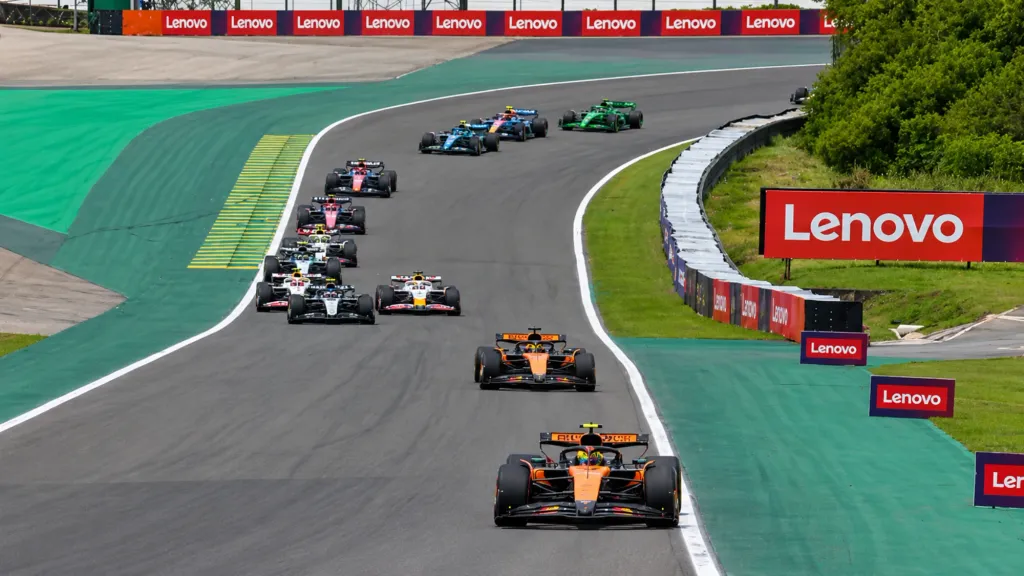
Passing happens mainly at the Senna S and the Descida do Lago. The 2026 cars have no DRS flap. So Overtake Mode matters on the main straight and the back straight. On top of that, São Paulo’s weather often changes the whole race.
INTERLAGOS CIRCUIT WEATHER
Weather changes quickly at Interlagos, and sudden rain has shaped many classic races here. A storm can soak one part of the track while another stays dry. Grip then shifts from lap to lap. November also falls early in São Paulo’s wet season. So afternoon storms are common. Check the forecast closer to race day.
INTERLAGOS CIRCUIT LAP RECORD
Valtteri Bottas holds the race lap record at Interlagos, a 1:10.540 set in 2018. He drove a Mercedes W09. Lewis Hamilton also holds the fastest qualifying lap, a 1:07.281 from the same season. Both marks date from 2018.
HISTORY OF THE INTERLAGOS CIRCUIT
The Old Interlagos Layout
The original Interlagos layout was almost twice as long as today’s circuit. It stretched about 7.96 km with 26 turns when it opened on 12 May 1940. Builders began work in 1938. They took ideas from classic tracks such as Indianapolis and Brooklands.
Formula 1 Arrives And Leaves
Interlagos hosted a non-championship F1 race in 1972. Then the World Championship Brazilian Grand Prix arrived in 1973, and Emerson Fittipaldi won it. The race ran here from 1973 to 1977 and again in 1979 and 1980. After that, F1 moved to Rio de Janeiro because of safety and surface concerns.
Renamed For José Carlos Pace
The circuit took its official name in 1985 from Brazilian driver José Carlos Pace. He won the 1975 Brazilian Grand Prix here. He died in a plane crash in 1977.
The Redesign And Return
A major redesign in 1989 and 1990 cut the circuit to about 4.3 km. The new layout was safer, and F1 returned in 1990. Resurfacing followed in 2007. Since 2021, the race has carried the São Paulo Grand Prix name instead of the Brazilian Grand Prix. F1’s contract with the circuit runs to 2030.
CAN YOU VISIT THE INTERLAGOS CIRCUIT
The circuit hosts far more than Formula 1. It also stages the WEC 6 Hours of São Paulo, Stock Car Brasil, and TCR races. A kart circuit named for Ayrton Senna sits on site too. Check the official circuit website for current events and tickets.
FREQUENTLY ASKED QUESTIONS
Where is the Interlagos circuit?
The Interlagos circuit is in the Interlagos district of southern São Paulo, Brazil. The address is Av. Sen. Teotônio Vilela 261.
Which country is the Interlagos F1 circuit in?
The Interlagos F1 circuit is in Brazil. It sits in the city of São Paulo.
How long is the Interlagos circuit?
The Interlagos circuit measures 4.309 km per lap. A 71 lap race covers 305.879 km.
How many corners does Interlagos have?
Interlagos has 15 corners, with 10 turning left and 5 turning right.
What is the Interlagos lap record?
Valtteri Bottas set the race lap record, a 1:10.540 in a Mercedes in 2018.
What is the elevation of the Interlagos circuit?
The circuit sits roughly 780 to 800 metres above sea level. The lap climbs and drops about 43 metres.
Does Interlagos run clockwise or counterclockwise?
Interlagos runs counterclockwise, so most of its corners turn left.
What does Interlagos mean?
Interlagos means “between the lakes” in Portuguese. It’s also the name of the São Paulo district around the circuit.
Why is the circuit called Autódromo José Carlos Pace?
The circuit took the name in 1985 to honor Brazilian driver José Carlos Pace. He won the 1975 Brazilian Grand Prix here.
When did F1 first race at Interlagos?
The first World Championship Brazilian Grand Prix at Interlagos took place in 1973. Emerson Fittipaldi won it.


1 Comment