
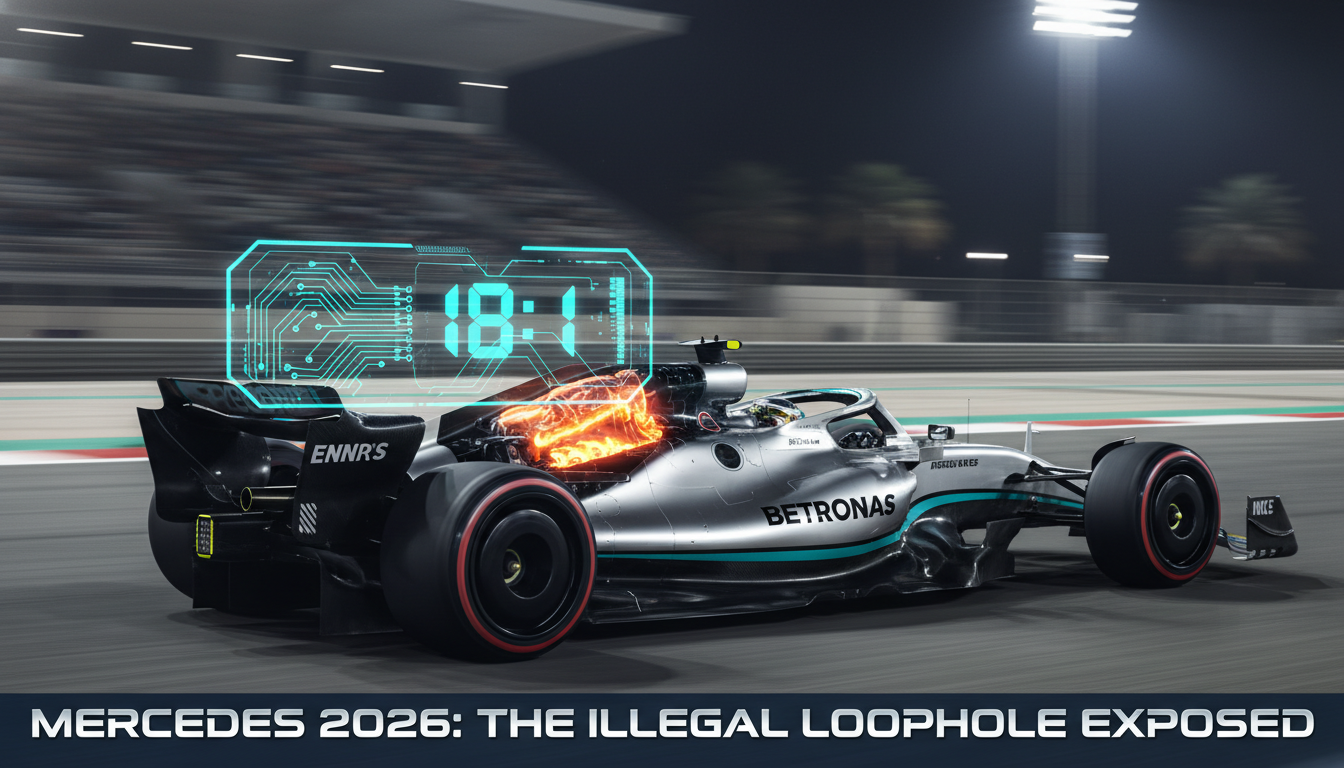
Rivals claim it’s a “shape-shifter.” Discovery the truth behind the Mercedes 2026 F1 engine scandal that has Ferrari and Red Bull demanding an immediate FIA ban.
The floodlights of the Sakhir circuit bore witness to a chilling performance as the first 2026 pre-season test came to a close. After two days of strategic “niggles” and mechanical drama, the Mercedes 2026 F1 engine was finally unleashed, resulting in a dominant Silver Arrows 1-2. Kimi Antonelli stunned the paddock with a blistering 1m 33.669s, leaving even the mighty Red Bull-Ford powertrain looking pedestrian by comparison. However, the speed hasn’t silenced the critics; instead, it has intensified a “civil war” over a suspected thermal expansion loophole that rivals claim is a clear violation of the 2026 technical regulations.
Consequently, the mood in the paddock has shifted from curiosity to genuine fear. If the performance seen on the final day is a true reflection of the Mercedes 2026 F1 engine, the sport could be heading into a repeat of the one-sided 2014 era before the first race even begins.
The 18:1 “Thermal Trick” Explained
The technical core of the controversy surrounding the Mercedes 2026 F1 engine lies in a “magic” alloy used within the cylinder heads. According to paddock insiders, Mercedes has pioneered a material that expands at precise operating temperatures, effectively altering the engine’s compression ratio mid-lap. While the FIA mandates a strict 16:1 ratio for static inspections, this “thermal trick” allegedly allows the engine to jump to an 18:1 ratio once the car surpasses 300kph on the straights. This allows the Silver Arrows to deploy their 350kW electrical surge for significantly longer than any other manufacturer.
Therefore, the power unit failure that sidelined Antonelli earlier in the test may not have been an accident. Instead, it appears to be the result of the team pushing the limits of this expansion technology to see exactly where the “breaking point” of the new alloys lies.
Antonelli and Russell: Sandbagging or Superiority?
For 19-year-old Kimi Antonelli, the Bahrain test was a trial by fire. After losing almost an entire day to an engine swap, the Italian sensation returned on the final day to clock the fastest lap of the entire pre-season. This sudden surge in performance suggests the Mercedes 2026 F1 engine has a “Qualifying Mode” that has yet to be fully countered. While George Russell spent the week claiming the team has “taken a step back,” the final sector times tell a story of unmatched energy recovery that has Red Bull-Ford and Ferrari reeling.
Meanwhile, Max Verstappen has been surprisingly vocal about his frustrations with the 2026 regulations. His real concern likely stems from the fact that the Mercedes appears to be harvesting energy at a rate that allows for a much more aggressive deployment strategy during wheel-to-wheel combat.
The Looming FIA Homologation War
As the first test concludes, the focus shifts from the track to the FIA’s technical department. Rival teams are reportedly preparing a “request for clarification” regarding how engine compression is measured. If the FIA decides that the Mercedes 2026 F1 engine must remain at 16:1 even at peak operating temperatures, the Silver Arrows could lose their entire performance edge overnight. This is high-stakes poker, with Mercedes betting that their alloy technology is perfectly legal under the current wording of the 2026 rules.
The tension is palpable as the March 1st homologation deadline approaches. If Mercedes wins this legal battle, the 2026 season could mirror their 2014 dominance. If they lose, the Brackley-based team could find themselves starting the season with a massive horsepower deficit.
A Masterclass in Psychological Deception
Ultimately, Mercedes leaves Bahrain with the fastest lap and the most unanswered questions. They have managed to frame themselves as the “struggling” underdogs while simultaneously locking out the top of the timesheets. It is a classic masterstroke, designed to lure rivals into a false sense of security while they fine-tune a power unit that could break the competition. The Mercedes 2026 F1 engine is the most talked-about piece of hardware in the sport, and it might already have won the championship.
The sandbags will only truly come off in Melbourne. Until then, the world wonders.Have we just witnessed a reliability disaster, or the birth of a new dynasty?


1 Comment