
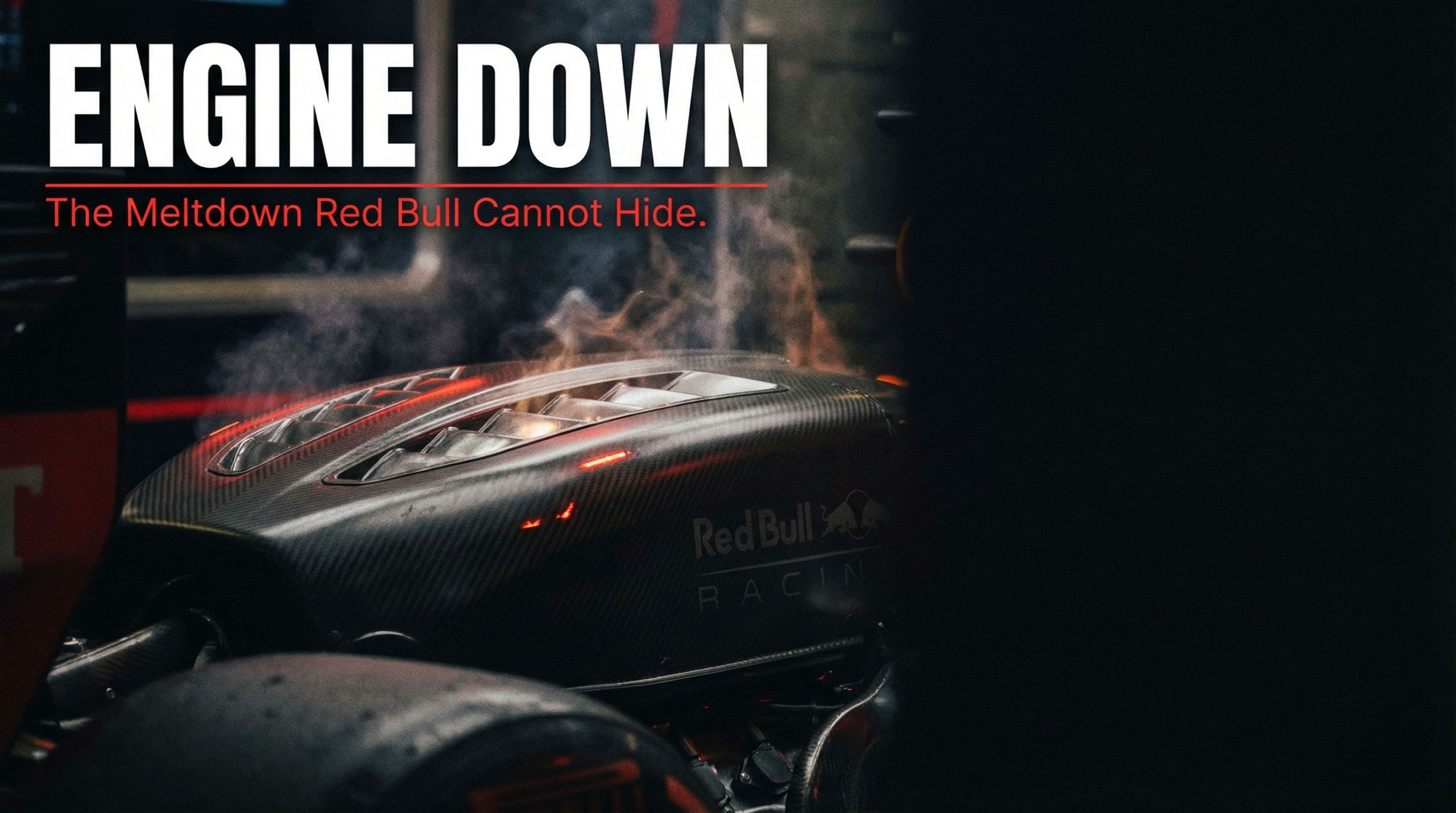
The championship-winning team arrived at Bahrain testing expecting dominance. Instead the Red Bull 2026 engine melted down under the desert heat and exposed a programme in serious trouble. Isack Hadjar stopped his RB22 at Turn 7 after just 20 laps. A red flag flew. The world watched as Red Bull scrambled for answers on the most shocking day of pre-season testing.
Max Verstappen had completed 136 problem-free laps just days earlier. He called the engine’s power “amazing to see” from a new manufacturer. That optimism evaporated completely by the end of the week.
The Cooling Failure That Changed Everything
The crisis began with a cooling system failure that exposed a fundamental design flaw. Engineers identified an overheating intercooler as the root cause. Red Bull had moved that component to an unusual saddle position above the V6 unit to save weight. However, in Bahrain’s 38-degree heat that placement proved disastrous.
Heat stress built up rapidly. Coolant stopped flowing properly. The engine began to fail. One paddock insider put it bluntly. “They built this for fast qualifying laps and light weight. They have not tested how it runs in long races when it is this hot. Today showed what they missed.”
Red Bull prioritised weight saving over thermal management. That gamble failed badly.
Four Hours in the Garage While Rivals Ran Free
The Red Bull 2026 engine meltdown ended the team’s testing day instantly. While mechanics chased the problem, the rest of the grid kept working. Ferrari’s Charles Leclerc topped the timesheets. Mercedes continued developing their power unit. Williams gathered valuable data after missing earlier sessions.
Red Bull spent four hours staring at engine data. Hadjar watched from the hospitality suite. Earlier in the week, a persistent hydraulic leak had already cost the team nearly half a day. That was not an isolated incident either. Furthermore, Racing Bulls reported a “major blip” with their shared RBPT-Ford unit, triggering an investigation into the common architecture of both power units.
The lost track time cannot be recovered. The data gap grows every hour the car sits silent.
Verstappen’s Fury and the “Anti-Racing” Verdict
Verstappen did not hold back after his final stint. The four-time champion labelled the new generation of cars as “Formula E on steroids.” He criticised the extreme energy management required by the 2026 regulations. Furthermore, he argued that constant lift-and-coast driving to harvest energy has killed the pure driver feel of Formula 1. Those 2026 technical regulations fundamentally changed how every driver interacts with their car
His frustration went beyond regulations. The car itself struggled with battery deployment compared to rivals. Meanwhile, if the lead driver is already threatening retirement over the feel of the car, internal morale at Red Bull may be far more fractured than the team admits publicly.
Verstappen sits in a car nobody fully trusts anymore.
The Energy Deficit Nobody Can Ignore
Lap times only tell half the story. GPS telemetry data revealed something far more concerning. The Red Bull 2026 engine looks strong in short bursts. However, it cannot sustain the same deployment levels as Mercedes over a full 10-lap stint.
In Bahrain’s high-speed sectors, the RB22 clipped its power earlier than the Silver Arrows. The battery depleted faster than it could recharge. Consequently, Verstappen resorted to aggressive downshifting tactics just to keep the MGU-K alive.
- The new hybrid system demands equal power from fuel and battery. Battery size stayed the same while electric power tripled. That equation punishes any inefficiency ruthlessly.
- Active aerodynamic systems require manual switching between high downforce and low drag modes. Those shifts change weight distribution and hurt cooling performance.
- The new sustainable fuel burns hotter than traditional fuel. It demands completely different combustion timing and cooling strategies. Red Bull’s fresh programme has zero years of accumulated knowledge to draw from.
- Carlos Sainz publicly praised Red Bull Ford as “a clear step ahead” just days before the meltdown. That credibility evaporated the moment Hadjar could not complete a single race simulation.
- The team’s primary focus for the second test shifted entirely to software optimisation. Power exists but the energy management chess match is being lost comprehensively.
The Road to Melbourne Gets Shorter Every Day
The homologation deadline passed on March 1. Hardware designs are now frozen. If the cooling and deployment issues were not resolved before that deadline, Red Bull is locked into a potential horsepower deficit for the entire season.
Furthermore, the engineering reckoning falls directly on engine boss Ben Hodgkinson. Did the team test at genuine race temperatures. Did their simulations include long stints under extreme heat. Or did confidence in clever design push out smart engineering.
Two weeks before Melbourne, the task list is brutal. Redesign cooling ducting.The Australian GP 2026 could expose or redeem Red Bull’s entire programme in a single weekend. Reposition the intercooler validation. Test under extreme conditions with almost no time remaining. Consequently, if Melbourne goes wrong, Verstappen’s championship ambitions crumble before the season truly begins.
Red Bull’s engine programme was supposed to be the jewel of Christian Horner’s 2026 strategy. Right now it looks more like the crack that could shatter the entire campaign. The benchmark hit a wall at Bahrain. Whether they can rebuild it in time remains the biggest unanswered question on the grid.

6 Comments