
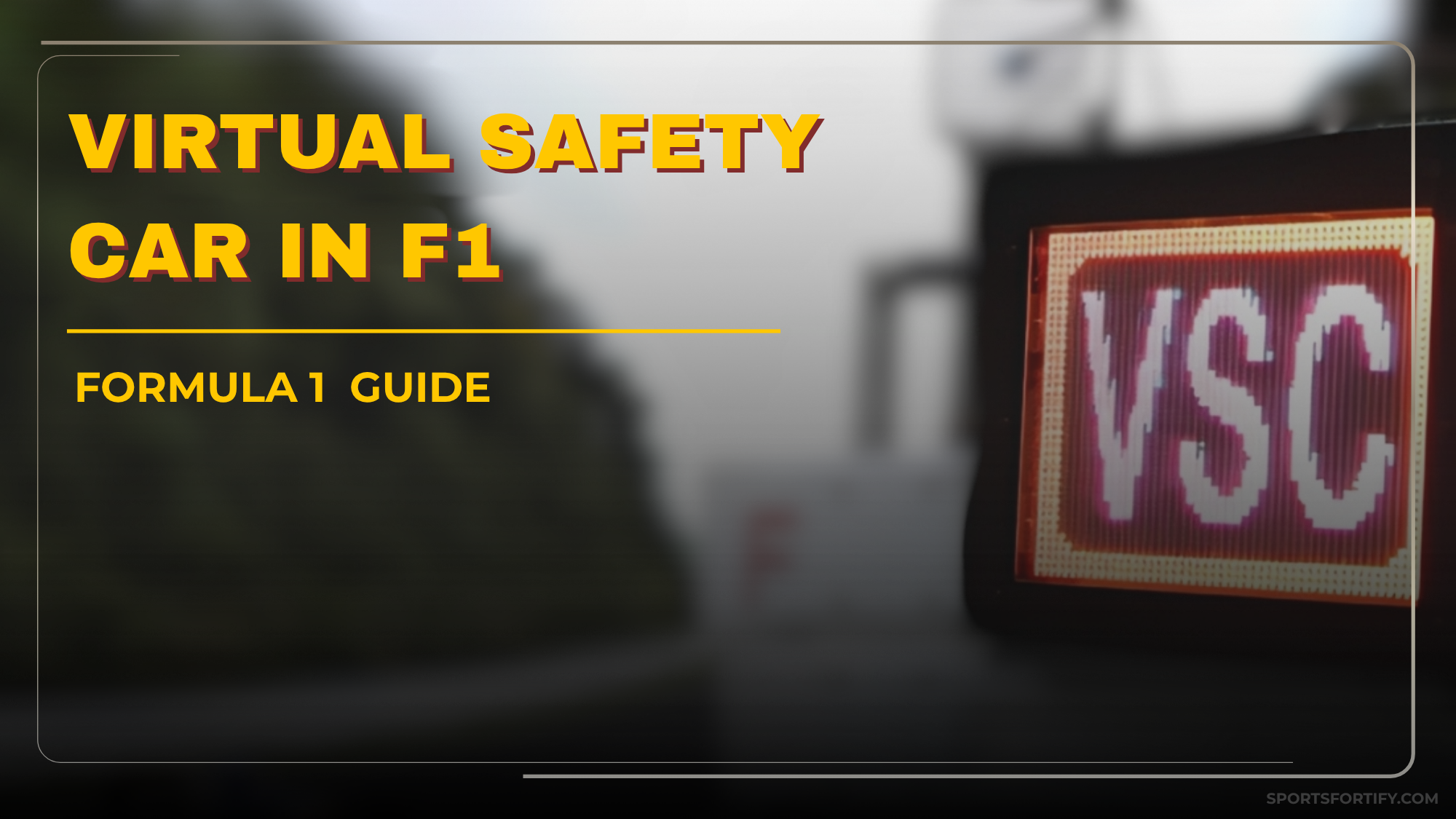
The virtual safety car F1 system confuses almost every new fan. Cars slow down but no actual safety car appears on track. Drivers maintain gaps but somehow some teams gain massive advantages. Furthermore, the VSC decided the winner of the 2026 Australian Grand Prix just days ago. Understanding this system changes how fans watch every single race.
WHAT IS A VIRTUAL SAFETY CAR IN F1
The Virtual Safety Car slows every car on the circuit simultaneously. However, no physical car drives onto the track like a full Safety Car. Race Control activates the VSC when a hazard exists but conditions do not require full intervention. Additionally, all drivers must reduce speed by approximately 40%. They follow strict time deltas displayed on their steering wheels. The system monitors compliance through GPS tracking.
Think of it as a temporary speed limit that every driver must obey at the same time.
WHY DOES F1 USE A VIRTUAL SAFETY CAR
F1 introduced the VSC in 2015 after Jules Bianchi’s tragic accident at Suzuka in 2014. Previously, marshals worked trackside while cars still passed at dangerously high speeds under yellow flags. Furthermore, deploying a full Safety Car for minor incidents created unnecessary disruption to the race.
The VSC solved both problems immediately. It slows cars enough for marshals to work safely. Additionally, it avoids bunching the entire field together behind a physical car on track.
In simple terms, the VSC handles smaller incidents. The full Safety Car handles bigger ones.
HOW DOES THE VSC DELTA TIME SYSTEM WORK
Every driver receives a minimum lap time delta on their steering wheel during a VSC period. They must stay above this delta at all times. Furthermore, the system tracks every car through GPS in real time. If any driver goes faster than the delta allows, stewards issue a penalty. Understanding exactly how F1 penalties work reveals why even small VSC violations carry serious championship consequences. The delta typically reduces speed by roughly 40% compared to normal racing pace across every sector of the circuit.
However, here is the crucial detail that decides races. Drivers can vary their speed within individual sectors. Consequently, a driver can slow down more in one sector and speed up slightly in another. This flexibility creates the strategic window that teams exploit during pit stops. It transforms a safety procedure into a genuine tactical weapon for race strategists.
That small detail changes entire race outcomes.
HOW DOES THE VSC AFFECT PIT STOP STRATEGY
This is where the virtual safety car F1 system becomes genuinely race-defining. During normal racing, a pit stop costs approximately 20 to 25 seconds. However, during a VSC period, every car on track travels roughly 40% slower than usual. Consequently, a car diving into the pits loses far less time relative to the slowed field. The saving from pitting under VSC compared to green flag conditions reaches approximately 10 to 12 seconds.
Furthermore, teams that react instantly gain a massive advantage over hesitant rivals. Any team that stays out faces a painful decision afterwards. They can pit later under green flags and lose the full 20-plus seconds. Alternatively, they can gamble and hope another VSC appears later. Mercedes pitted both cars under the Melbourne VSC. Ferrari stayed out. That single decision determined the entire Australian Grand Prix winner.
One call under one VSC. That is all it takes to win or lose a race.
WHAT HAPPENED WITH THE VSC AT THE 2026 AUSTRALIAN GP
The 2026 Australian Grand Prix provided a perfect real-world example of VSC strategy. Hadjar’s engine failed on Lap 12 and triggered the first VSC. Mercedes immediately pitted Russell and Antonelli together. Both switched from medium to hard tyres. Knowing what F1 tyre compounds mean explains why switching rubber under a VSC transforms the entire second half of a race. Additionally, both saved approximately 10 seconds each compared to a normal green flag stop. They rejoined the track without losing any meaningful position.
Ferrari made a conscious decision to stay out on old tyres. The team believed another VSC would appear later in the race. However, Bottas retired on Lap 18 and triggered a second VSC. Race Control then closed the pit lane entry completely. Consequently, Ferrari found themselves trapped with no strategic escape available. They eventually pitted under green flag conditions and lost over 20 seconds to Mercedes.
Ferrari’s gamble failed because the pit lane closed at the worst possible moment. The Ferrari strategy crisis that unfolded under this exact VSC became the defining story of the opening race.
WHAT IS THE DIFFERENCE BETWEEN A VSC AND A FULL SAFETY CAR
The differences matter enormously for race strategy and outcomes.
- Under a VSC, cars maintain their gaps to each other. Under a full Safety Car, the entire field bunches together.
- A VSC typically lasts 2 to 4 laps. A full Safety Car often lasts 4 to 8 laps depending on the incident severity.
- The VSC does not require cars to form a queue. The full Safety Car requires every car to line up behind it.
- Pit stops under both cost less than green flag stops. However, a full Safety Car eliminates large gaps entirely by bunching the field.
- The VSC ends suddenly with all cars resuming speed simultaneously. The full Safety Car ends with a rolling restart controlled by the leader.
- Overtaking remains prohibited under both the VSC and the full Safety Car at all times.
The VSC is a surgical slowdown. The full Safety Car is a complete race reset.
WHEN DOES THE VSC END AND RACING RESUME
Race Control decides when the track is safe for normal racing. Once marshals clear the hazard, a “VSC ENDING” message appears on timing screens. Furthermore, drivers see a green signal flash on their steering wheel displays. All cars then resume racing speed simultaneously across the entire circuit. There is no countdown. The transition from VSC to green happens within seconds.
Importantly, this sudden restart creates immediate racing opportunities. Drivers on fresher tyres can attack rivals on older rubber instantly. Consequently, the laps immediately following a virtual safety car F1 period often produce the most exciting overtakes of the entire race. Teams plan their entire strategy around these critical restart moments.
When the green signal flashes, everything changes instantly.
FREQUENTLY ASKED QUESTIONS
No. Overtaking is strictly prohibited during any VSC period. Any driver who passes another car under VSC conditions receives a time penalty from the stewards.
Most VSC periods last between 2 and 4 laps. However, the exact duration depends entirely on how quickly marshals clear the hazard from the track.
The race continues counting laps normally under VSC conditions. The total number of laps does not change. However, the slower pace means less competitive racing happens during those laps.
Not every team benefits from stopping. Cars already on fresh tyres or in strong track position may lose more by pitting. Strategy depends entirely on each car’s unique tyre condition and race position at that specific moment.


3 Comments