
There are 10 official F1 flags. Each one tells drivers something different, and missing the wrong one can cost a penalty, a race win, or disqualification. Yellow slows drivers down. Red stops everything. Blue means step aside. Black means you are done.
Knowing what every flag means is the fastest way to follow any session with confidence.
All 10 F1 Flags
| Flag | Color / Pattern | Driver Action | Overtaking | |
|---|---|---|---|---|
| Green | Solid green | Track clear — full racing | Yes | |
| Yellow — Single | Single waved yellow | Danger ahead — slow down, no overtaking | No | |
| Yellow — Double | Double waved yellow | Serious danger — slow down sharply, be ready to stop | No | |
| Red | Solid red | Session stopped — return to pits immediately | No | |
| Blue | Waved blue | Faster car approaching — let them pass | Must Obey | |
| Chequered | Black and white squares | Session or race finished | End | |
| White | Solid white | Slow vehicle on track — heads-up warning only | Yes | |
| Slippery Surface | Yellow and red vertical stripes | Oil, water, or debris on track — adjust approach | Caution | |
| Meatball | Black with orange circle | Mechanical issue — pit immediately, fix or retire | Yes | |
| Black and White | Half black, half white diagonal | Warning for unsportsmanlike conduct — yellow card | Yes | |
| Solid Black | Black with car number | Immediate disqualification — pit now, race over | No |
Source: FIA Sporting Regulations 2026 — sportsfortify.com
How Many F1 Flags Are There
There are 10 official F1 flags in 2026. Some drivers go an entire season without seeing a black flag. Others have their race decided by a single yellow at the wrong moment in qualifying. Knowing all 10 means you actually understand what is happening on track when the chaos breaks out, not just that something went wrong.
F1 Yellow Flags
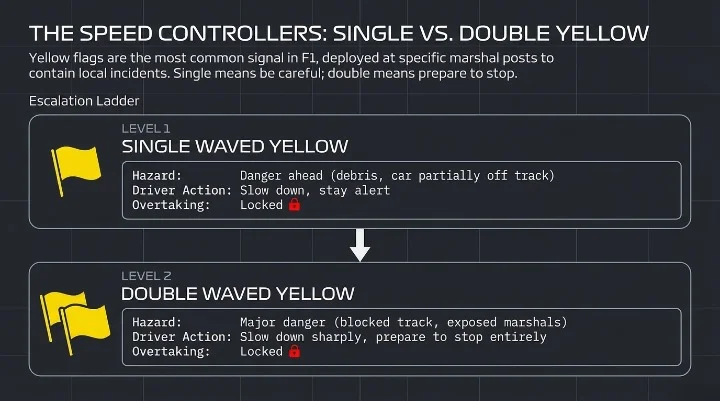
Yellow flags are the most common signal in F1. A single yellow means danger ahead. It could be a car sitting partially off track, debris on the racing line, or marshals working in a dangerous position near the circuit. Drivers must slow down, stop overtaking, and stay alert.
During qualifying and practice, a yellow flag carries an extra rule. Any driver currently on a flying lap must abort it immediately. The lap time gets cancelled outright. Teams watch every flag sector obsessively in qualifying because a yellow in the wrong zone can erase the fastest lap of the session in under a second.
Double waved yellows are a different situation. Two flags at the same marshal post signals serious danger. There could be a car fully blocking the track or marshals in an exposed position with nowhere to go. Drivers must slow down sharply and be ready to stop completely. Single yellow means be careful. Double yellow means prepare to stop.
F1 also uses the Virtual Safety Car and Full Course Yellow during races when a local flag zone is not enough. Under the VSC, every driver follows a target lap time shown on their steering wheel. Nobody gains an advantage by pitting during dangerous conditions. The FCY covers the entire circuit with stricter speed control. Both tools exist because one yellow sector sometimes cannot contain a serious incident safely.
F1 Red Flags
Red flags stop the session completely. Race control deploys them when conditions become too dangerous to continue. Heavy rain blocking visibility, a major crash, or damaged barriers are the most common triggers. Every marshal post shows a red flag at once. Drivers must stop racing, reduce speed, and return to the pit lane.
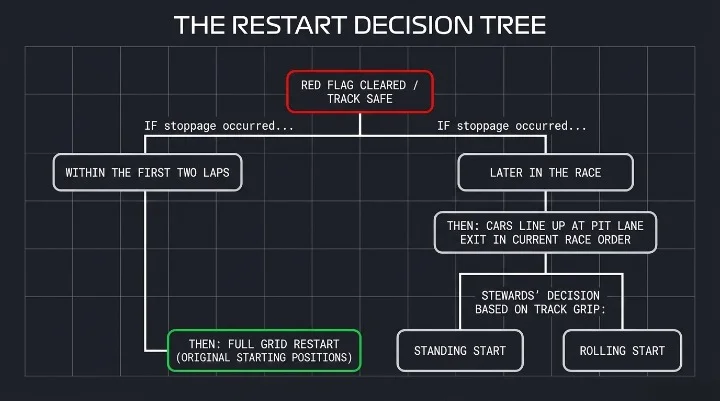
What happens next depends on when the stoppage occurred. A red flag within the first two laps means a full grid restart. Later in the race, cars line up at the pit lane exit in race order and wait for officials to confirm the track is safe. Stewards then decide between a standing or rolling start based on conditions.
The 2021 Belgian Grand Prix is the most controversial red flag situation in recent memory. Officials waited more than three hours. Only two laps behind the safety car ever counted. That outcome triggered serious debate about minimum race distance rules. The FIA tightened those guidelines directly afterwards.
F1 Blue Flags
Blue flags tell a driver they are about to be lapped. Not that they are slow. Not that they are in the wrong place. The race leader is right behind them and needs to get through.
During races, blue flags are mandatory. A driver who ignores three consecutive warnings gets a penalty. For 2026, enforcement is noticeably stricter after incidents in 2024 and 2025 where lapped cars directly affected title fights at critical moments. The standard penalty is now five seconds, and stewards are reviewing every single case more closely than in any previous season.
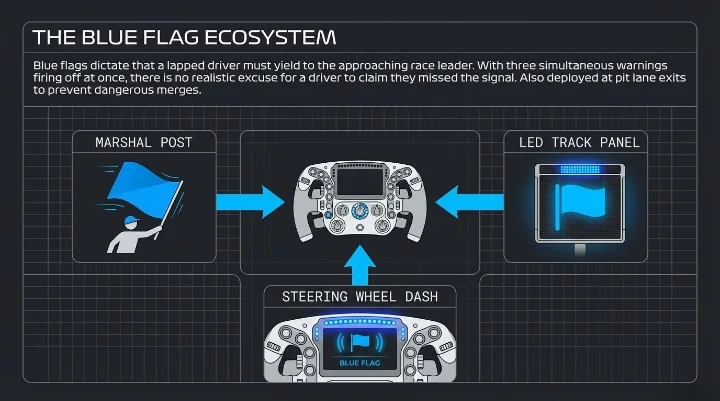
Drivers receive three simultaneous warnings when a blue flag situation arises. Marshal posts wave physical flags. LED panels around the track flash blue. A warning light pulses directly on the steering wheel. With all three active at the same time, there is no realistic excuse for missing the signal.
Blue flags also appear at pit lane exits. They warn drivers returning to track that faster cars are already on the racing line. This prevents dangerous merges when the gap between cars is tight.
F1 Chequered Flag
The chequered flag ends the session. Black and white squares signal the finish of practice, qualifying, or the race itself. The leader receives it first. It keeps waving until every car crosses the line and completes its final lap.
Early flags have caused real controversy. In 2019 at Suzuka, a digital display showed the flag to Valtteri Bottas one lap too soon. The 2018 Canadian Grand Prix, 2014 Chinese Grand Prix, and 1985 British Grand Prix all had the same problem. When a chequered flag appears too early, the official result comes from the last correctly completed lap before the mistake was made. F1 tried digital panels for the flag and went back to human wavers after Suzuka proved that screens fail at the worst possible moments.
What Is the Rarest Flag in F1
The solid black flag. It means immediate disqualification. The driver must enter the pits and does not return to the race. Stewards use it only for serious violations including dangerous driving and cars found to be illegal. Nico Hulkenberg received one at the 2024 Sao Paulo Grand Prix. Before that, the last black flag in F1 was 17 years earlier. That gap tells you exactly how rarely officials reach for it.
Three other rare flags matter too. The white flag warns drivers about a slow vehicle ahead. It could be a medical car, a safety vehicle, or a damaged car crawling back to the pits. Drivers do not have to move aside. It is a heads-up before they come across something much slower around a blind corner.
The slippery surface flag uses yellow and red vertical stripes. It appears before corners where oil, water, or debris has reduced grip sharply. Drivers use it to adjust their braking point before reaching the affected zone. Finding out about grip loss mid-corner at 180 miles per hour without warning is not something any driver wants to experience.
The meatball flag is the black flag with an orange circle. Officials show it alongside a car number when they spot dangerous mechanical damage. Loose bodywork, floor damage, and fluid leaks are common triggers. The driver must pit immediately. If the car passes inspection, it can return to the race. If not, the race is over. Hulkenberg got this flag at Sao Paulo too, minutes before being shown the full black.
F1 Flags in 2026
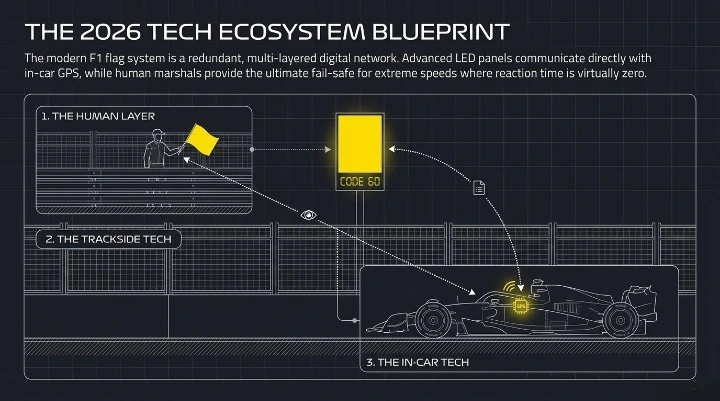
F1 upgraded its flag system for the 2026 season. Every circuit now runs advanced LED panels around the full track alongside traditional marshal waved flags. The panels connect directly with the GPS built into modern F1 steering wheels.
The combined system shows flag colors, speed limits during FCY and Code 60 conditions, weather warnings, and track limit alerts. Human marshals are still essential. The technology adds a backup layer in poor visibility, night races, and fast circuits where reaction time is extremely limited.
Blue flag enforcement is the biggest practical change this year. The five second penalty is now the starting point. Lapped drivers in 2026 have far less room to claim they missed the signal than they did in any previous season.
F1 Flags Meaning
There are 10 official F1 flags in 2026. Green, single yellow, double yellow, red, blue, chequered, white, slippery surface, meatball, and solid black.
Blue flags tell a driver that the race leader is approaching from behind to lap them. Ignoring three consecutive warnings brings a penalty. In 2026, that penalty is five seconds.
The black and white diagonal flag is a formal warning for unsportsmanlike driving. Think of it as a yellow card. A solid black flag can follow if the driver continues the same behavior.


2 Comments